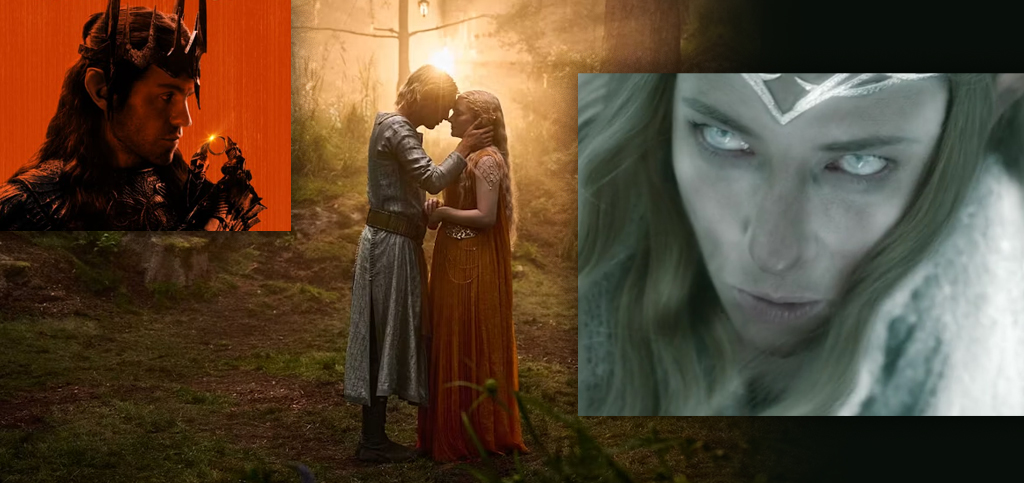
With the third season of The Rings of Power coming later this year, Amazon is starting up its promo material. This—combined with ongoing political turmoil, war, and the powerful “charismatic” demagogues that make the real world worse than it needs to be—seems like the right time to talk about Sauron again. That is, Sauron the Third Wheel, as he is portrayed in Amazon’s adaptation.
Sauron in the books and in other adaptations is fairly clear cut: he’s terrifying, faceless, and evil, and had been evil since long before Elves and Men even awoke in Middle-earth. His time of moral ambiguity took place before time was measured.
But this topic also means talking about Galadriel, and to a lesser extent, Celeborn. Now, I know that adaptations are just adaptations. It’s all fan fiction with a budget, and there’s nothing inherently wrong about that. New Line’s / Peter Jackson’s Rings and Hobbit films are no different in this regard.
What concerns me is how those adaptation choices portray and change the ideas they represent (the “core of the original,” as scholar Tom Shippey would call it), and ultimately impacts how book or TV show fans engage with them.
But I’ve really got to start with . . .
Galadriel
I’ve written a lot about this lady. First, years ago, in “The Trial of Galadriel” on Tor.com (Reactor), then thoroughly in “Where in the World Is Galadriel in the Second Age (And For That Matter, Where Is Celeborn)?” just as The Rings of Power season 1 was starting up. Funny enough, I wrote that last one in defense of how The Rings of Power was going to portray her. And I’ve written a lot about Galadriel here and there all throughout “The Silmarillion Primer” series. Plus through all my other reviews of the show.
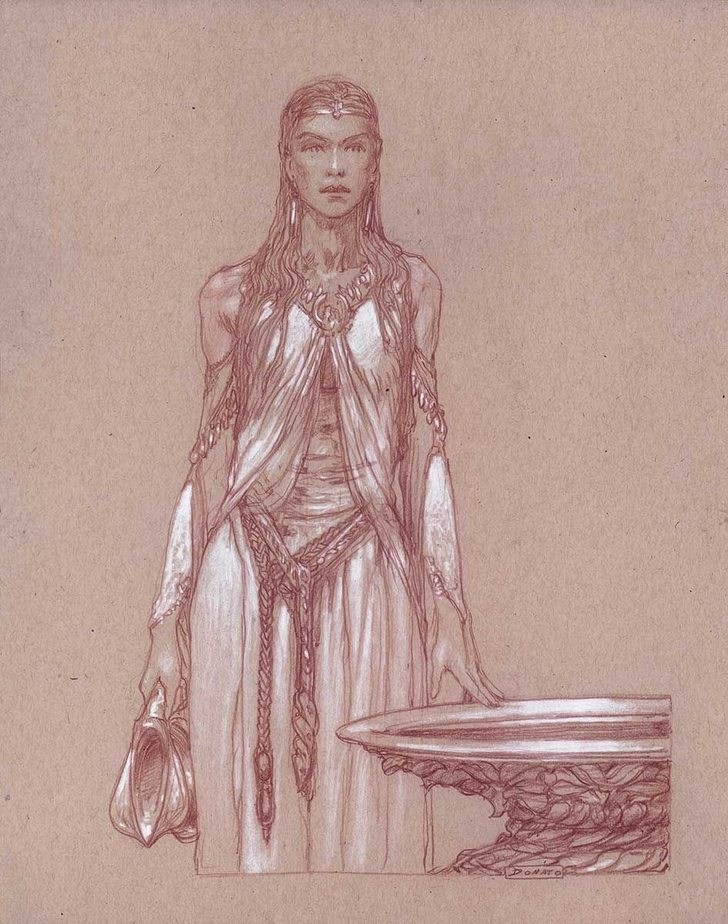
But setting all that aside, I want to talk about the importance of the daughter of Finarfin. That is, the personality, the disposition, even the relationships of Galadriel. But first, let’s be super clear: She is fully her own character and not defined by any dude. Tolkien made her that way right from the get-go. When we meet her, sure, she’s standing beside Celeborn, but neither bosses the other around. They are the Lord and Lady. Tolkien invented her during the writing of The Lord of the Rings only when the Company (not yet actually called the Fellowship) entered Lothlórien. Then he did some retrofitting her into his Elder Days stories (and so Christopher Tolkien worked her into the published Silmarillion).
All in all, Tolkien wrote more about Galadriel character, her deeds and her personality (even if he never finalized one version of her origin story), than he did Sauron’s or Celeborn’s. Nevertheless, because of The Rings of Power, we’ve got to talk about both Celeborn and Sauron because the showrunners and marketers have tried to make them into a love triangle—maybe not overtly, but they’ve made it so in the fan discourse. Hence, you get “Haladriel” (the enemies-to-lovers “ship” many fans enjoy). Insultingly, if you ask me.
But let’s talk about Galadriel herself first. In Unfinished Tales, Christopher Tolkien presents the following assertion:
There is no part of the history of Middle-earth more full of problems than the story of Galadriel and Celeborn, and it must be admitted that there are severe inconsistencies ‘embedded in the tradition’.
It is these “inconsistencies” that help defend some of the character choices made in The Rings of Power concerning Galadriel. She’s fiery and young and tempestuous; she’s a warrior not just in a metaphoric stance but in a rides-around-on-horses-wearing-armor-and-wielding-weapons stance. I’ve had no trouble about that aspect whatsoever. I know some “fans” and haters of the show are bothered by the very idea that a female Elf bearing arms and armor—their protests are just them playing out their own hang-ups about gender roles. It threatens them. That’s their problem.
In a 1973 letter (not even in Unfinished Tales), Tolkien wrote this about Galadriel, referring to her youth “in the far past”:
She was then of Amazon disposition and bound up her hair as a crown when taking part in athletic feats.
Funny enough, he wasn’t even trying to discuss her demeanor, just the construction of her name, Galadriel, which is Sindarin and means ‘Maiden crowed with gleaming hair.’ Because Tolkien was a philologist first and storyteller second! Okay, now let’s now add to this what Unfinished Tales says in one version of her history:
Her mother-name was Nerwen (‘man-maiden’), and she grew to be tall beyond the measure even of the women of the Noldor; she was strong of body, mind, and will, a match for both the loremasters and the athletes of the Eldar in the days of their youth.
Which means that ethereal Elf-lady in Lothlórien—who says things like ‘I it was who summoned the White Council” and “Yet hope remains while all the Company is true’—once had Elf-men in headlocks and pinned others to the mat back in the gymn in her bygone Valinor days.
Then we get this:
She looked upon the Dwarves also with the eye of a commander, seeing in them the finest warriors to pit against the Orcs.
As a commander. I’m cool with Amazon stretching that simile to have Galadriel even more martially oriented than perhaps Tolkien imagined her. In The Silmarillion, we have all four of her brothers (Finrod, Orodreth, Angrod, Aegnor) explicitly going out into wars and she does not. She always remains in Doriath in the court of Thingol and Melian.
But then again, Unfinished Tales also includes:
Even after the merciless assault upon the Teleri and the rape of their ships, she fought fiercely against Fëanor in defence of her mother’rs kin.
So matter how you slice it, Galadriel is a fighter on more than one level. The point is, a warrior Galadriel is not a lore-breaking Galadriel. Heck, check out this badass illustration by Angus McBride from 1995’s M.E.R.P. gamebook Dol Guldur, which pre-dates the Peter Jackson films by several years—therefore many years before average non-book-reading moviegoers had any preconceived ideas about Galadriel and whether or not she should be wearing armor or wielding weapons.
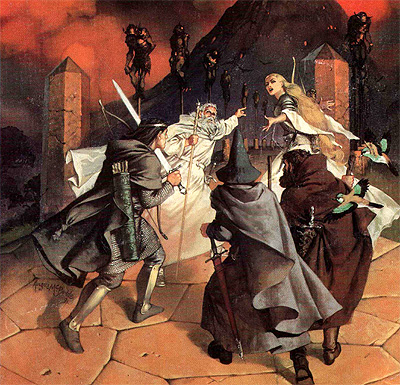
Anyway, I dropped all those quotes above to emphasize once again that I’m totally okay with the fighting aspects of J. D. Payne and Patrick McKay’s portrayal of Galadriel in their show. I don’t even care all that much that Tolkien’s Galadriel is supposed to be 6’4″ and yet I’m half a foot taller than actress Morfydd Clark. I think I’m about Cate Blanchett’s height. Yet we’re both still some inches shy of book Galadriel’s physical stature.
BUT.
I’m far less okay with Payne and McKay’s Galadriel being SO . . . EASILY . . . TRICKED all the damned time. For an Elf, the show has made her dim-witted, which blows my mind for their lead female protagonist. RoP Galadriel is manipulated by Gil-galad, then repeatedly conned and tricked by Halbrand/Sauron. Then later she’s outsmarted by Adar, like a couple of times, and this is just at the top of my head.
Worse than all of these is the fact that she’s set up in The Rings of Power as Sauron’s greatest enabler. To be absolutely clear: The Rings of Power season 1 made Galadriel unequivocally one of the primary reasons (1) Sauron returns to his evil ways and (2) is afforded great opportunities to dominate Middle-earth he otherwise would not have had (drifting way out on the ocean). She’s the one who actively convinces him to leave Númenor with her (she gives him the pep talk that leaves him teary-eyed, then resolved) and then personally brings him into Eregion into the midst of the Elves.
In sharp contrast, the essays published in Unfinished Tales make it clear that over time—and well after publishing The Lord of the Rings—Tolkien kept imagining an even greater role for Galadriel as the primary enemy to Sauron. To the point where, he writes, Sauron himself . . .
perceived at once that Galadriel would be his chief adversary and obstacle, and he endeavored therefore to placate her, bearing her scorn with outward patience and courtesy.
That is a passage and concept The Rings of Power has avoided like the plague. Rather, they’ve done the opposite. They’ve set things up so that the best Galadriel can ever achieve is, I guess, atonement for a series of poor decisions that she makes. But it’s not like it’ll all just break even someday, when he’s vanquished, since Sauron will live on after his defeat by Elendil and Gil-galad and will therefore go on to cause so much misery and death in the Third Age (through all his servants and proxies and minions) up through the War of the Ring. This is all because, according to Payne and McKay, Galadriel felt sorry for the mortal she thought he was and hoped to get his help with a personal vendetta. And given the marketing, Galadriel also seems to have a soft spot for him because he chose a handsome form. Come now.
Having said all that, I’d now like to look at her independent relationships with Celeborn and Sauron. And this is where I think The Rings of Power is doing her really dirty.
Celeborn
In all versions of their shared story, Galadriel meets and marries Celeborn in the First Age. In a lot of fan discourse, Celeborn is often the butt of jokes because he seems like the weaker of the two despite their being presented as a kind of power couple among Elves. As if he’s arm-candy or a trophy husband. It’s funny, but there isn’t all that much to justify it. I personally avoid the bandwagon of making fun of Celeborn (the reverse would be intolerable, wouldn’t it?) because the narrator of The Lord of the Rings—to be clear, Tolkien himself—has Galadriel speak of Celeborn in glowing terms.
In other words, Tolkien didn’t see the joke. Galadriel says to the Company of the Ring:
“For the Lord of the Galadhrim is accounted the wisest of the Elves of Middle-earth, and a giver of gifts beyond the power of kings. He has dwelt in the West since the days of dawn, and I have dwelt with him years uncounted; for ere the fall of Nargothrond or Gondolin I passed over the mountains, and together through ages of the world we have fought the long defeat.”
I suppose some readers imagine Galadriel is saying this sarcastically, or maybe passive aggressively? But I’m one of those crazy readers who believes the narrator. I don’t try to read between the lines and ask, wait, what is this person really saying? I think the narrator, and the character, is saying precisely what she means to say.
But let me break down that quote a little bit, into plainer language.
“For [Celeborn] is [considered] the wisest of the Elves of Middle-earth, and a giver of gifts [above and beyond] the power of [any mortal kings]. He has [lived in the westernmost edge of Middle-earth] since [the first rising of the Sun], and I have dwelt with him [most of the time since]; [because before] the fall of Nargothrond [in year 495 of the First Age] or Gondolin [in the year 510] I passed over the [Blue Mountains and eventually the Misty Mountains], and together through ages of the world [Celeborn and I] have fought the long defeat.”
Well, do we as readers get to bear witness to the ancient wisdom of Celeborn that Galadriel is talking about? A little? Not nearly enough to live up to her words about her husband. But she believes it, so I believe it and I think the characters do, too. Yes, the Rings narrative gives more page space to Galadriel’s power and attention, because it’s more relevant, but behind the scenes, Celeborn accomplishes a lot, not only during the War of the Ring but also in Second Age wars, too, against Sauron.
So what about Celeborn in The Rings of Power.?
Well, in season 1 episode 7 (which I discuss in “A Wife in the Dark“) Galadriel finally acknowledged his existence. The writers decided to suggest that Galadriel met her future husband the same way Aragorn and Arwen met, and Beren and Lúthien, and Thingol and Melian . . . he spots her in the woods . . . all of which are fantastical versions of a real moment in Tolkien’s and Edith’s romance. I’d personally have preferred they invent a new way for two characters to meet and fall in love in Middle-earth. But this is a minor point.
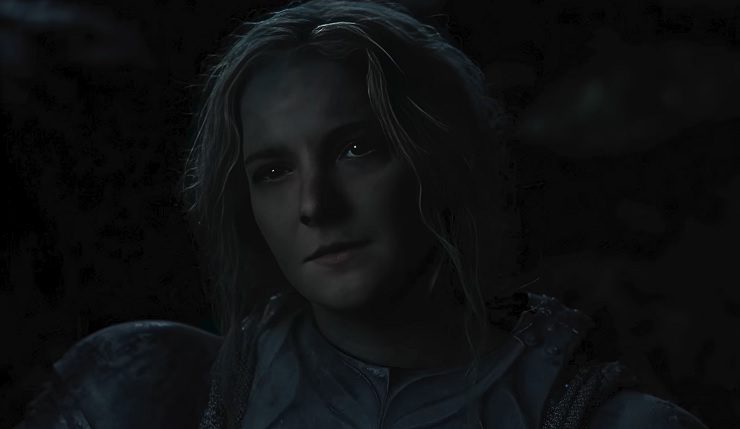
In any case, we learn that in this story, Galadriel believes Celeborn died long before, presumably in the same war that took her brother from her. But now we know from real-world marketing that Celeborn will indeed be back. I mean, he has to come back: how else could they have a daughter, Celebrían, who will go on to marry Elrond and give birth to Arwen?
What will he be like? We’ll see. “[Celeborn] is something of a “lover-boy,” actor Jamie Campbell Bower (who will play Celeborn in the upcoming season 3) is quoted as saying in this recent Empire article.
The article also quotes Morfydd Clark talking about Galadriel and Celeborn: “’She’s kind of rude to him in the books. . . . She’s the queen!’”
In truth, no, Galadriel’s not actually “rude”* to Celeborn in the books, but that’s definitely what a moviegoer might safter after watching Jackson’s Fellowship of the Ring. The Rings of Power keeps taking pages (with all its callbacks, especially) from the films, not the books. Never mind Galadriel isn’t actually queen, and in fact she only refers to herself as one when describing what would become of her if she claimed the One Ring. (Yes, Tolkien did refer once to Galadriel as an “elven-queen” in a letter to simplify who she is to his publisher.)
* What Galadriel does is gainsay her husband once in front of the Company of the Ring. She rebukes him mildly after Celeborn suggests that Gandalf might have fallen into “‘folly’” by going into Moria. To that, she says, “‘He would be rash indeed that said that thing’” because she thinks better of Gandalf than Celeborn does in that moment, plus Celeborn has some prejudice against the dwarves of Moria (which he apologizes for moments later).
Anyway, I guess Celeborn in The Rings of Power will be a “lover-boy,” at least according to the actor. How does Tolkien’s text characterize him? Well . . .
The scouts and vanguards of Sauron’s host were already approaching when Celeborn made a sortie and drove them back. . . . [Unfinished Tales]
Three times Lórien had been assailed from Dol Guldur, but besides the valour of the elven people of that land, the power that dwelt there was too great for any to overcome, unless Sauron had come there himself. Though grievous harm was done to the fair woods on the borders, the assaults were driven back; and when the Shadow passed, Celeborn came forth and led the host of Lórien over Anduin in many boats. They took Dol Guldur, and Galadriel threw down its walls and laid bare its pits, and the forest was cleansed. [Appendix A, The Lord of the Rings]
A power couple indeed, tag-teaming their efforts against Sauron and his servants. Against the fortress of Dol Guldur, Celeborn led the martial forces, then Galadriel mopped the place clean with spell-power! Elf magic.
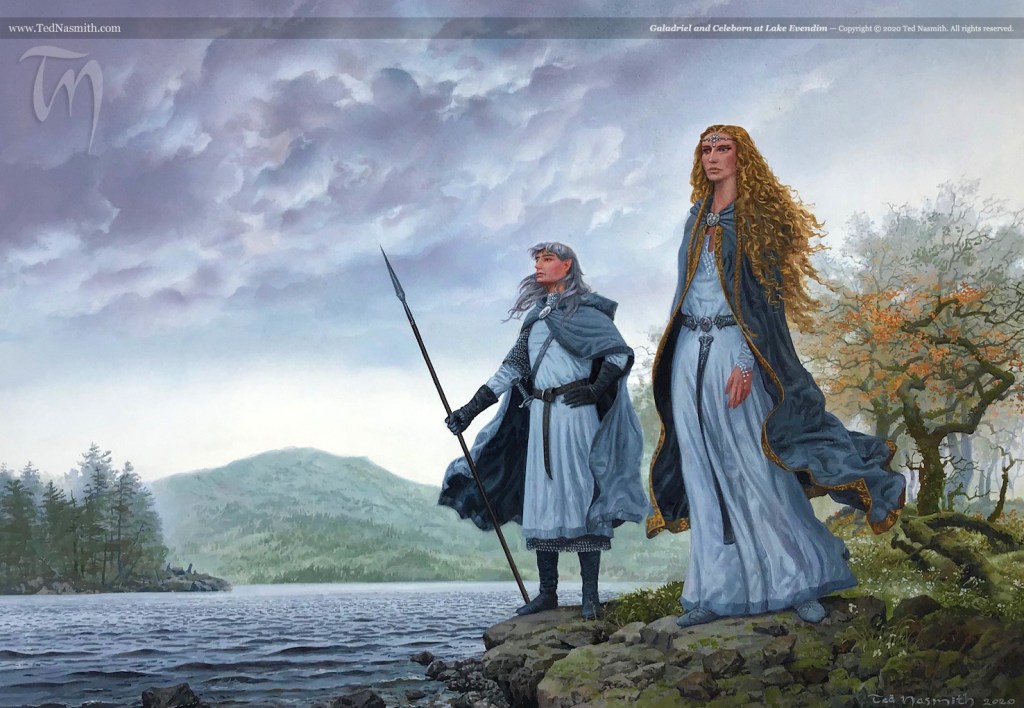
I genuinely look forward to meeting Celeborn in The Rings of Power. I like Jamie Campbell Bower well enough (more from Sweeney Todd than Stranger Things.) I’m a little annoyed at the contrived nature of the character’s absence in the show thus far and Galadriel’s conspicuous lack of concern for him (she seemed very bent on revenge against Sauron for her brother’s sake). I’m trying to stay optimistic.
Haladriel
So . . . Sauron. “Haladriel” is what Amazon’s marketing encourages because that brings more viewers. To me, there is a disappointing percentage of fans who see an attractive major female protagonist on screen and immediately thinks, Look, a pretty “single” girl. She NEEDS a romance.
That deeply ingrained stereotype is troublesome, all by itself. While I would have preferred Celeborn to have been on the scene somewhere from the outset (thus avoiding “Haladriel”), at least Galadriel’s husband got a mentioned near the end of the first season. Mostly as a throwaway line. He exists, he’s just presumed dead (and no one’s looking for him). But as I already said, in this show, Galadriel’s revenge-fueled obsession with Sauron (prior to meeting actual Sauron) had been centered around the death of her brother, Finrod. (I could go on a separate rant about him. I won’t for now.) The bottom-line: All along, she seems to have been thinking a lot more about Finrod’s death than Celeborn’s, which is already weird. There needn’t be any romance for an already married Galadriel (whether Celeborn is alive or not). There shouldn’t be a “ship” at all.
But of course there is.
So are we to think that Galadriel, as presented in the story of the show (as opposed to mere watercooler speculation on the part of fans), is genuinely attracted to Sauron in that way? Well, I wouldn’t actually have thought so. I’d give the writers and actors the benefit of the doubt. I’d defend the character staying on track, as an Elf already bonded to another (Elves mate for immortal life).
BUT . . . it turns out the writers and directors know what they’re doing. They’re pandering to an audience who likes the enemies-to-lovers trope, which has never been more popular. (And this is all aside from the ridiculous Elrond–Galadriel kiss.) This was the first bit of proof that Amazon marketing fans that flame.
Then we got this quote from Charlotte Brändström, director of episodes 7 and 8 of season 2, in an interview with Nerdist:
Yeah. Galadriel obviously was in love with Halbrand. She was very attracted to him. So when Sauron changes shape . . . Sauron knows this because he gets into her head, so he knows what she’s thinking, what she’s feeling. So when he immediately takes Halbrand’s shape, he completely destabilizes her because that was her weakness. She had very strong feelings for the King, for Halbrand, obviously in the first season.
Yes, “obviously.”
Does Amazon have the rights to adapt material from The Silmarillion? Mostly no, with little bits of “yes.” What about text from The History of Middle-earth series? Nope. So does that mean they specifically cannot research or account for Tolkien’s ideas in books like Morgoth’s Ring, which provides tons of insight into the psychology and nature of the Elves? I don’t know. That book points out that Elves wed for life (immortal life); there is no infidelity among them, either. In fact, it was a HUGE fuss among the Valar (the little-g gods) that one time an Elf wanted to remarry when his wife chose to die and not come back. One time. Elves are above marital infidelity and petty mortal temptations, except for those very few who fall into evil (like Eöl in The Silmarillion) and treat marriage as a matter of control.
The Rings of Power has willfully brought into their storyline a will-she-won’t-she trope better suited for Game of Thrones and reality TV. I know, this is just my opinion as a Tolkien fan. I know I don’t speak for anyone else. And I certainly won’t be waging a campaign against anything. It’s not going to change, and I’m not trying to yuck anyone’s yum. I’m just quietly ranting on a humble little blog that this had to be . . . err, everyone’s yum.
I do think Tolkien is above this. I think the character of Galadriel should be above it, and I even think Sauron should be, too. There is nothing prior to Payne and McKay’s show that vaguely suggests that the Maia known as Sauron was lonely, and wants a queen to rule beside him.
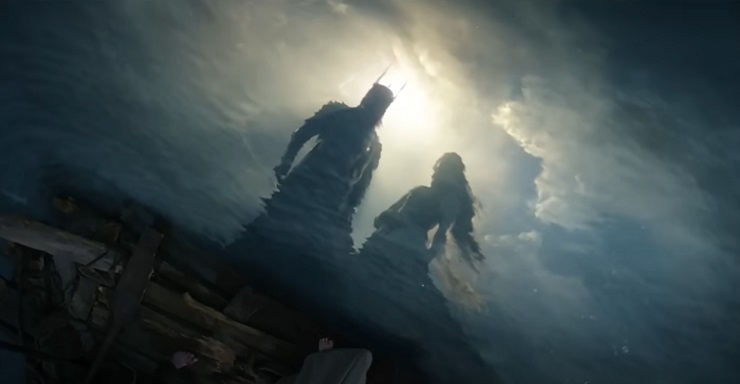
He’s the eponymous Lord of the Rings, for crying out loud. Or he is at least about to be, in the timeline of this series. In Fellowship, Gandalf tells Saruman that “‘only one hand at a time can wield the One, and you know that well, so do not trouble to say we!’” The Jackson script had a decent way of paraphrasing that: “There is only one Lord of the Rings, and he does not share power.” So making Sauron a third wheel, a side role in the story of Galadriel and Celeborn’s relationship, is one of the lamest moves this show has made.
What I wish they would lean into more—and sure, they kind of had a little bit—is not the fact that Sauron isn’t evil, but that he wants to do things differently than his master, Morgoth, did before him. Sauron never repented or even tried in Tolkien’s texts. He only only comes “close” in that he came forth to apologize at the end of the War of Wrath (and the First Age), but did so not out of guilt, only out of fear of punishment. And that fear is precisely why he went underground and didn’t end up seeking pardon after all.
But what they could have done is not have Sauron crying but trying hard to bring order to Middle-earth, where Morgoth had only brought destruction. That would have been on point, and align well with Tolkien’s lore. Where Morgoth was obsessed with unmaking everything, Sauron, according to Tolkien in Morgoth’s Ring . . .
had never reached this stage of nihilistic madness. He did not object to the existence of the world, so long as he could do what he liked with it. He still had the relics of positive purposes, that descended from the good of the nature in which he began: it had been his virtue (and therefore also the cause of his fall, and of his relapse) that he loved order and co-ordination, and disliked all confusion and wasteful friction.
But Sauron never stopped being evil and destructive in his pursuit of that order and co-ordination. That’s what I wish the showrunners had embraced more instead of dalliances with possible queens.
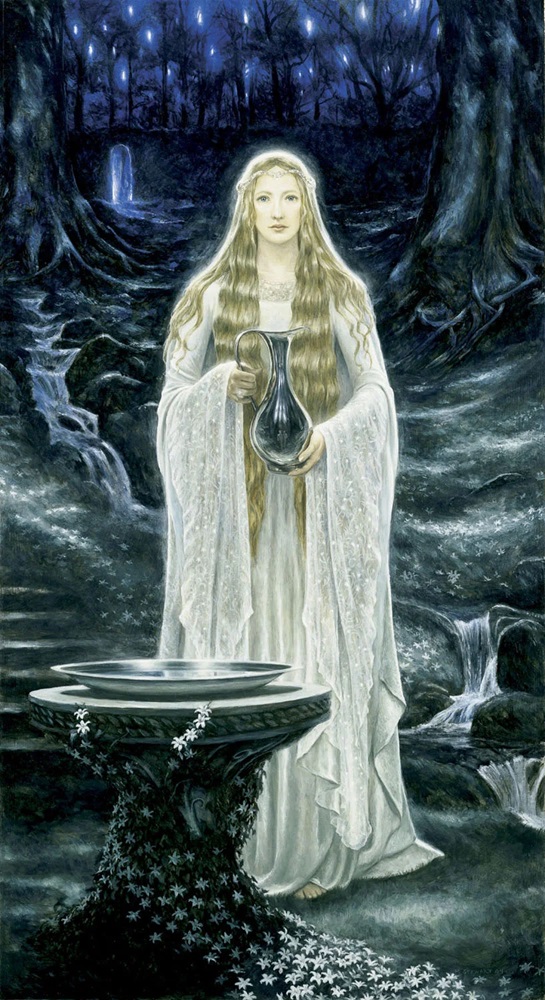
Do not get me wrong! I like and welcome romance where it belongs. In my original “The Trial of Galadriel” article on Tor.com, I included this illustration I’d found.
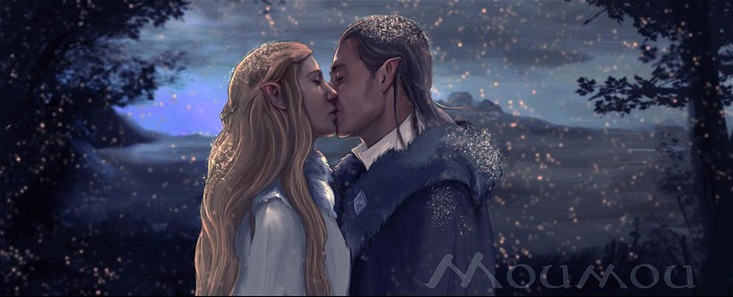
I think it’s sweet. Two married (powerful!) Elves who are actually in love and have been for millennia, without the interference of Dark Lords. It’s nice. It’s right to the lore, too. Elves aren’t corrupted by carnal temptation in the same way. An Elf isn’t going to cheat on her husband (even if she thinks he’s dead, because he’s going to be rehoused in a new body and waits for her in the Undying Lands), but . . . Elves can be corrupted in other ways. For example, some accomplished jewel-smiths might accept some shady tips from a mysterious master craftsman whose knowledge is almost too good to be true, and there allow his desire to preserve and enrich the mortal lands to corrupt his efforts and thereby make some ill-advised Rings of Power. But that’s Tolkien for you.
There’s even textual lore that married Elves can (and often do) spend long periods away from each other; a married Elf does not lose himself or herself in their partner. They can have distinct interests. For example, when going to war against an enemy fortress’s armies, one of them might like to lead the warrior’s charge. The other might prefer to throw down its walls and lay bare its pits after the fighting is done. Each partner’s mileage may vary!
But this Haladriel obsession—this idea that Galadriel was quietly in love with Sauron despite having been married already—and the appeal it brings to some fans, genuinely has me genuinely wondering: If Hitler had been devilishly handsome, would people be writing fan fiction about him by now? That’s ridiculous, right?
Or how about this: If, in the season finale of The Rings of Power season 2, when Sauron tells the Orcs . . .
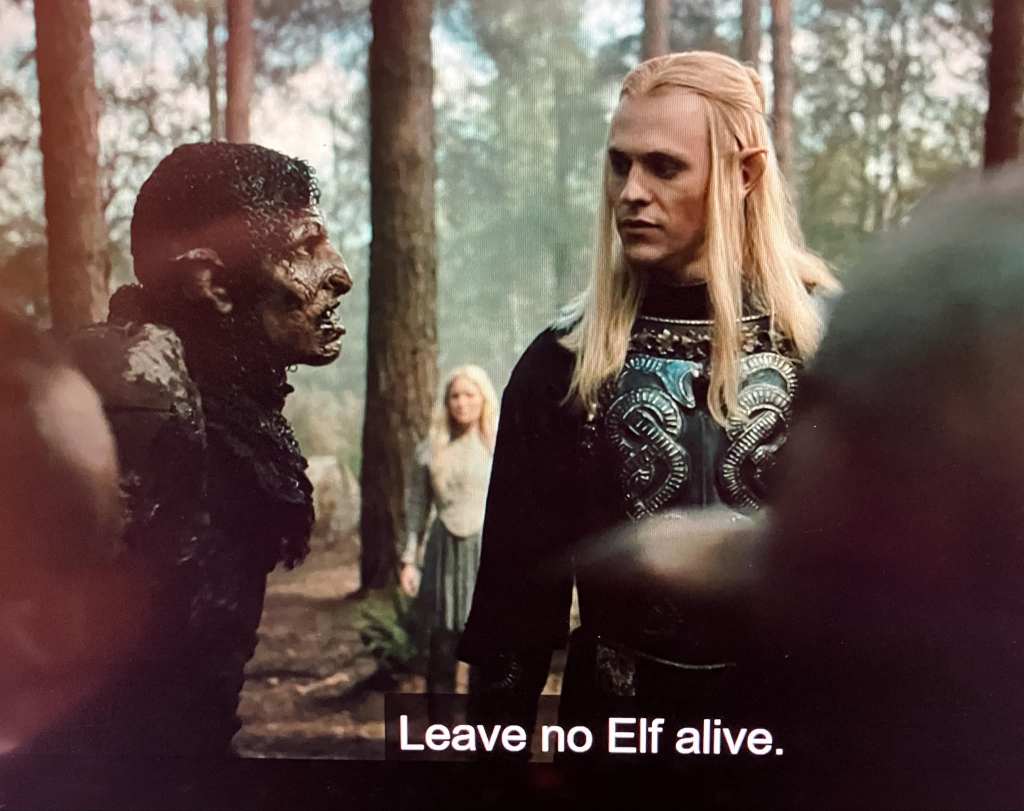
. . . and then we cut over to see those Orcs breaking into a house in the Elf-city below, acting on their master’s direct orders, and then we see them proceed to cut down an Elf-child with an axe . . . would all this Haladriel “shipping” continue apace? Would such a scene make a blip at all? Do fans only get mad at the Orc doing the axe-swinging? Is the master who gave the order scot-free of this crime?
Or do fans just like to pretend handsome bad guys are just still somehow changeable deep inside for the right person? The toxic, abusive boyfriends and husbands of the world might nod their heads in approval.
But mostly I just wonder what Tolkien would think. No, he wouldn’t like Jackson’s films, either. I know that. He’d have trouble accepting all kinds of changes across the board. Don’t even get him started on Faramir, Saruman’s premature end, or the cherry tomatoes of Denethor!
The Peter Jackson films made names like Frodo, Gandalf, Gollum, and Sauron household names, where before they were only known in some households. Pop culture absorbed the massive success of the trilogy, and all these years later even people who weirdly haven’t seen Jackson’s films kind of know who Gollum is—that weird naked little gray guy who talks funny.
Jackson’s films were always at the best when they inspired a viewer to check out the books. If a viewer doesn’t, it’s a shame, but it’s fine. They’ll just live their lives thinking Faramir was kind of a jerk, Aragorn was filled with self-doubt, Galadriel is creepy, Elrond is contemptuous of Men, and they’ll never find out about Glorfindel or that crazy wood-hermit Tom Bombadil.
But then The Rings of Power came along. I know it’s polarizing and has lots of haters (in two camps), but it does have a lot to offer. Best of all, it’s bringing more people to the books. But to those viewers who don’t go to the books, they can just enjoy a high budget kind-of generic fantasy show that is, in my view, still better by far than Game of Thrones or The Wheel of Time. It’s got an odd mix of cranky Elves, some very cool Dwarves, a meteor-catapulted wizard, and a sludge monster that is somehow Sauron? Oh, and that fiery Elf-girl who’s angry all the time and easily tricked by men might just have a new love interest coming soon!
In the end, I like having Galadriel take center stage. I like warrior Galadriel, but I wanted an ethical, smart, faithful Galadriel who, when we meet her in Lothlórien, is in the retirement phase of her Middle-earth career, who knows her role as the “chief adversary” to Sauron is not the same as it was. Who speaks words of wisdom, resists temptation at the last, and isn’t just quoting Sauron himself when she says that if she took the Ring, she’s be “stronger than the foundations of the earth” and what have you.
 Foreshadowed and Foresung
3 responses to “Galadriel, Celeborn, and the Third Wheel of Sauron”
[…] Galadriel, Celeborn, and the Third Wheel of Sauron […]
LikeLike
You had this piece ready to go, right? ☺️Thanks for this, great read, with the next Roving Ranger!
LikeLike
Thanks, Marcel! Funny enough, I started this post shortly after the end of season 2. Sat on it a while, knowing I’d want to finish it before season 3 actually started.
LikeLike