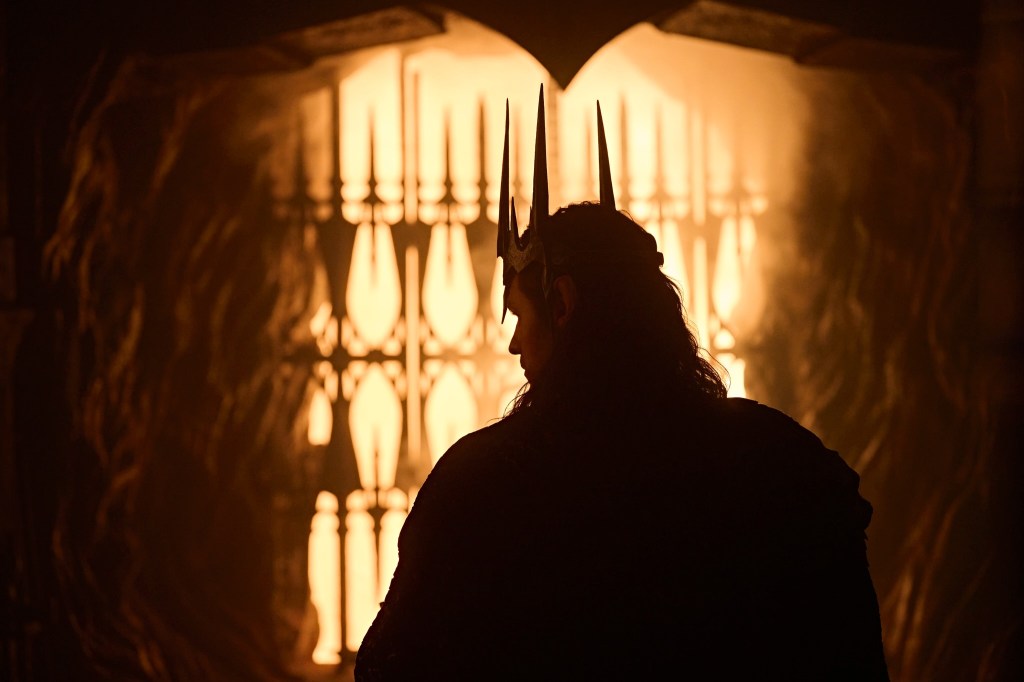
The Rings of Powers Season Three press release is out now. I’d like to comment on just one passage from it.
But first, a reminder. For as long as Amazon’s show lasts, I will continue to stand on the little lore-based hill between two very loud camps, which is a frustrating place to be.
- One camp is made up of the haters, those people who freaked out the moment they saw a Black man (Ismael Cruz Cordova) cast as an Elf and a Black woman (Sophia Nomvete) cast as a Dwarf. This camp is made up mostly of bad faith critics, because they’re not fans of Tolkien’s faith- and compassion-based secondary world anyway. They literally do not count. But they are angry, loud, and I’m quite certain I know who they voted for in the last election (if they’re U.S. citizens) and you do, too. This camp has made the larger Greenwood the Great that is the Tolkien fandom into a veritable Mirkwood, if you understand me.
- For the record, I say again that Ismael and Sophie have done phenomenal jobs in their roles: Arondir the Silvan Elf and Disa the Dwarf are stand-out characters. The Rings of Power has excelled in their original characters and faltered in their pre-existing characters. Arondir is the most Elf-like of the show’s Elves and Disa is just a delight all-out.
- The other camp consists of those people who embrace The Rings of Power as being somehow fully true to Tolkien’s vision . . . somewhere, somehow. They’re good people, they get to have their opinions, they’re not hating on anyone. The book fans among them confuse me, to be sure, as I feel they are doing a lot of pretending and connecting a lot of dots that the show itself isn’t. This camp does not include those people who don’t know much at all about Tolkien but still enjoy the show. I have no criticism for them at all; I’m a little envious of them, in fact.
I just can’t fit in either camp. And, look, there are plenty of other people, like me, just milling about the audience, not really in any camp at all. I guess those are my people. Anyway, with all that said, let’s get to it.
Jumping forward several years from the events of Season Two, Season Three takes place at the height of the War of the Elves and Sauron, as the Dark Lord seeks to craft the One Ring that will give him the edge he needs to win the war, bind all peoples to his will – and at last rule all Middle-earth.
I’ve talked at length—and will probably continue to talk at length—about the plot problems of the show as a reflection of Tolkien’s legendarium. It’s not that the plots are bad for a fantasy show, only for a Tolkien one. In the above summary of Season 3, they’ve just summarized the essential plot of The Lord of the Rings. Change one or two words and we’ve got the same old plot, don’t we?
. . . as the Dark Lord seeks to
craftwield the One Ring that will give him the edge he needs to win the war, bind all peoples to his will – and at last rule all Middle-earth.
Basically, Sauron vs. the peoples of Middle-earth, and he needs his Ring to make it an overwhelming victory! Stick with a formula that works, I guess? Like Hollywood these days, afraid to tackle an original story. And that’s a shame, because Tolkien had a really good story behind how and why the Rings of Power were made, and how it all shook out (and it’s not at all what this show is doing). While Tolkien’s stories do have deliberate echoes and repeating patterns (in a mythic, gradually lessening quality), he doesn’t just redo the same thing in the way Amazon’s show is doing it.
In Tolkien’s own take on the Rings of Power storyline, the creation of the One Ring was Sauron’s scheme in the first place, and it failed—and that is precisely why there is a War of the Elves and Sauron. It’s the only reason. Had the sixteen Rings of Power succeeding in dominating the Elves, clinched by the One, he’d have succeeded without even fighting a war. He’d have had the Elves under his control, which was the whole point. All that cool stuff we know . . . the giving-out of the Rings to non-Elves (seven to Dwarves, nine to Men, with three hidden by Elves) and the whole War which triggered Númenórean interference . . . that’s all just fall-out. That’s all plan B, or C, or D. That’s Sauron improvising. It’s a messy and fascinating storyline, more realistic because it didn’t go down the way the most powerful being on Middle-earth meant it to.
But The Rings of Power‘s primary audience doesn’t know about that cool stuff, so the showrunners are just rehashing what they’re already familiar with: Men and Elves running around as the Dark Lord rises, with the One Ring at the center of it all, and even Hobbits popping up, unnoticed. That’s the formula. The Second Age of Tolkien’s Middle-earth was far more nuanced. It didn’t involve wizards, halflings, and Balrogs at all—but RoP has dragged those familiar elements in just because.
Oh, I should explain: By episode 5 of season 2, I started to think of Sauron and Celebrimbor as Rauron and Relebrimbor, etc., nicknames for the Rings of Power (RoP) version of these characters as very distinct from the text. That’s all. I’m poking fun. I am actually fond of Vickers’s and Edwards’s acting chops!
Anyway, I do look forward to the cast again—particularly Ismael (I hope they give Arondir something good to do this time), Sophia, Robert Aramayo, and Owain Arthur. I wish Galadriel, Elrond, Gil-galad, and even Sauron truly felt like screen counterparts to their book personas and motivations, but they really really don’t. But, hey, The Rings of Power at its weakest is still better than Game of Thrones at its strongest. So there’s that!


2 responses to “Rauron’s Return”
[…] then The Rings of Power came along. I know it’s polarizing and has lots of haters (in two camps), but it does have a lot to offer. Best of all, it’s bringing more people to the books. But […]
LikeLike
[…] Rauron’s Return […]
LikeLike