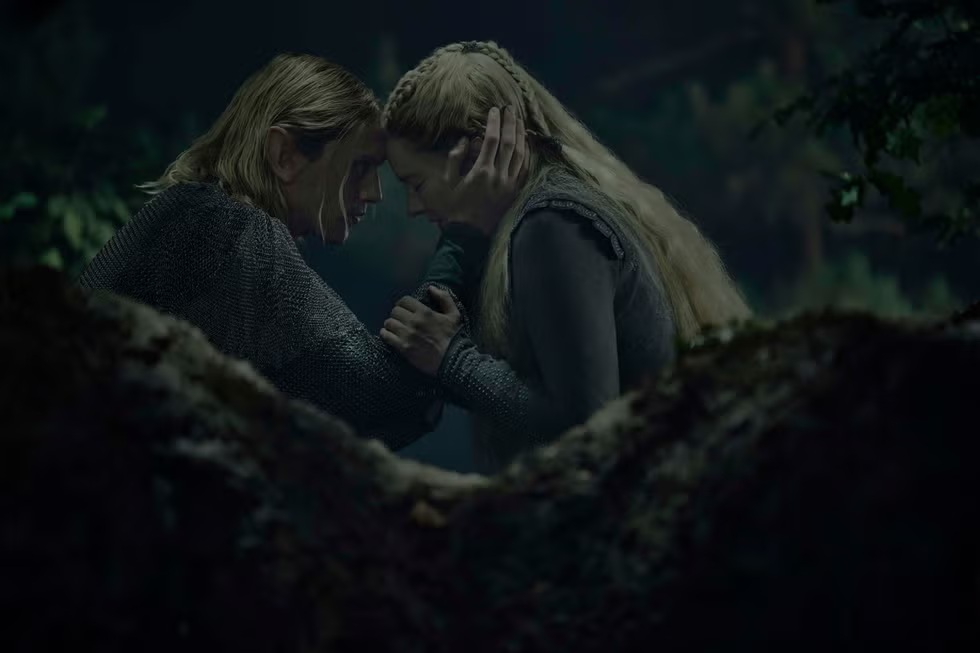
My eyeballs weren’t properly lubricated for the bout of eyerolling barreling toward me in episode 5. It’s a very self-conscious episode, afraid to tell its own story, so it leans hard (again) on the pre-existing Jackson films. And when it does try its own thing, it’s just another generic fantasy series with awkward dialogue and Tolkien place names.
Spoilers ahead.
First, a reminder of all my previous reviews of past episodes (and other bits and bobs): Concerning The Rings of Power.
So, Gundabad.
- Marnûkh wakes on the rack, prepped for torture. Well, wasn’t he a torturar himself once?
- RoP Sauron is not the best torturer himself, it turns out. He appeals to the possibility that the Orc might care about his own offspring. I tend to think such a tactic would be beneath Book Sauron’s consideration. This is a being who surely has way better methods of torment than any physical torturer should. Book Sauron is a Maia; RoP Sauron might not be. But never mind that.
- Sauron learns that Galadriel was taken by Eagle to the borders of Eryn Galen (what will one day be Greenwood/Mirkwood). He says he wants every Orc “from here to Erebor canvassing the Eryn Galen.”
- It’s a weird choice, to head that way. Seems like the Eagle could have easily just taken them to Rivendell instead. But they go elsewhere because that’s where the love triangle needs to shake out.
- Sauron monologues once again to a small room with fewer than a dozen Orcs in it. He even throws in the “[noun] will shape the fortunes of all” wording (as Galadriel says of hobbits in Jackson’s prologue). “Now is the mighty hour come,” he adds with menace and drama so that the line can be used to good effect in a trailer. But . . . now? I think he means later. How about just “soon”? He’s many steps away from making his favorite ring.
- Theo listens silently, way in over his head. I hope it stays above his head. I’ve got a little spark of hope that he backs out of the deal that’s getting worse all the time.
Flashback to loooong ago, so we can have Elrond and Elros talk!
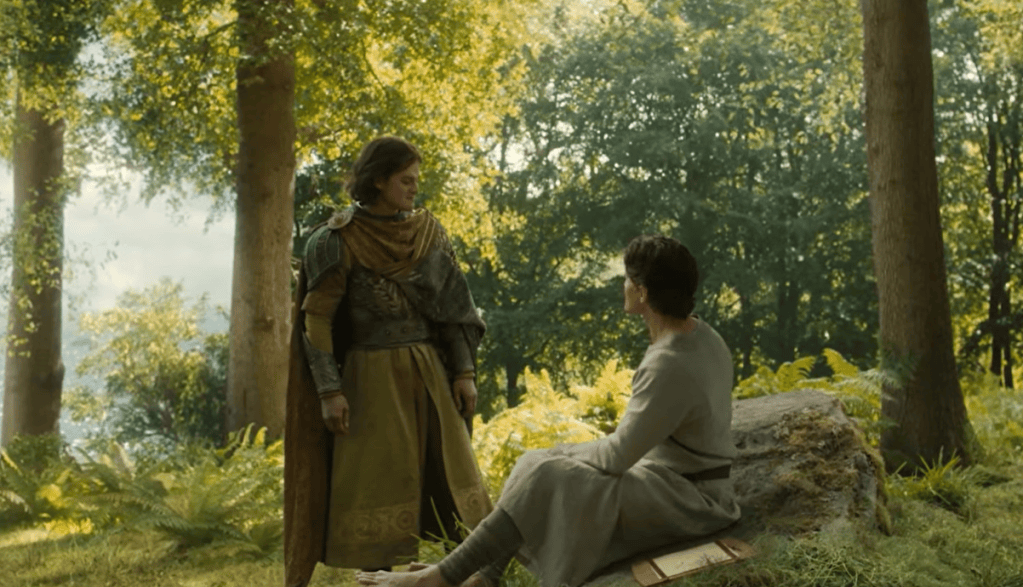
- This is a scene many Tolkien fans will be happy to have because Tolkien never gave us any details: We know that Elros chose mortality but we don’t know why or how it went down. The conversation here is a good one, but it’s just so brief. In my opinion, this should be the culmination of years of conversations the twins should have been having. Here it almost sounds like this is the first and last time they brooched the subject. It’s just a shame that so many great ideas and momento us yet complex decisions (such as the decision given to the Half-elven whether to be counted among Elves or among mortal Men) are always packed into one quick scene in this show. It stands out because these characters live so long, or never die at all.
- Apparently the moment you choose mortality, your ears round themselves out. That that is the big indicator for Elrond is such a bummer. Is there any great Tolkien concept this show can’t water down?
Then we cut to the present day, when Elrond and Gil-galad are on their way to Númenor.
- You know, given the importance of Elrond not only in the scenes to come, but his place in the hierarchy of the Elves of Middle-earth as a whole, this once again feels like it’s not even the same show it started as. Remember the very first episode of the first season, when “Herald” Elrond was forbidden from going to the High King’s council because it was for “Elf-lord’s only”?
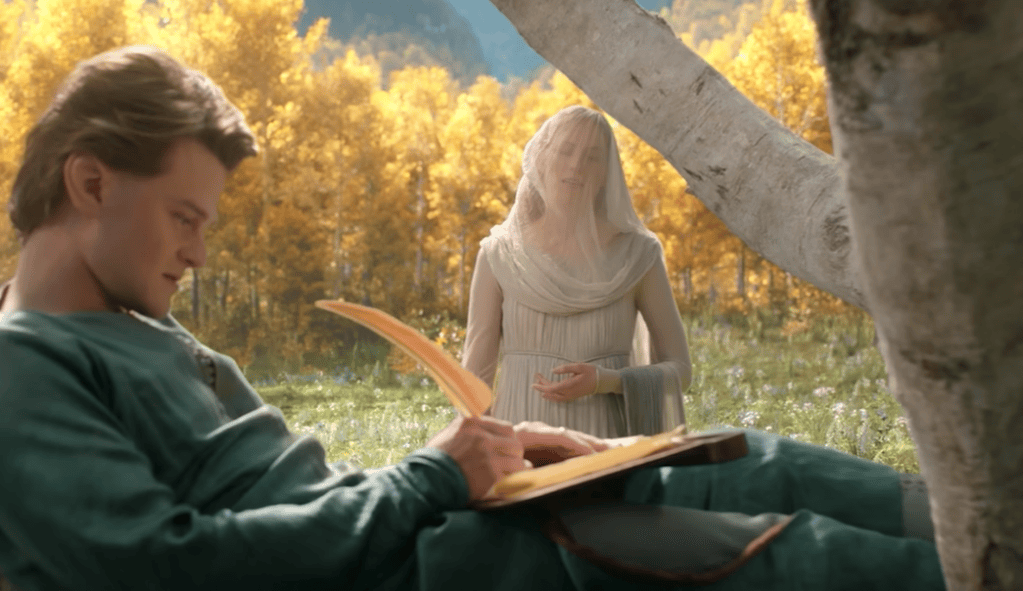
- With Eärendil and Elwing as his parents, themselves descendants of the best of Men and Elves (and even a Maia), and he’s no Elf-lord? Not the right pedigree? That was BS.
- But somehow Gil-galad’s still Frowny McFrownface. Nothing’s good enough for him.
Anyway, time to cut over to the woods of Eryn Galen / Greenwood.
- Galadriel and Celeborn are together alone at last. They continue the long tradition of characters talking melodramatically to one another’s backs. But hey, Elrond did it to Gandalf in Jackson’s films, too, starting with his harsh “Men? . . . Men are weak” bit.
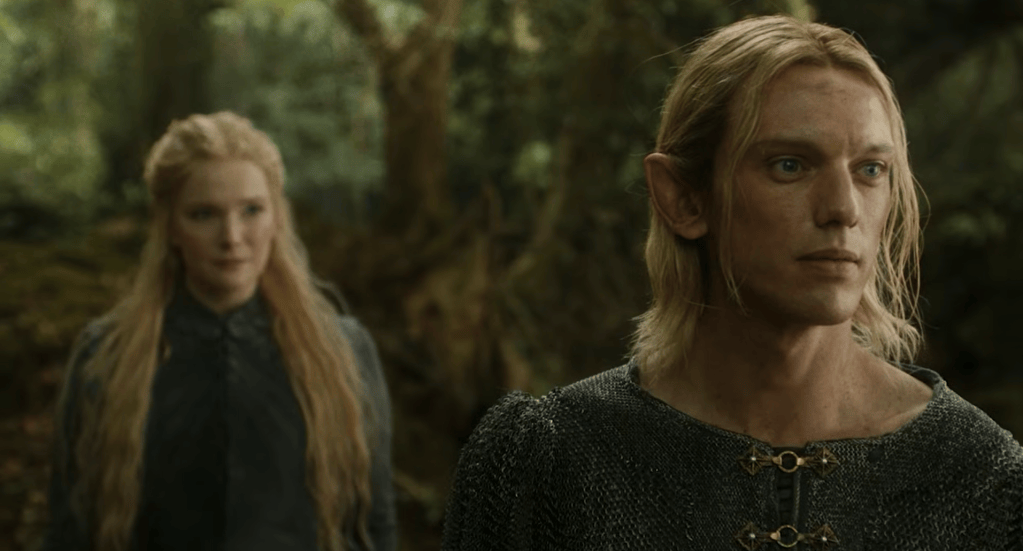
- Galadriel and Celeborn’s conversation is such a mish-mash of names and events that really strains the Tolkien lore Amazon is allowed to write with, muddling all resemblance to Silmarillion stories. I try my best to imagine the alternate geography and sequence of events to make it make sense. It’s hard. This is much easier to process if you’re not a book nerd, but then all those names (Thangorodrim, Ancalagon, etc.) would just be meaningless to hear. Such a strange line they’ve chosen to walk.
- But just working with what events the show has given us, it still doesn’t make much sense. We’re to understand that Celeborn was a prisoner beneath Thangorodrim (technically, the peaks above Morgoth’s fortress of Angband, but they don’t say that here), which is way mightier and worse than what Mordor will be. Then, at the end of “the war,” when the “fortress fell,” Celeborn was somehow moved by the losing side way out of the region, no doubt through enemy forces, to another prison from which no one ever liberated him for thousands of years.
- Celeborn must have been a model prisoner indeed!
- It’s kind of amazing Celeborn is still wearing Elf-like attire. The show goes out of its way to make Orcs seem gross and crude, but they seem to care well for their prisoners. Celeborn is looking pretty good for having survived generations of torturers and Orc-wardens. No limbs cut off or anything.
- Fun fact: In The Silmarillion, an Elf named Gwindor (a prince of Nargothrond) was captured and enslaved in Angband, too. When he escaped only 23 years later (on his own, which involved cutting off his own hand), he was a shell of his former self: physically aged for an Elf, wearier, damaged in spirit. That was just 23 years. Did Celeborn get like a VIP package in the mines?
Let’s go to Gandalf.
- Gandalf, in the books, is quick-witted. The dude is sharp all the time. He’s cranky sometimes, sure, and his humor is often dry; his sarcasm cutting when it needs to be. Once hobbits are in his life, he excels at hobbitry. And while I genuinely like Daniel Weyman’s depiction of the character and I can appreciate the idea of a “younger” Gandalf not yet at the top of his game, season 3 Gandalf is . . . proving to be kind of a dummy.
- When last we saw Gandalf in episode 3, he got a direct orders from the man upstairs. That message was, as a refresher here:
“You were not sent to Middle-earth to defeat [Pallando] . . . You were sent to save him. Only together can you prevent the armies of Rhûn from joining Sauron. Only together can you save Middle-earth. Arise now, Gandalf, Servant of the Secret Fire.”
- Now, fresh off that encounter, knowing his divine purpose, he should have all the confidence in the world to thread this needle. To maneuver his way through the situation.
- So, here in this episode, armed with staff and hat, Gandalf marches right into Pallando’s temple in front of all his followers, and he hardly even paraphrases what the Secret Fire told him. He just says it straight out—no subtly, no caution. No cleverness, no riddles, no careful wording designed to open a dialogue. He basically says, “Hey, Pallando. The boss said I’m here to save you. So this is me saving you. Now we can save Middle-earth.”
- This is dialogue catering to “second-screen” viewers who saw Jackson’s original trilogy once or twice, and are scrolling through their phone while The Rings of Power is on in the background. What a shame.
- So the guy formerly known as the Dark Wizard (DK) gets up out of his throne, walks forward, exchanges a few confrontational words with Gandalf . . .
- And then moments later Khamûl the Nazgnagôl suddenly appears in the throne.
- Setting aside the now-revealed ability of the Nine Rings to turn their wearers invisible on a whim . . .
- My wife right away said something like, “Was that guy just sitting on the other guy’s lap the whole time?” and now I will never not think of that.
- Even if that’s not the case, we’re to understand that the moment Pallando got out of the throne, Khamûl crept over invisibly and sat down in it so he could dramatically make himself visible in said throne? I’m not sure that’s the flex he wants it to be. That’s basically stealing someone’s seat when they get off the couch to get a drink, except it’s trying to do it on the sly. Real tough guy move.
- Anyway, in retrospect, I’m 100% surprised that we didn’t get some slight variation of, “Tell me, new friend. When did Pallando the Blue abandon reason for madness?”
- This doesn’t at all sound like a follow-up to the dialogue the Stranger and DK exchanged at the very end of season 2, when DK destroyed the Harfoots’ canyon village.
- Anyway, a no-touch staff battle proceeds, just like the one Gandalf and Saruman will have thousands of years from now, and Pallando even does the ol’ staff-telekinetic wall-scrape to Gandalf. I have to wonder: Is this a technique the Istari learned in Valinor at staff practice, or is this more of a Gandalf thing? Like, he’s the common denominator, isn’t he? Either way, Gandalf is racking up some frequent wall-scraper miles, isn’t he?
- This might be the show’s biggest and most unoriginal eyeroll-inducing moment ever. This confrontation and battle of wills between Gandalf and Pallando should be memorable or at least interesting.
- Look. I’ve always conceded that Ian McKellen and Christopher Lee’s wizard fight looked cool, no matter what. There’s serious cinematic power in the moment. Even though right away book readers were thinking, Ohh . . . that’s not how it happens.
- Now both wizard battles have been presented in movie and TV. Meanwhile Tolkien’s written confrontation between Gandalf and Saruman is elegant, layered with meaning (and gobs of real-world application), yet it remains menacing. It makes both these on-screen versions seem like squabbling children.
- Various types of media have the power to illustrate/parallel/analogize things in real life. For example, I haven’t thought about Spike and Chester, two characters with from some Looney Tunes cartoons, in years. But then suddenly The Rings of Power and its incessant callbacks and fawning to the far more competent The Lord of the Rings films (despite their not being perfect adaptations) made me think of them. The analogy fits.
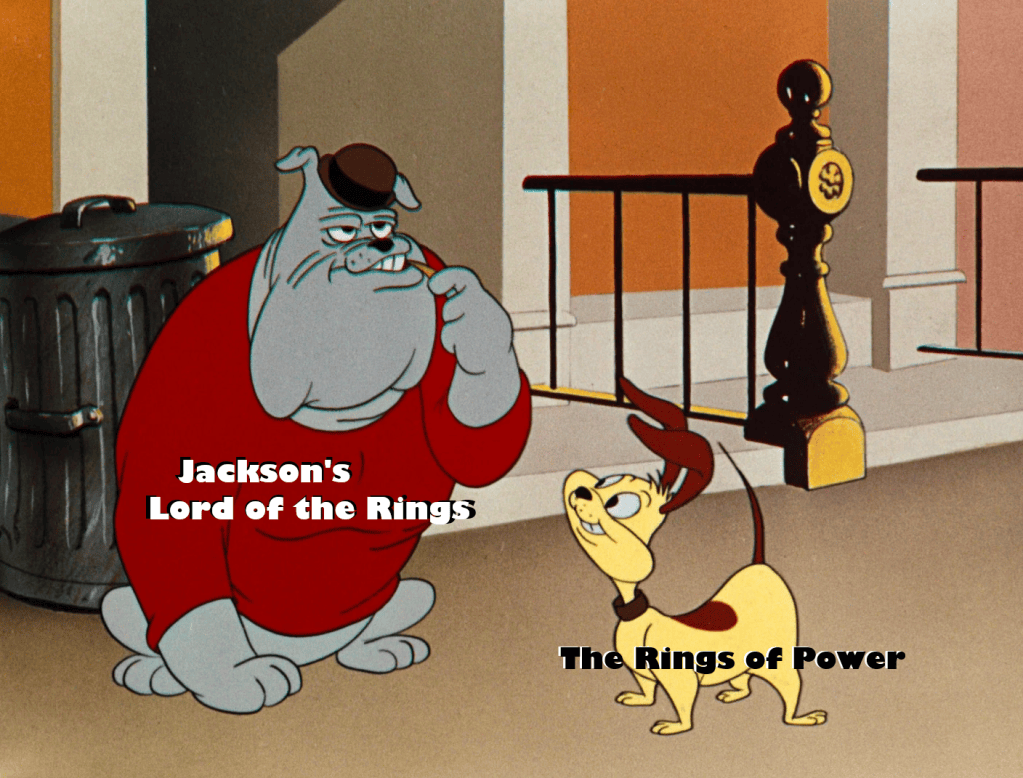
- Given that The Rings of Power seems to both copy and yet one-up Jackson’s films when it can, it may be that it’s trying to outshine them, or replace them in pop culture’s estimation. Like the end of 1952’s “Tree for Two,” where Chester and Spike exchange roles.
- Anyway, Gandalf loses, as he does all his pre-Whitening wizard-vs.-wizard fights, and all goes to black.
Back to the goings-on in Númenor.
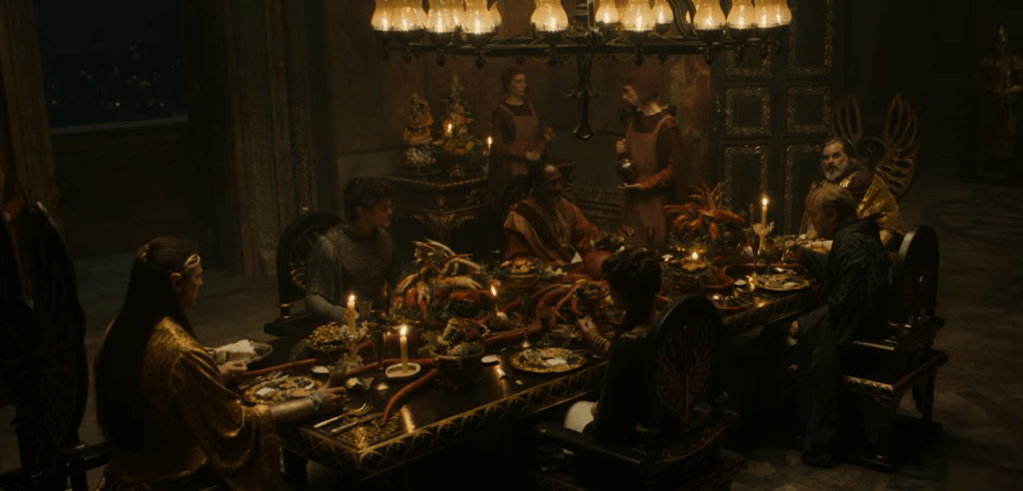
- I don’t want to find callbacks, but why do we need a Denethor-style close-up of Ar-Pharazôn eating something with his mouth a little open?
- I like seeing more developments in Númenor, but this whole plot about making the Elves go out and ask nicely for Númenor’s help against Sauron is confusing to me. For a show that did some much time compressing (millennia collapsing into mere years, and the Rings of Power events being folded into the fall of Númenor), why does it suddenly need to pad things out? There’s so much to do.
- I know I sound like a grumpy old man in these episode reactions posts, but I still want to find time to call out the good things. I generally hate the plot but I genuinely like most of the characters and their actors. Trystan Gravelle is an excellent Pharazôn. I wish he was a more Tolkienian Pharazôn, but what we’ve got he does well. He certainly has the look down.
- Gil-galad doesn’t seem like a skilled statesman. Just sayin’.
- Elrond meeting Isildur is pretty great. Their famous Jacksonian interaction inside Mount Doom is not really a book thing, but I suspect they’re going to push toward it.
Back to the Greenwood.
- The godawful Galadriel/Sauron/Celeborn love triangle—which was surely contrived to draw in a certain demographic—is well and truly here now.
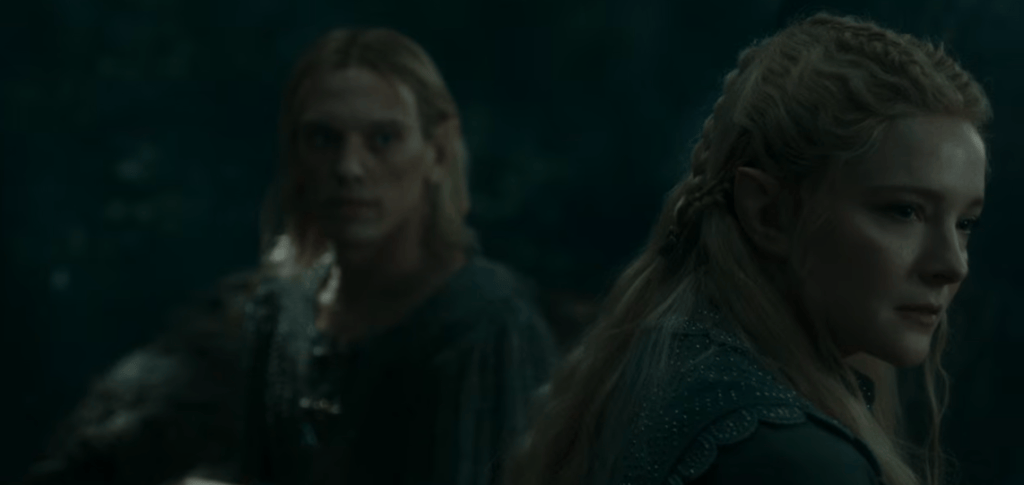
- By far the worse line in this episode is Celeborn asking Galadriel if, in all this time apart, she found someone else? It’s such a staggering misunderstanding of the way Elves work in Tolkien’s legendarium. It once again defines Elves (as we’ve seen with Dwarves) as just pointy-eared humans who live a long time.
- I’m not going to tease apart all the dialogue. It’s pretty bad. Once again Galadriel not fessing up about Sauron leads to more problems.
- Her subsequent dream about Sauron gives her a jump-scare, makes her fall out of the three they were sleeping in, and gets knocked out (at least it’s not a whole big cliff like the end of season 2), and this event separates the two.
- It looks like her Elf Ring picked the wrong week to stop manifesting helpful powers! Nenya can protect a whole Elf-refuge from Sauron’s armies but it can’t prevent her from being knocked out for a moment? Hardly even a minor concussion for an Elf, I’d say.
- While she snoozes for a bit, RoP Celeborn does what RoP Celeborn does best: He gets captured by Orcs again.
- Sauron shows up on his fell beast and sort of reintroduces himself. Then he says some really cringey things, and looks are exchanged, and it’s all very lame. The Triangle of the Rings continues apace.
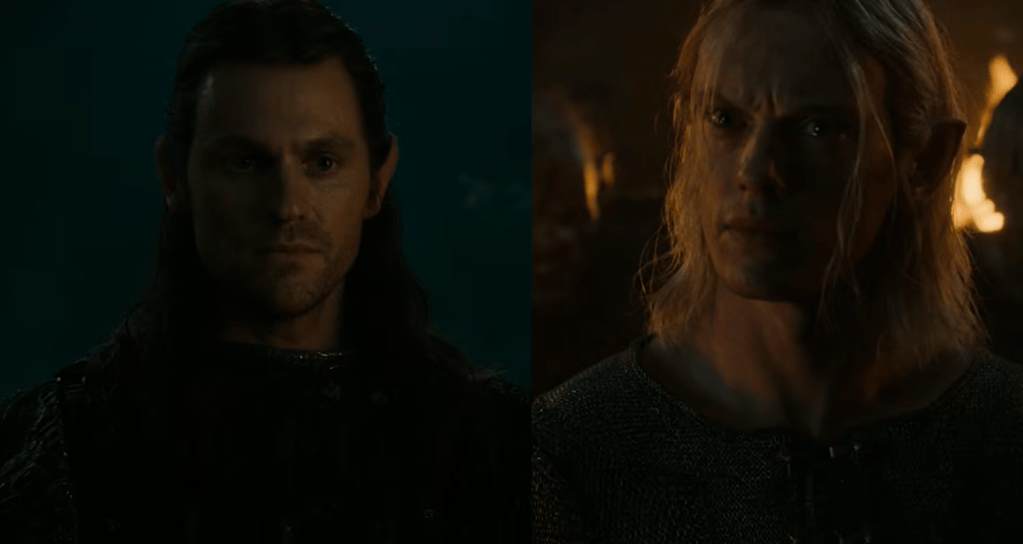
- Well somebody told him you had a boyfriend who looked like a girlfriend that he had in February of last year. It’s not confidential . . .
Well, at least we close with Gandalf having a very weird day.
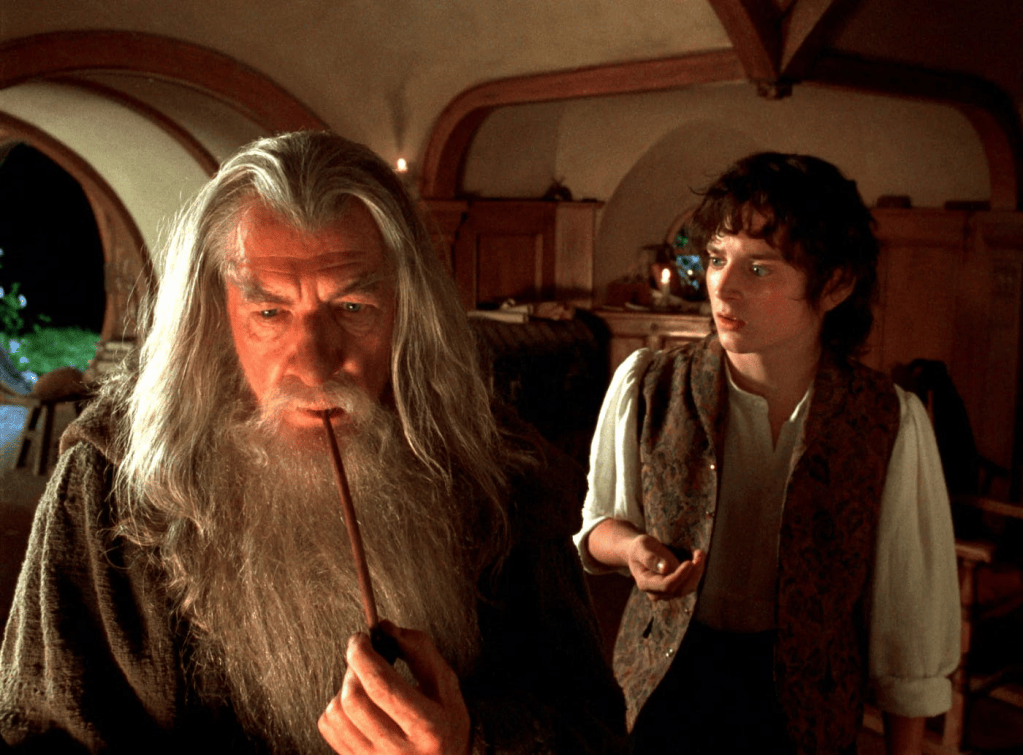
“Frodo, did I ever tell you about the time I woke up strapped to the back of a Mûmak? Err, that is, an oliphaunt. You’ll see one later someday. Sam especially will love them. You see, I was bound as a prisoner, on the way to Mordor, where I was soon to meet Sauron himself. Did you tell you this one already?”


One response to “RoP : S3 Ep 5: The Lady of Lórien”
[…] Episode 5: The Lady of Lórien […]
LikeLike