Episode 4, here goes nothing. Spoilers!
First, a reminder of all my previous reviews of past episodes (and other bits and bobs): Concerning The Rings of Power.
We start in Mordor.
- But wait, speaking of Mordor and the war (which has been going on for five years), do you suppose Sauron’s been conducting it almost entirely from Barad-dûr? The show is the show and the books are the books, but consider: In Unfinished Tales and The Nature of Middle-earth, references are made of Sauron himself in Eriador commanding his own armies. This is not to say he didn’t have lieutenants or generals (he probably did) and didn’t oversee every single battle or skirmish, but the dude was clearly more involved than we see him in the show. Not once have we seen Orcs come in and report about the war.
- Also, if Galadriel has left Rivendell to go on her side quest, and she took her ring with her, are we to suppose (by the show’s own logic) that Rivendell is no longer safe from the armies? Her Ring of Military Defense (like Gil-galad’s and Círdan’s rings) has been holding back Sauron’s forces, right? But now Galadriel is off to Gundabad.
- Side question: Why can her ring hold back legions but not help her in her fight against one mortal man bearing a lesser Ring of Power? Why are we about to see her so vulnerable among Orcs?
- .Anyway, we’re in Barad-dûr now. Orcs are getting tossed around; they’re unable to bridle the lone fell beast that Sauron wants to have saddled up.
- So . . . fell beasts. Of course we’ve got to have one of these at hand. At this point, it’s only the Watcher in the Water we’ve not yet seen dragged into the Second Age along with other iconic beasties from the Jackson films (and even the books). There’s still time to get the Watcher’s origin story, right?
- Side note: The term “fell beast” is a useful one, because even Tolkien doesn’t give them a proper name (which is a little surprising).
- I can’t explain why, but there’s something funny about an Orc telling his boss, in Mordor, “But I’ve found a set of horses.” And then helpfully adds that he could ride to Gundabad in “just a few short weeks. . . Month, at most.” You’d think Sauron could tap into the miraculous travel times this show has to offer.
- To my point earlier above, for five years Sauron’s been waging war but he seems to be weeks’ or months’ distance from where a lot of the war is taking place. Has he had a fell beast this whole time, with which he could check on and conduct his war? But this scene sure makes it look like this is the first time he’s going to take to the air on a winged creature.
- Also, why in the world did Sauron leave it to Orcs to try to saddle the fell beast in the first place? Is Barad-dûr like an PEZ dispenser of Orcs that he can spare a few? He walks right over and it’s instantly tame. Why waste the Orcs?
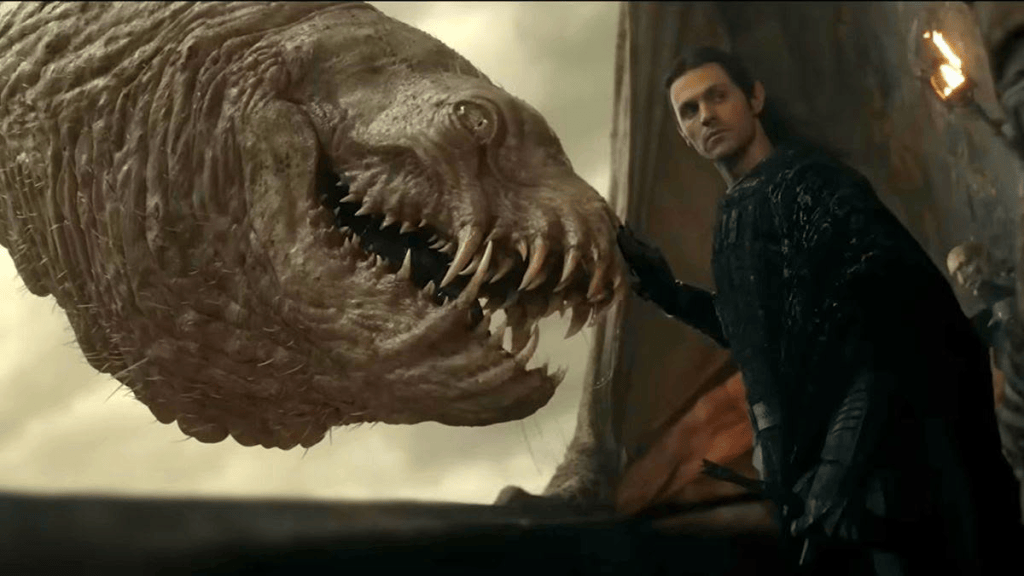
- “They were once Eagles, you know,” Sauron helpfully points out to the nearby Orcs, who didn’t (and were never going to) ask. It’s curious how the showrunners, who have full access to the text of The Lord of the Rings which gives us the most plausible (and coolest) origin of the winged beasts, felt the need to toss up a new one.
- Aside: The actual text tells us that the creatures, whatever they were (“if bird, then greater than all other birds”), Sauron “nursed it with fell meats.” Nothing about that suggests they only want to eat living meat, like they just implied here. Why discard the very expensive text Amazon paid to have rights to use? Contrast this with a time in The Silmarillion, where Morgoth uses his power to increase the size and power of a werewolf whelp (Carcharoth), and we’re told he “fed him with his own hand upon living flesh.” So that’s a case where carrion won’t do. But fell beasts? I don’t think Tolkien mean to make them so choosy.
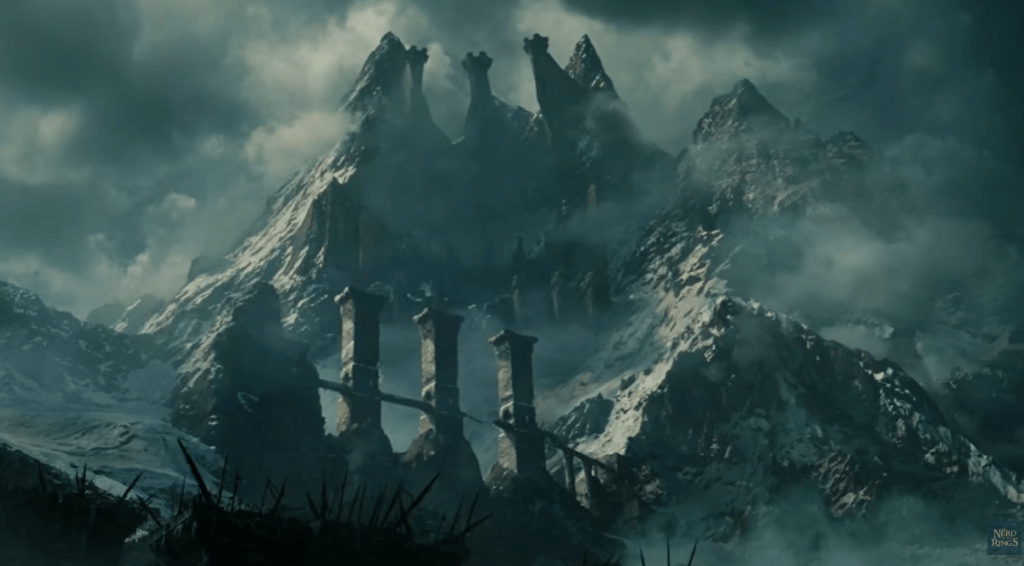
- Now we cut over to Gundabad.
But let me ask a genuine question. I swear, I’m not being snarky. I want to know what other people genuinely think.
At the start of the first season of this show, Middle-earth (at least according to the Elves of Lindon) was at peace, relatively speaking. The war against Morgoth had been ended long before, with Morgoth defeated. And then, according to Galadriel’s prologue narration, the many orcs who remained (who had or then multiplied and spread to every corner of the world) were under the command of Sauron. Where this towering black-armored Sauron* fits into anything in the RoP timeline, I genuinely don’t know:
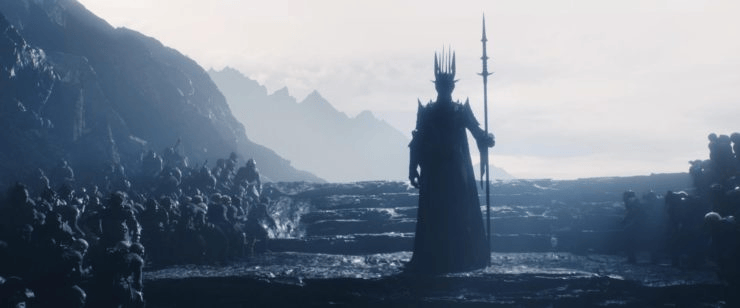
*It cannot be after the red-haired, Jack Lowden form of Sauron (because right after that scene he became Sludge Sauron), so it must be before. If he ever was this form at all. I’ve since realized that there are scenes and visuals that are figurative and not at all literal. Is this meant to be the same?
Anyway, back to my question and the prologue. The war was over, Sauron was in charge, and all the orcs follow him wherever he is. Then, following the sequence in her prologue, Galadriel’s brother (I don’t even like naming him because he’s just not the same guy they got the name from) goes hunting Sauron. But Sauron got him first. So, dead brother. Then Galadriel takes up the task her brother died doing, which to me implies she was not until then in the fighting Sauron’s armies business prior. Only at this point in time, when her brother is dead, has she gone on the offense, in vengeance. To the ends of the Earth. For centuries.
In that snowy opening, one of the Elves in Galadriel’s company says “It’s been years since the last Orc was sighted.” They encounter only a snow-troll in a former Sauron-occupied fortress, no actual active Orcs or organized enemies. She and her company then return to Lindon. At which point Gil-galad, reciting a speech that Elrond wrote for him, says, “though Morgoth fell an Age ago, some feared a new evil might arise from his shadow. So for centuries, these soldiers have swept across crag and crevice, washing away the last remnants of our enemy like a spring rain over the bones of a spoilt carcass. And now, at last, they return to us in triumph, for they have proven beyond any doubt that our days of war are over. Today . . . our days of peace begin.”
Here’s my genuine question. Here in season 3, Marnûkh mentions Gundabad, and he says it’s “a place where no Elf would dare follow. The most feared, most impenetrable of all Orc dungeons.” Elrond responds with, “It was said to be abandoned.”
When are we to suppose Gundabad was in its “most feared, most impenetrable” status? Before an Age ago, when Morgoth was defeated? Or sometime later, when Galadriel and some others Elves were hunting Sauron for centuries, “across crag and crevice” (maybe somehow skipping Gundabag?)?
I know the show jumped ahead five years and there’s been war taking place. Five years isn’t much, though, certainly not to Elves. (Which we know from Elrond’s continual surprise whenever he sees Durin’s family advancing rapidly through time, kids growing up, etc.) Are we to understand that this dreaded dungeon “where no Elf would dare follow,” somehow fits into the same Middle-earth status quote described by Gil-galad in the first episode of season 1?
I truly don’t know when things are meant to have been at their prime. Or are they just contradicting themselves again and can’t match up all their depictions? I do’nt know.
Anyway . . .
- Wormy maggots are offered like bar peanuts at the door. How polite and hospitable A glimpse of Orc culture or an excuse to show Orcs liking gross things?
- Galadriel and Arondir are separated, of course.
- Now over to Khazad-dûm, where the entire Dwarf plotline (which until now has been one of stronger ones in the entire show) is about to start tanking.
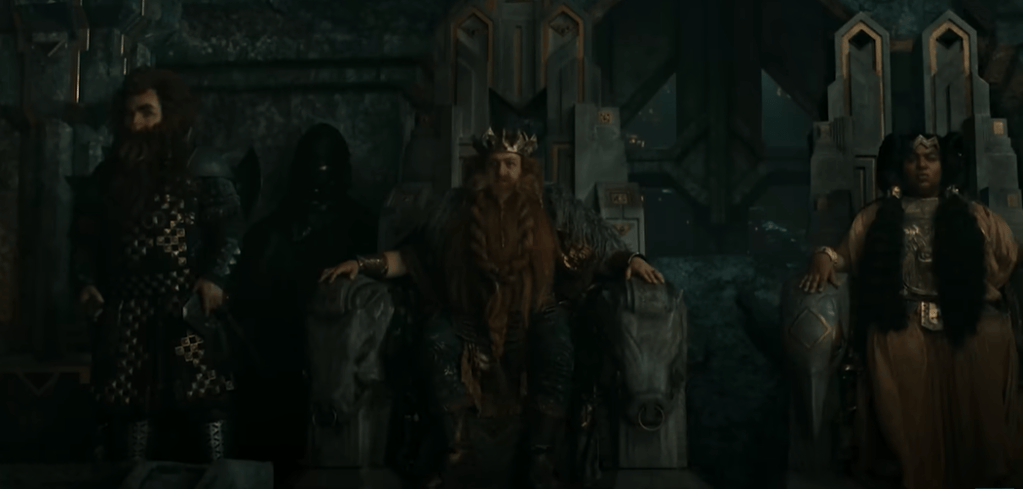
- The crown is being contested. Durin is no longer assured of continued kingship. I do think the reason for doubting Durin’s authority is a really good one. I think the writers found something here and made it work: that Durin III’s selection of Durin IV could theoretically be compromised because he was compromised by his Ring of Power. I think that is the kind of Middle-earth-based, magical-corruption-inspired intrigue that would fit well into existing legendarium lore. If Durin III went mad because of the Ring, then his appointing Durin IV as his heir is sus. Whether it is or it isn’t, it makes sense to wonder. More of this talk, please!
- So whether the kingship stays with Durin or goes to Thráin will be determined by trial by combat. Which they’re calling Aulë’s will. That I’m not sure I like. On the one hand, no, I don’t think this is the sort of thing Aulë would actually approve of. Dwarves, from the get-go, at least according to the narrator of The Silmarillion, are a bit warlike by nature. That is true.
- But I don’t think it’s because Aulë made them so; I think it’s because Aulë made them without Ilúvatar’s permission and they’re imperfect. They were also made in Arda Marred, a world already imperfect because of Melkor (Morgoth). But this is all book stuff. RoP is a far cry from that.
- Besides, whatever Aulë would want for the Dwarves, people forging their own religion and interpreting their god’s will is a thing societies mess up all the time.
- Next we jump over to Durin and Disa’s home, where they discuss the trial to come and the fact that Durin is known for being defeated by Thráin because his brother always knows how to get under his skin and make him lose his cool. Disa asserts that if he can “face a Balrog,” he can face his brother.
- Whoa, now. The show just barrels right over and ignores two big problems:
- They’re using the word ‘Balrog.’ Which means they’ve actually somehow identified the thing they saw? Durin, Disa, and Narvi all witnessed the demon with their own eyes and have since discovered its kind? They weren’t discussing this in open among other Dwarves, so it’s probably not common knowledge, but still, the word is out there.
- Are they not at all concerned that the Balrog still exists right beneath them somehow? How is this not huge news somehow affecting the course of Khazad-dûm? Narvi, at least, as the delve-master, would be concerned, surely? Also, what do the common people of Khazad-dûm think happened to King Durin III? He went mad, sure, but what took him down? What’s the story?
- If the current king of Khazad-dûm knows a Balrog lurks beneath them, are we really to assume that he hasn’t said anything to Elrond about it? Nothing? Not even, “Hey, one of those rings made my dad go crazy and start killing Dwarves, then he threw himself at a Balrog”? Nothing? This would be huge news in the world of Elves. I get Durin might not want to just blab about the Balrog openly to the Elves, but not even Elrond? Remember that in The Lord of the Rings, no one even knows a Balrog is there until Legolas names it Lothlórien. I know where things need to end up, but they need to make sense to get there.
- They’re using the word ‘Balrog.’ Which means they’ve actually somehow identified the thing they saw? Durin, Disa, and Narvi all witnessed the demon with their own eyes and have since discovered its kind? They weren’t discussing this in open among other Dwarves, so it’s probably not common knowledge, but still, the word is out there.
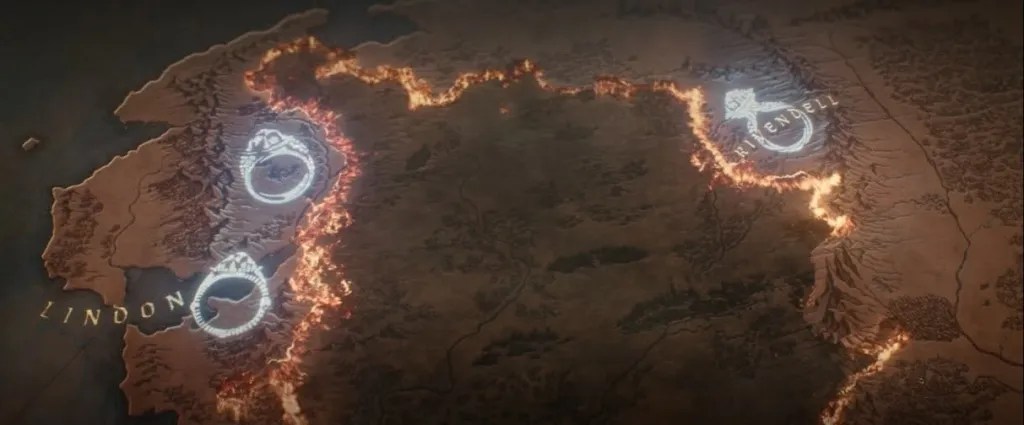
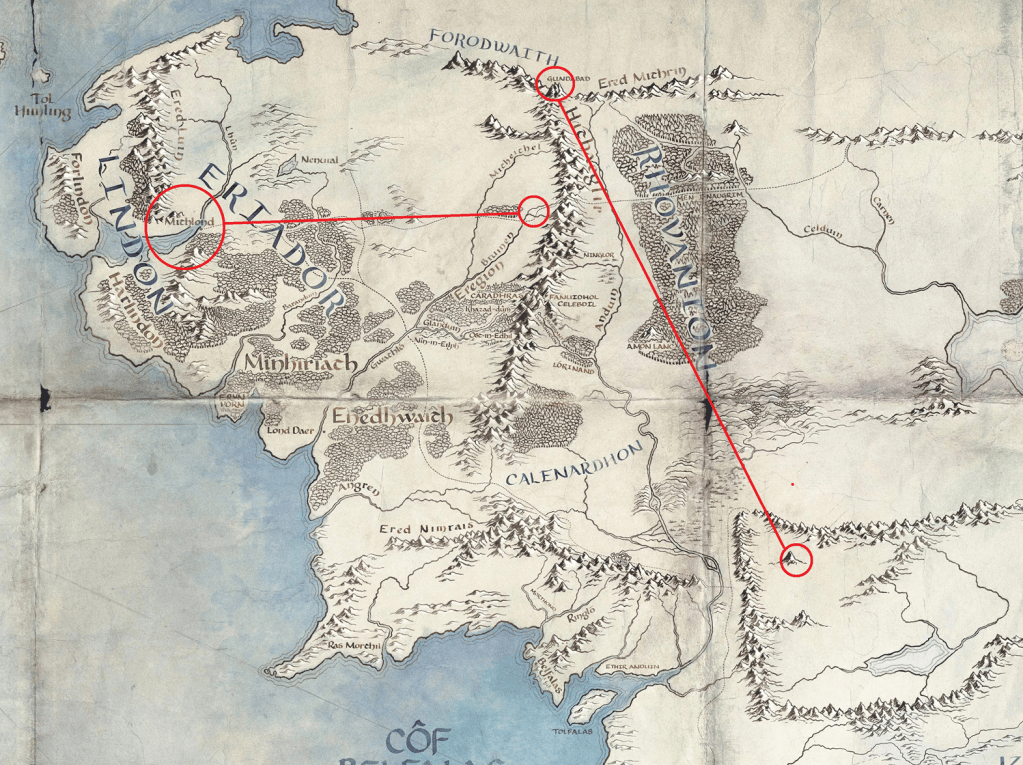
- Over near Lindon, we have Gil-galad and Círdan surveying a battlefield, then Elrond shows up. We don’t know much time has passed since Elrond departed, but was it anywhere near “just a few short weeks. . . Month, at most”? Elrond’s made this journey before, of course, but didn’t he ride through this big charred swath of enemy-occupied territory?
- Shouldn’t that make it take signficiantly longer?
- For reference, compare the distances between Rivendell and Lindon and, say, Mordor and Gundabad (which by horse would take weeks):
- Anyway, we’re setting up a journy that Gil-galad and Elrond will be making to Númenor. I just need to accept that.
- Despite knowing that in the books, neither Galadriel nor Elrond nor Gil-galad are said to have even visited the Dúnedain on their island. Gone is the elegance of that very long and slowly evolving relationship between the kings of Númenor and the Elves of Middle-earth, and the earning warning of Gil-galad’s letter to Tar-Meneldur long before Sauron-as-Annatar showed up to talk about ringmaking. Back when he was just an evil presence that Gil-galad became aware of but couldn’t name.
- Speaking of Númenor, we jump over to Elendil in his rolling cage, where he and Kemen have a chat.
- I really like this Elendil’s character, if not his vague lineage, and I like seeing him as a wise father figure. You can see he pities Kemen. But man oh man, I didn’t expect the GoT-ification of The Rings of Power to pick up the pace like this. So Kemen says his mother “worked her trade at night.” I wish, I wish, he meant smuggling. But this is 2026 and Amazon wants to market this show to as many as people as possible.
- For the record, there is absolutely no reference to prostitution in Middle-earth in any way. The modern, jaded reader (who loves George R.R. Martin’s grimdark fantasy) will say, what, you don’t think it existed at all in his world? It doesn’t matter. It’s part of no story, and Tolkien spent no time referencing it. It was beneath him and the stories was telling. It was germane to nothing, is the point.
- Even if there was, it seems less likely to place it in Númenor. Maybe after Sauron’s thorough corruption of it begins. Because during that time, things got ugly. Sauron’s evil was actively at work: “And men took weapons in those days and slew one another for little cause; for they were become quick to anger, and Sauron, or those whom he had bound to himself, went about the land setting man against man, so that the people murmured against the King and the lords, and or against any that had aught that they had not; and the men of power took cruel revenge.”
- Are the Dúnedain a flawless people? Hell no, especially in the second half of its existence when the kings were become crueler and more power-hungry and more craving of immortality. But beyond a general discontent about growing old and dying, the people right there on the island don’t fall into this sort of societal disorder until the end. Individually, I suppose they could. Even some of the early to middle kings have their problems. Just ask Aldarion and Erendis.
- But if the writers of The Rings of Power can use prostitution as a shortcut to pity or disgust for Kemen and Pharazôn . . . yeah, no hesitation.
- Turns out, Anárion was able to find some riders and horses and catch up to the carriage. If that was a possibility this whole time, you’d think Pharazôn would have come up with a better plan. Unless it was entirely Kemen’s plan to work out, and he bungled. It’s feasible.
- I’m very interested in what will become of Kemen in the custody of the Faithful, actually. I’m a sucker for a redemption story. We’ll see.
- Back in Gundabad, Marnûkh proves true to his word, turning on the other Orcs. The Elven-smith, Mataille, turns out to be real (maybe?) but . . . dead. Now the pretense of what Gundabad is gone. Which brings us right over to . . .
- Celeborn!
- Finaly. But dang, what a soap opera plot.
- But come now. Let’s first remember that Galadriel freed herself from a Númenórean prison with metal bars in short order, but couldn’t escape a rickety wooden rolling Orc prison.
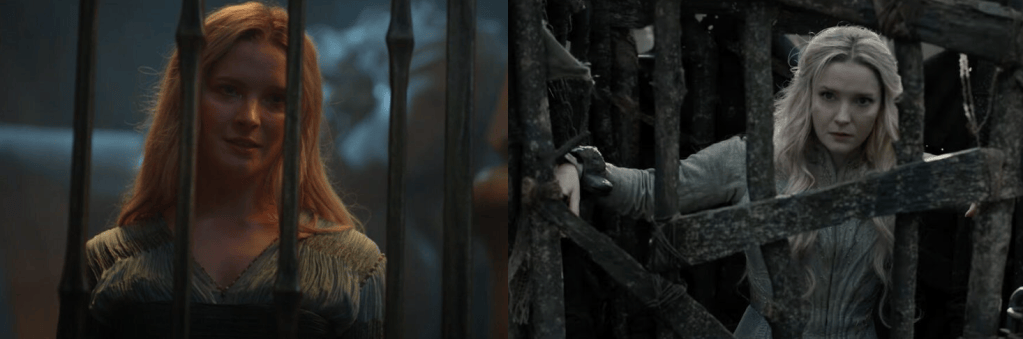
- And now Celeborn hasn’t been able to escape Gundabad in centuries. Milliennia, more like. He claims he has gotten out, but always got recaptured.
- Also, why the heck did Orcs keep him alive all this time? Who was he valuable to? Not Sauron, at least not yet. And who exactly were Celeborn’s captors during Gil-galad’s full “Age” of peace—while the Elves “swept across crag and crevice” searching for Sauron’s evil? That’s a lot of food and water needed to keep one Elf going. All of this is so contrived.
- So Arondir doesn’t know Celeborn’s name. Fine, that’s legit. No reason to believe, especially in this version of events, that Celeborn’s some household name. He’s no celebrity like Galadriel is.
- But isn’t it interesting that Arondir shows no recognition of the name Doriath, or King Thingol. Now, I know the show is just name-dropping these words to try and lend authenticity to these characters. And in fact Doriath and Thingol, while never thoroughly described, are mentioned in The Lord of the Rings.
- But even within the context of this show, it’s been established that Arondir is a Silvan Elf, a Wood-elf. And he himself name-dropped Beleriand as “an entire Elf-realm” where he came from, but now “it lies under the wave.” But, by the show’s own visual map-exposition, there was no Beleriand (per Galadriel’s prologue, the Elves sailed from Valinor to a Beleriand-less Middle-earth and then fought Morgoth there. So in this show, Beleriand is some other place now sunken.
- But let’s pretend Beleriand—like in the books—was a whole series of lands and realms, some claimed by Elves, some not. No Wood-elves / Silvan Elves lived there even in the books. But let’s pretend there were. Maybe they’d be living among the Green-elves of Ossiriand, who are Nandor (the closest thing to Wood-elves there). Even they had a lot of dealings with Doriath, the most enduring of Elf-kingdoms. It’s absurd, the idea of anyone in Beleriand having no clue who Thingol is or what Doriath is.
- Just empty name-drops, possibly even made for a laugh.
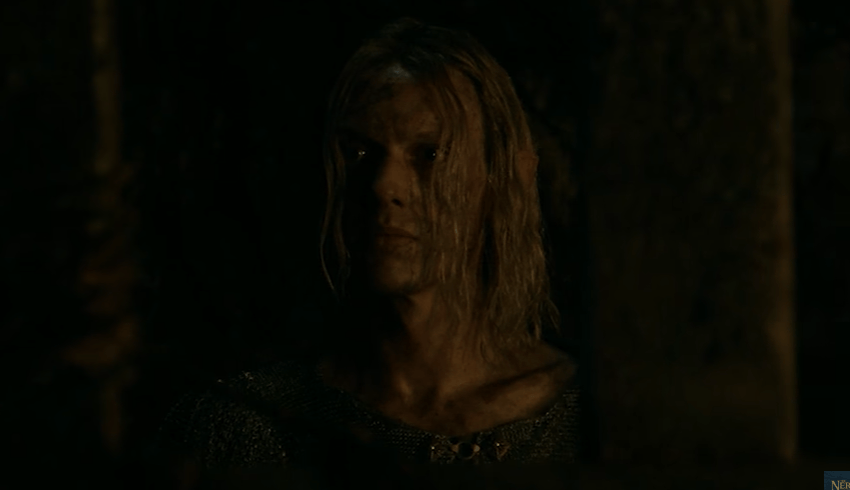
- I do think Celeborn listing off important names but not the one that Arondir would obviously know (Galadriel’s) is kind of funny (and I like Marnûkh’s snark here), but it’s clearly just a set-up for the reunion moment. Every bit of wording with Tolkien names are either unearned and clunky or else important but . . . off somehow.
- In any case, the idea that Arondir was considering not trying to free Celeborn (or any Elf) is a shame. Arondir has consistently felt the most Elf-like character in all three seasons. He only lets him out because Celeborn knows his way around the prison. I guess if it wasn’t for that fact, Celeborn would never lived long enough to become the Lord of Lothlórien. Noted.
- When we return to Khazad-dûm, when unfortunately begin the fade-out of what had shown to be one of the cooler parts of the show. Everything involving the contention of the crown has been intriguing—I didn’t even mind that little nugget of annoyance that maybe Thráin had once tried to woo Disa before she married Durin.
- But now?
- Now they’ve strayed, quite willfully and shamefully, into the kind of infidelity kind of crap that will hang The Rings of Power alongside . It’s stopped just a pace short of turning this into The Desperate Housewives of Khazad-dûm. Maybe not all the way there, but close enough that you can’t put the toothpaste back in the tube now.
- Filmmakers and TV show producers have had such glorious opportunities to depict these amazing non-human characters, to make them seem just human enough to be relatable to us (as Tolkien did) and yet just inhuman enough to evoke a fantastical race in a fantastical setting. Elves, when done right, feel like they’ve stepped out of Faerie. Dwarves, when done right, feel like they really could have been molded from the earth. Even Orcs are sometimes otherworldly and freaky. But then the writers reveal that they were never going to lean into the fantasy world they’ve been so privileged to have.
- I liked Disa so much. I don’t blame the actress in the least. And I don’t believe Disa from seasons 1 or 2 had any such cheated-on-Durin-with-his-own-brother nonsense baked into her backstory. This is a new angle. They dragged her down and they dragged Durin down, who then also became stereotypically hot-headed and lost the crown of Khazad-dûm because of that.
- Worse: Until this moment, Durin and Disa were such a breath of fresh air: a marriage full of love and trust not just for a fantasy series but for a TV show in general. The world needed them. Now they’re just a couple that I used to think the world of. Bummer.
- Back in Gundabad, things come to a head.
- Galadriel briefly enters the slowest of motions in her shock at seeing Celeborn again. That’s one slow-falling sword!
- Nazgnagôl in the house!
- Then the fight goes outside.
- An Eagle! Landroval! I don’t dislike his presence, only the out-of-the-blue means by which he’s brought in. Galadriel’s explosive flare-arrow wouldn’t be over the top if we’d seen she was capable of making such a thing previously. Even back at the campfire the night before, had we seen her concocting something, that would be great. But instead we get a seemingly random conjuration.
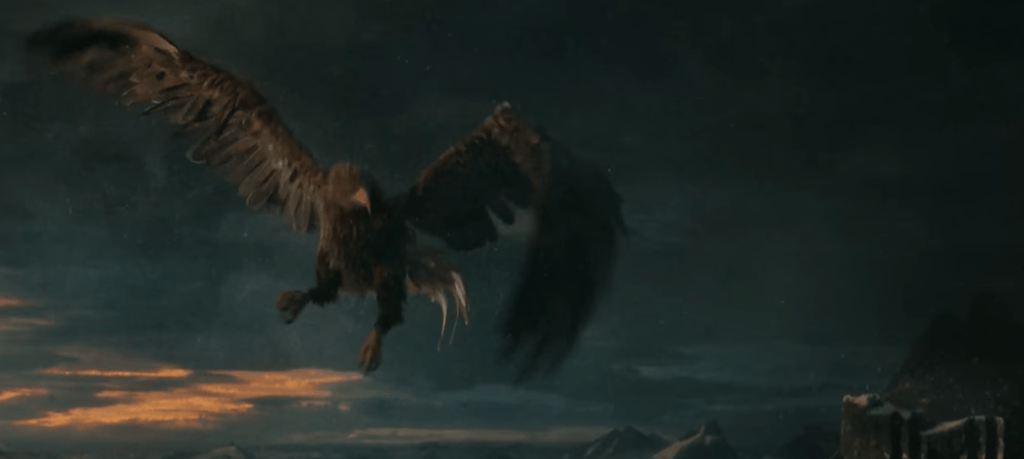
- Say . . . Why didn’t the Eagles just fly them to Gundabad in the first place?? They’re not helping that sort of question by being this fast and loose with Eagles.
- Arondir gets to pull some more Legolas-style moves.
- Marnûkh is struck down (killed!?!?) by the Nazgnagôl. Hmm, I’m guessing not. But hurt, for sure. Captive soon, for sure.
- Theo is the Nazgnagôl. Ooof. Kind of knew this was coming, just didn’t see it happening this soon.
- Arondir . . . argh. Well, the writers have found a use for him, after all, and it’s to pivot Theo’s ominous story arc.
- Here’s what I want to happen (but it won’t): I want Theo, later, upon reflecting on this, to actually back out of his deal. To ultimately reject the Ring. To give it back, abandon it, whatever it takes, and not become one of the Nazgûl, after all. (A bit of honor restored for her mother’s sake.) It would forcing Sauron to give the same Ring to someone else. That’s both fascinating an idea and, honestly, breaks no lore. Who’s to say that the first men offered the Nine Rings all accepted it, or kept it? I could well imagine some of the sorcerers or kings “failing” to meet Sauron’s standards, and ultimately forcing Sauron to reclaim the Ring and try someone else. Yes, Theo would certainly be killed for his insolence, but what a way to snub the Dark Lord and regain some honor?


One response to “RoP : S3 Ep 4: Gundabad”
[…] Episode 4: Gundabad […]
LikeLike