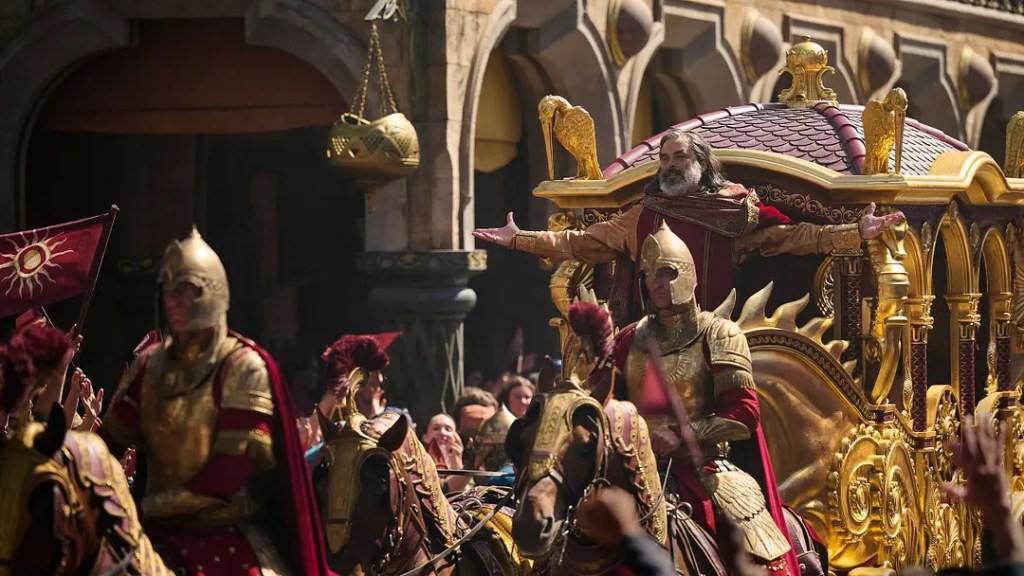
Time to talk about episode 2, “The Gift of Men.” Spoilers abound, of course.
- Most of the establishing shots in this episode are awesome.
- Though, there’s something about one of the ones at the end—when the camera pans back away from the city at night—where something slips, where it does look and feel like an elaborate toy set and not a real place.
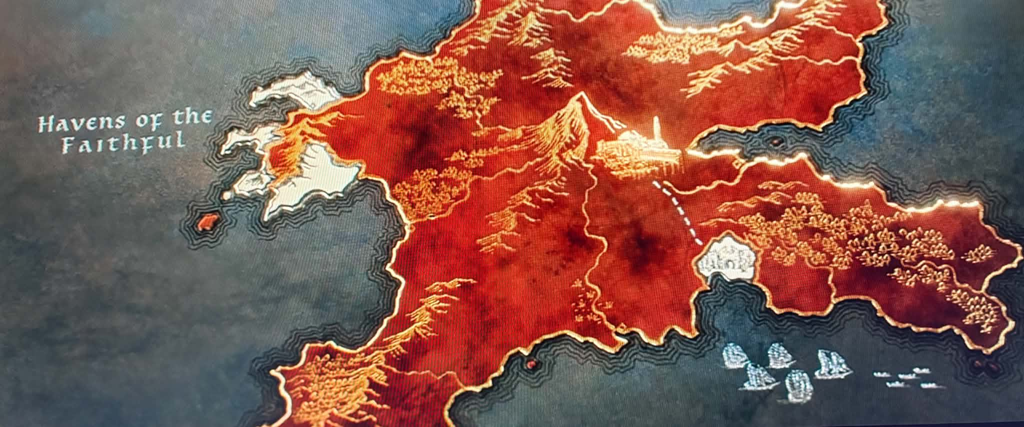
- Whenever we get a description in place of a name, it’s an instant reminder that the show is dancing around the rights it doesn’t have. It breaks the fourth wall. To me, it’s an instant reminder of why it would have been better to choose a place, a time, a story that it can comfortably dwell within. So for example, we get . . .

- . . . instead of the actual name of the city (in the books): Armenelos, the City of Kings.
- In the books, Armenelos is not a port city at all. It’s actually landlocked. It’s situated near the center of the island and only by river can it reach the sea through the town of Nindamos. Now, I get it. They don’t want to spend time on explaining that, or showing other locations, so what The Rings of Power has done is to combine Armenelos with the eastern port of Rómenna and they just sort of carved the bay inward so that it’s closer to the center. Now the unnamed Capital of the Númenórean Empire can reach the sea directly.
- Hey, it sounds like Pharazôn’s properly attaching the kingly Ar- prefix at last! Well, why not? He’s got the scepter of rulership. Good for him. Now he’s a little closer to book Pharazôn.
- And whoa, look at that dripped-up gilded carriage! So much gold. How perfectly fitting. Make Númenor Great Again!
- By far, the most cringe-inducing thing the show has done to the everyday Númenóreans is make them naive, exploitable, easily swayed, and kind of dumb. Chanting Pharazôn’s name like the crowd at an American football game is almost as lame as it gets. This is a callback to season 2 when seemingly the whole court shifted allegience from Míriel to Pharazôn in an instant because Belzagar started up a catchy three-beat chant: “Phar-a-zôn! Phar-a-zôn! Phar-a-zôn!”
- That one moment aside, Belzagar sure is an asshole. They’re doing a good job making him slimy and unlikable, like Kemen.
- Belzagar’s name has been borrowed from the book king Belzagar, who was the seventeenth king of Númenor, aka Tar-Alcarin.
- I do like that Belzagar dismisses Sauron as a “phantom,” but Ar-Pharazôn (or his ego) takes him more seriously. That feels right.
- I wish it was clear what the average non-Elf in Middle-earth knows about Sauron. This may be an consequence of the shifted paradigms of this show.
- To be clear: In the books, Sauron in the Second Age is not known as Sauron at all until he forges the One Ring and is revealed for who he is by the Elves. And then gradually the rest of Middle-earth becomes of aware of him and calls him the Dark Lord, but that’s after his war with the Elves. Before that, Sauron has been MIA since before the end of the First Age. Most humans will have no clue about him at all.
- So what I wonder most, in this version of events, is: What do Númenóreans think Sauron is? It’s unclear. I’ve heard the showrunners refer to Sauron in articles and interviews as a Maia, but the show hasn’t. He’s just a sorcerer. Do the people all think he’s just some powerful mortal dude who has somehow transcended normal mortal power through his sorcery?
- Now, loremasters and kings in Númenor might have better idea than most. But I’m trying to work with what data the show itself has presented. Which isn’t much!
- Oh, shoot! A would-be assassin. Intriguing!
- Oh, shoot. It’s Isildur!
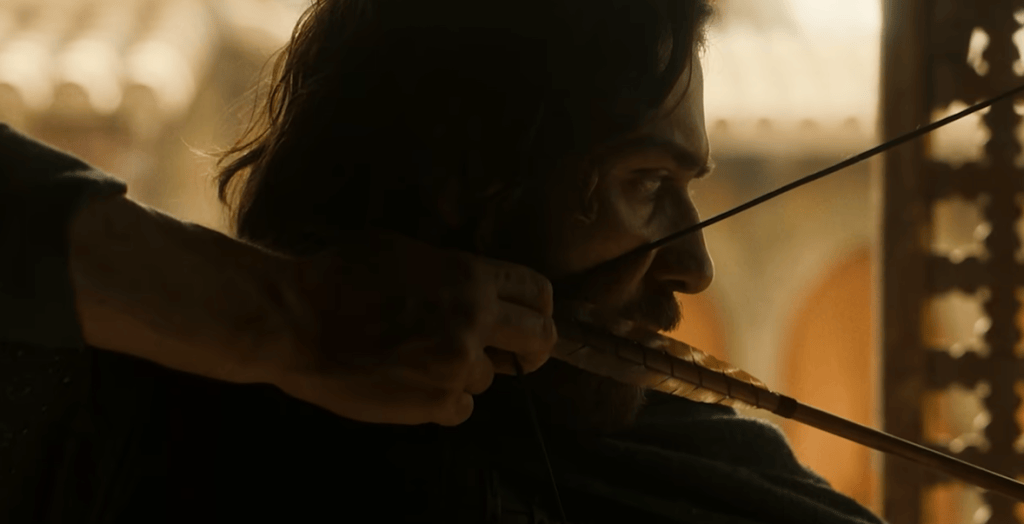
- Oh, shoot: he shoots . . . Pharazôn’s girlfriend. Dang.
- They’re doing Isildur dirty. Extra dirty, because now he’s killed someone, and it wasn’t even Pharazôn. I’m at least glad to learn that he was mostly operating alone, and he wasn’t sent by Míriel or Elendil.
- Side note: Peter Jackson did Isildur dirty, too. Worse, even. I understand why, just as I understand why it didn’t make sense to put Tom Bombadil or Fatty Bolger or Ghân-buri-Ghân in movie theaters in 2001. The moviegoing audience wasn’t ready. There’d have been no time to paint a wider picture of Isildur, so he had to take the fall.
- I am glad to see Isildur and his sister, Eärien, interacting again. I’m bummed we didn’t get to see them reunite. When last we saw her, she thought he was dead. Or am I misremembering? Wait a second. Even his dad thought he was dead! We never got to see the moment where they realize Isildur survived his adventures in Middle-earth. A missed opportunity.
- It’s weird. That’s a big deal, and I wish we got to see them reunite, wish we’d be given that relief, a little moment of sunshine these characters could use. Meanwhile, the show spent a lot of time showing us the tearful parting of Nori and Poppy (end of season 1) and then the joyful reunion of Nori and Poppy (start of season 2), and in the grand scheme, that was meaningless. Meanwhile the harfoots have fallen out of the story.
- Am I the only one who thinks bearded Isildur looks a little bit like Jim Halpert?
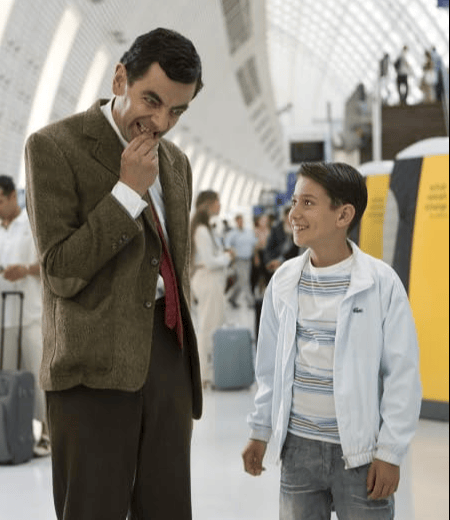
- Fun fact, for those who don’t know: The actor playing Isildur, Maxim Baldry, was in Mr. Bean’s Holiday in 2007 as a kid. Now that’s an honor!
- Okay, back over to Middle-earth.
- I’m liking the storyline with Durin and his brother, so far. Family is complicated!
- A small point, but I like it when the show gives us a moment of exposition without wasting too much time on it. I wish they’d do that wish some of the journeys (that go by too quickly or are simply skipped). It helps. So the hand-off of the captured orc Marnûkh to the Elves was brief, but shown with the proper silent drama.
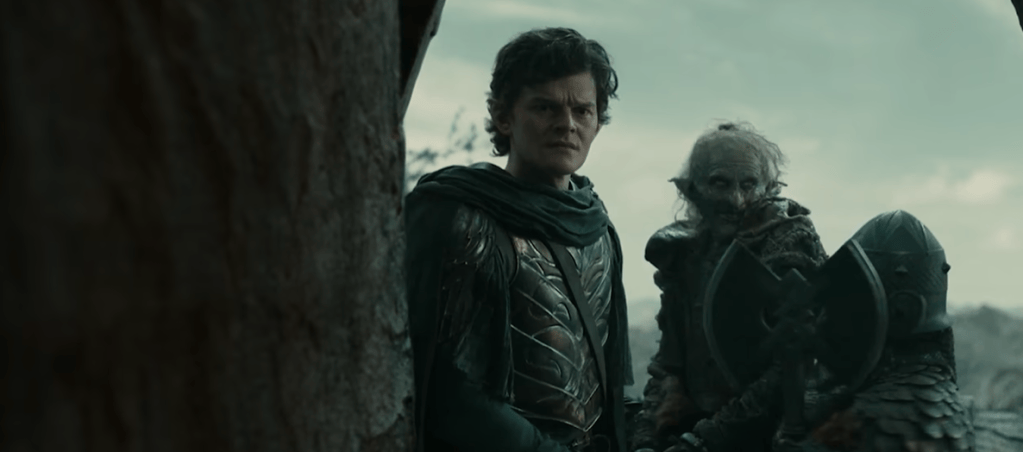
- Annnd back across the sea again! I do have a general dislike of how the tensions in Númenor have escalated very quickly (where of the course it’s a generation and political rift taking centuries; it’s a gradual an earned schism that leads to the Faithful vs. the King’s Men). In many ways, the violence we’re seeing (assassination attempts, bloody interrogations, hangings, etc.) is the sort of thing that should begin after Sauron has become Pharazôn’s “prisoner.”
- In general, The Rings of Power fast-tracks everything. The time compressions means that almost every turn of society or culture has to be escalated all in just one scene. It’s a shame.
- Here’s a clear example: In Tolkien’s texts, the Númenóreans, who have been gifted with so many skills and even longer life than most mortals, gradually become discontent across the centuries and millennia. They want more than they have. They envy the Elves their immortality, and they realize how much more powerful they are than the men of Middle-earth. Their royals, especially, who are already wealthy, want more power. It’s a very human story. All of this growing discontent and thirst for immortality finally culminates in a figure like Pharazôn: he’s just the last of the worst of them. By the time he comes around, Númenor is already an empire and has become a severe colonizing power, yes. The Faithful are by this time already socially and politically persecuted but it’s not a civil war.
- But in The Rings of Power, everything seems to shift quickly based on a single event. (Because readers can’t be bothered with subtly or believability?) There seemed to have been a peaceful status quo in Númenor at the start of season 1. Míriel was prepping to become queen because her dad, Tar-Palantir, was still alive. Pharazôn was just some wily advisor. But the arrival of Galadriel shifted things, and all of a sudden now—to be clear, only now that we’re near the end of Númenor’s full story—is there discontent about Elves? There was zero talk in all of season 1 about Númenóreans being unhappy with their mortality. The closest thing we got to motivation was having Pharazôn scare a single courtyard of people by saying tireless Elves might be coming for their jobs. (I’ll grant them, he probably gave this speech to more crowds elsewhere.) But talk of Faithful vs. King’s Men factions didn’t even start up until season 2. Only in season 2 did we get one line where Pharazôn expresses desire to have what the Elves have (immortality). Like the writers only just remembered that might be an important point later in the series and they’d better shoehorn such a line in fast!
- Hey, a new location! Bay of Elros, Secret Faithful Refuge. Looks cool. A shame they had to invent a new bay when there were a few perfectly good ones lying around.
- I like Míriel. I like how wise and Faithful-minded she really is. Rebuking foolish Isildur for doing what he did. Good.
- I won’t bother to gripe about distances, because it’s just a matter of plot convenience at this point. It will apparently take weeks to get from the Bay of Elros to the western edge of Númenor. (Never mind the blink-and-you’re-there travel times over on Middle-earth!)
- Back in Khazad-dûm, we get a pair of intrusive Nazgnagôl have shown up. I really dig that Durin doesn’t want Disa or Narvi to face them. It’s a nice touch.
- Durin homes right in on their rings, and that pisses him off. Love it. He demands they rings be taken off. They don’t. Instead they unmask themselves (which sure is noisy and clanking!). Subtitles reveal the dark-skinned guy to be from Harad, which is awesome. I want to see how multicultural these villains were before they signed on for future wraithhood. What I don’t like is how the subtitles don’t reveal the other guy’s origin. Why does only the Haradrim need identifying? Come now.
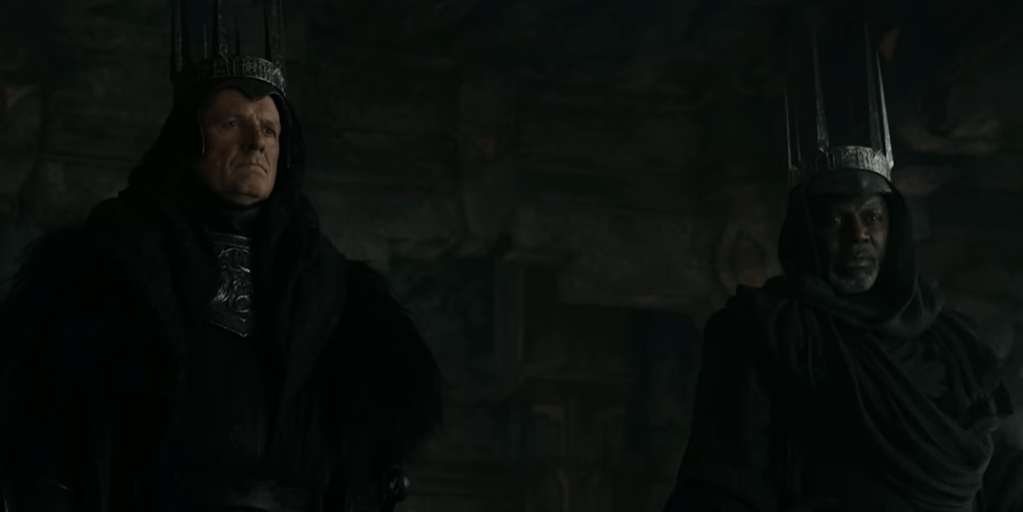
- All right, so the Ring-servant from Harad spouts a bit of the future Witch-king’s future words to Durin. This isn’t a Jackson callback because Jackson didn’t give the Witch-king vs. Éowyn confrontation (truly one of the best exchanges in the whole book) its full treatment. This is a book quote, just out of time and entirely out of context. It begs some questions. So are we book readers to think that this is just something that Nazgûl, any Nazgûl, tends to say as an intimation tactic? Is there a Nazgûl Training Program, and they’re instructed to memorize these words? So is the Witch-king just falling back on a lazy old bit that the Nine do from time to time?
- Setting its origins aside, it just doesn’t fit here. When Witchy says it to Éowyn, he’s trying to scare her off. He doesn’t like someone standing up to him, when everyone else (except Gandalf) had the good sense to run away in abject terror.
- But these two Nazgnagôl aren’t just trying to get Durin to run off. They’re trying to negotiate something specific. They need something: the orc who went AWOL. Going on about bearing thee away to the houses of lamentation where they shriveled flesh will be left naked to the Lidless Eye is a bit of overreach.
- Aside: There’s no hard rule here, but it also sure seems early to be calling Sauron the Lidless Eye. Such nicknames of terror tended to arise among his servants because they avoid saying his name.
- Could this moment be chalked up to the Nazgnagôl just being a bit wet behind the ears? Maybe. Maybe this guy is a writer, and he’s still workshopping the scary-talk? Obviously it’s going to get picked up by the Witch-king later. It’s good material. It just needs the right time and place!
- I do like that the words do, in fact, intimidate Durin, and that Thrain breaks the ice with his crude interruption. Even though we find out soon after that Thrain is, in fact, already in league or service to Sauron. Bummer. But worsening strife was inevitable.
- Speaking of the orc:
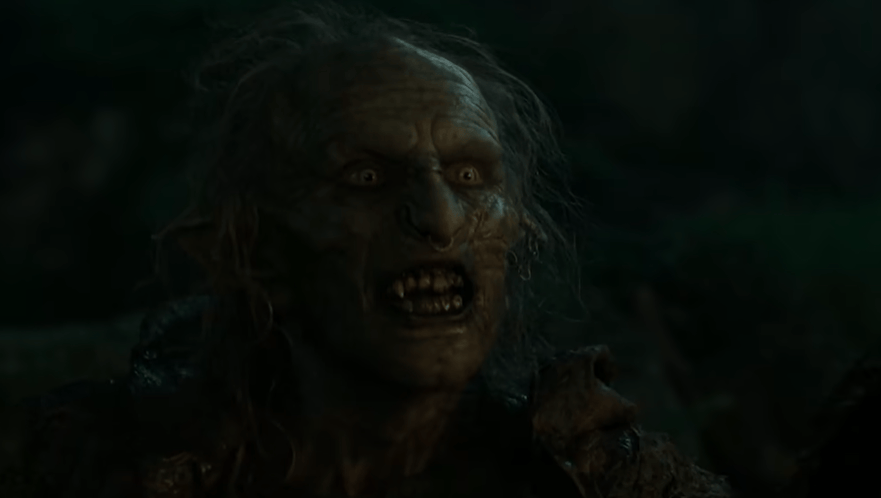
- Marnûkh mentions the Lord-Father, Adar. Good. I like where this is going. One of the good plot threads in the show. It’s original.
- What I don’t love is this whole plot (which will likely span multiple episodes) that Sauron still trying to figure out how to make a proper Ring of Power. This is a game of reversals. Of opposites. It’s Bizarro World Middle-earth. Where book Galadriel is the most opposed to Sauron of the Elves of Middle-earth, RoP Galadriel has been the most helpful to him. Where book Sauron is the one who brought Ringmaking skills to the Elven-smiths, RoP Sauron relied on Celebrimbor’s secrets.
- Remember: In the books, the One Ring is made before war breaks out, before Sauron comes for the other rings, before Celebrimbor is slain. Sauron only wants his rings at that point. He needs no secrets from the Elven-smiths.
- Marnûkh’s secret Elven-smith who “knows all Celebrimbor’s secrets” who is “the lsat of the Elven-smiths” is sketchy as hell, and a very weak dangling carrot. I hope this aspect is a deception, even though I hope he himself isn’t going to prove false. Maitalle is the name. I am very deliberately not looking this name up. I don’t want this spoiled. But I sure hope this proves to be interesting. I don’t buy that it’s really one of the lackluster backup Elven-smiths that were lurking in the background in season 2. There’s no way some highly knowledgeable smith is for real, because we would have seen her there somehow. This feels like a plot made up between season 2 and 3. Still, fingers crossed that this Maitalle plot is a good one!
- I’m already not a fan of the obvious Frodo/Sam/Gollum dynamic they’re brewing here. So Galadriel (Frodo) and Arondir (Sam) are going to be led by Marnûkh (Gollum) to meet a mysterious SHE. As long as she isn’t lobbing anything our way, why not?
- Oh, only a little while after hearing after Marnûkh mentions “One ring to rule them all,” Galadriel says imperatively to Elrond, “A Master Ring would give Sauron the power to bind all Ring-bearers to his will.” I almost laughed at that. I mean, how does she know that? Why is it just accepted that this is the obvious effect whenever you make rings? Sometimes the characters act and talk like they’ve read The Lord of the Rings first. Or at least watched the movies.
- Okay, back to Mordor!
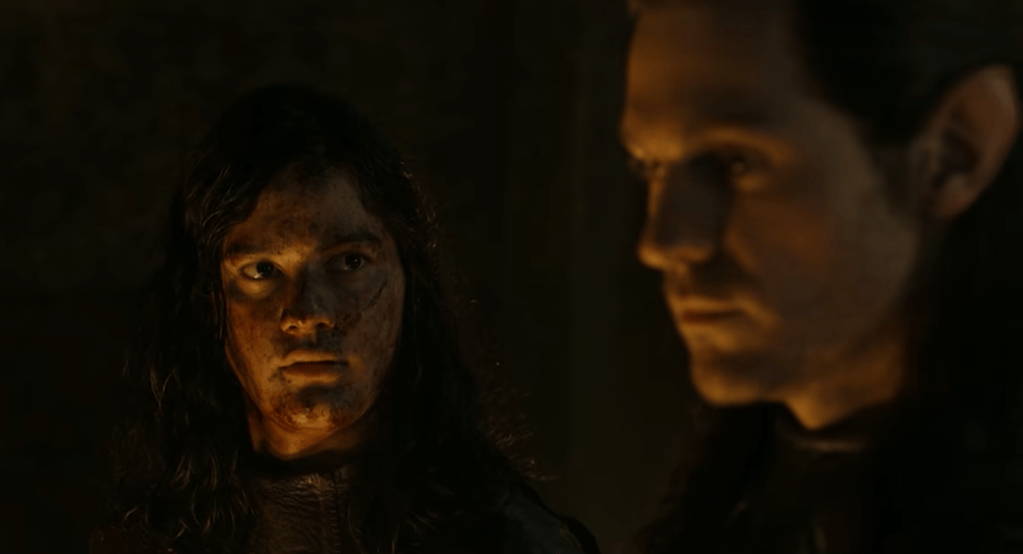
- Sauron having people just do some blood sport while he watches from his throne feels very small. Very petty. As much as I dislike the character decisions the show has made for Galadriel, I think they’re worse for Sauron. Things that should be beneath him . . . just aren’t.
- So, necromancy. On the face of it, I have no trouble with Sauron enacting necromancy! That, at least, is a big part of his past. I’m going to give the show the benefit of the doubt that he’s also doing a hell of a lot of lying here. Not that he can’t summon spirits. But the idea of him actually communicating with a long-dead man is bogus. Unless we later learn that Theo’s father, this Fäldred chap, was somehow already a disembodied spirit in death, and already somehow corrupted or surrendered to the idea of Sauron? I just can’t see it. Sauron was still black goo when Theo’s dad was alive, so . . . I don’t buy it.
- But if he’s just pulling all of this stuff out of his ass to manipulate Theo? No problem with that. I think about Gorlim and Gorlim’s wife from The Silmarillion. Sauron is a master of phantoms. Yes.
- Also, Sauron says that Theo’s dad was of “a Noble House of old, the sworn stewards of Mordor.” The same Mordor which was only just made at end of season 1, while the title card flipped from The Southlands to Mordor? It’s fine if Sauron is just lying, but even Theo should know better. Or, were the writers of season 3 not asked to watch seasons 1 and 2 first?
- Back to the Dwarves. Crap, Thrain is false! Bastard. But I don’t dislike this turn.
- Back to Númenor.
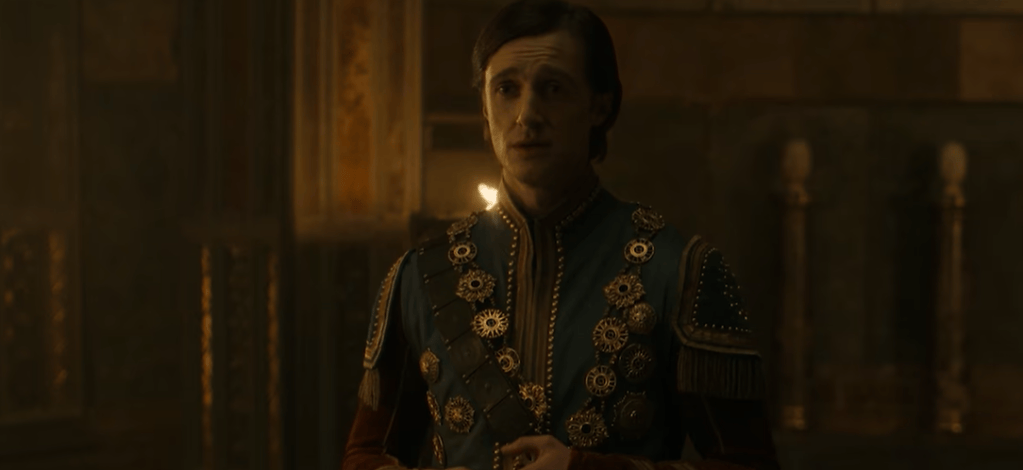
- Watching Isildur and Eärien dealing with court intrigue, and espionage, and skulking around . . . was actually surprisingly enjoyable. But in part it’s because it’s all just so made up for this story and didn’t feel like Tolkien’s anymore, that I kind of just relaxed, unburdened by too many comparisons. Like it was just another story. Which is what I really wish all this way anyway.
- In any case, things go poorly. They did fool me for a little while. Eärien was obviously a double agent but ultimately for which side? And now we know. It’s very sad.
- Edit: (Thaks for reminding me, idlewilderd6cd13699d) The means of Eärien’s end is a bit bothersome. Given her predicament, I expected she would end, but I’d hoped it would be a kind of self-sacrifice, as she’s seen that the King’s Men will torture for information and she’s afraid of giving up the Faithful’s secrets. But . . . the way she goes out is not cool. More to the point, suicide in Tolkien is a rare thing, but not unheard of. It should not be handled lightly.
- In the story of the Children of Húrin, there are two, and both are moments of despair. One involves flinging oneself from a cliff into a swift river.
- In The Lord of the Rings, Denethor succumbs to his despair and ends himself. No noble sacrifice; he’s just trying to escape the doom unfolding around him, and doing it irresponsibly and selfishly.
- In The Silmarillion, Maedhros throws himself and the Silmaril he stole into a fiery chasm. And Elrond’s mother, Elwing, jump from the sea to escape death/capture; not suicide as much as e during her e elise don’t get what they’re after.
- Beyond that, many characters in the legendarium perish knowingly, willfully, because they’re throwing themselves into a fight they know they cannot win. It’s not the same as suicide. To some extent, King Théoden and especially Éowyn believe they’re going to go down fighting. This is not the same as jumping from a ledge. I think the showrunners could have done better by Eärien. And, to be honest, Tolkien.
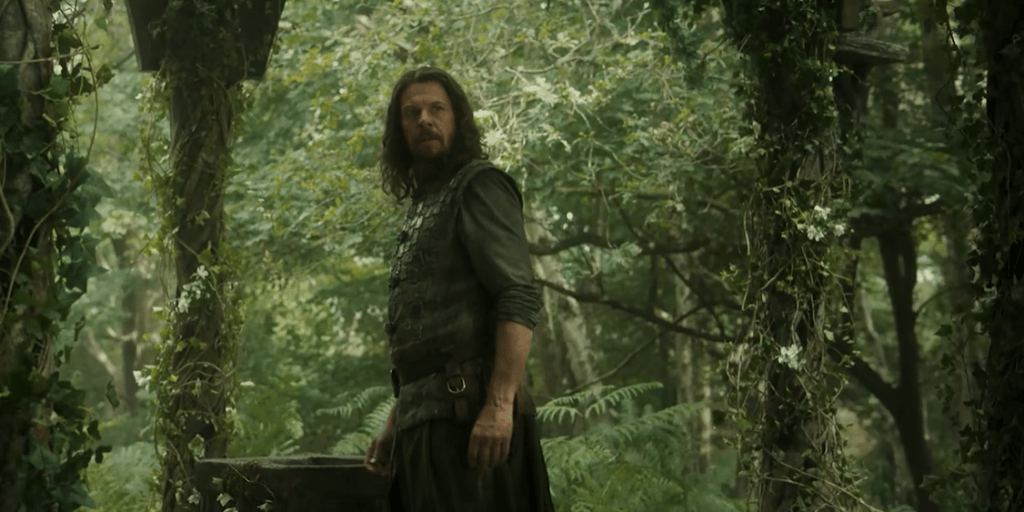
- Well, it was inevitable: Once the palantír (or multiple palantíri) came back into the story, they were going to mess with the way they work. The first one we saw proved to be both a fortune-telling device (forecasting the drowning of Númenor, no big deal) and a flashback provider (showing Pharazôn scenes from the previous season, so he could see that Sauron had been there on the island).
- But now? Well, apparently the Seeing Stones also create a dimensional mind palace for Stone-users to meet up and interact with one another, rather than the mind-to-mind conversations described in Tolkien’s texts. I guess we’re meant to assume that Isildur has used these before, when he was much younger, living over with the rest of the family in the west of the island? He says to his dad, “I’ll never get over how real this feels.” Like . . . this was a pretty common thing for him to do back home? Sure, I guess.
I know I sound like a grump all throughout this. I’m genuinely looking forward to the next the episode, even though I’m bracing for it. Whatever mess this show is making, and it is a big mess, a lot of it is super fun. And it’s gorgeous. The first thing I’m wondering: What object will make a reverberant metallic unsheathing sound in the next episode?


4 responses to “RoP : S3 Ep 2: The Gift of Men”
Spot on, as usual, Jeff.
I could be wrong, but I think I’ve heard them refer to Armenelos in the show; that Amazon had negotiated an exception to name the city. I wonder if they labeled it “the capitol” because they didn’t trust the viewer to know where they where.
As for the episode title, it seems to me that Eärien used the phrase in a way not exactly in keeping with how Tolkien intended. She says it as she’s deciding to commit suicide (a mortal sin for a Catholic) to escape betraying the Faithful under torture (presumably). It associates the Gift of Men with despair. That seems anathema to the idea of fighting beyond the expectation of hope. It leaves no room for euchatastrope.
Also, Marnûkh seemed pretty comfortable in the daylight for an orc, but maybe it was just overcast that day.
LikeLike
Totally. I completely forgot in the writing, plus I was running out of time. I’ve since gone up and added a bit of commentary around Eärien’s demise.
And, yeah, I’m going to mention the Marnûkh thing in the next episode, where it’s even more prominent.
LikeLike
This episode may be the single darkest and gratuitously violent piece of visual media made under the Lord of the Rings banner. Some of Jackson’s work was shocking (Saruman’s shishkabob death, and some of the battle scenes in Five Armies), but this show, and this episode in particular, seems to revel in such violence. We have:
Sauron’s petty bloodsports, on which we spend far too much time.
Assassination attempts, and subsequent close-up of the surgery
Torture, followed by a grusome-sounding execution
Hanging of an innocent chambermaid, and the camera lingers on the corpse
Mutilation – this one gets double points, as it’s Sauron forcing Theo to do it
The aforementioned suicide, after which the camera repeatedly zooms in on the dead woman’s face.
As for the rest of the episode…I was going to talk about more geography errors (Gundabad is “right under Sauron’s nose?”) but instead I think I’ll save that until all the episodes are out. For now I’ll say that I don’t trust a word of what Sauron “The Base Master of Treachery” tells Theo until given external evidence. For all we (or Theo) know, all Sauron’s sorcery did was make funny noises which he is “interpreting” in the manner which suits him. I’m not sure what I think about the Witch-king (who thanks to Jeff I will from now on be calling Witchy) being a lame kid who hasn’t done hardly anything; he didn’t even win his ring fight.
Lindon wasn’t in this episode at all; why isn’t high king Gil-Galad playing a bigger role?
I hope we get more Elendil next episode, he is by far my favorite character and Lloyd Owens has done an excellent job portraying him so far.
LikeLike
Interesting point. You’re right, this was a very gruesome episode. I think I didn’t notice because none of the acts of violence are necessarily off the table for Tolkien, but they are usually something we’re not going to stick around and watch. That’s a Song of Fire and Ice thing to do, and it doesn’t sit right here.
Yes! The “under his nose” comment struck me as absurd, too, in that moment, but I forgot to write about it. Later, maybe!
The geography is becoming as fluid as it is in Star Wars.
LikeLike