
9/11 is a day of remembrance for many Americans. Some strive for solidarity and unity—and I wish that’s all it would be—but many people just make it just another opportunity to spew their bigotry and their contempt for people who aren’t like them. They target the wrong people while supporting someone far worse than those they’re demonizing.
I find myself wanting to rant about that last group of people, but not yet. I actually want to take the opportunity to actually remember some stuff first. Some of the happiest times of my life were baked into a very hard time. I know from reading and writing about Tolkien that joy can eventually spring from sorrow.
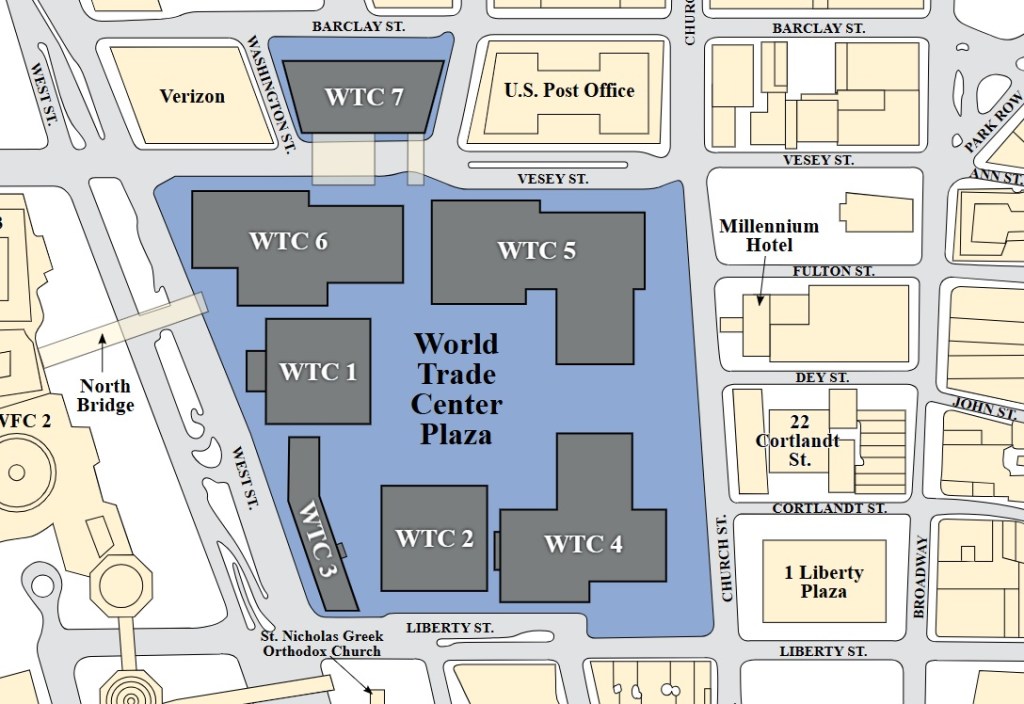
I met my future wife at Borders Books and Music in the World Trade Center. This was, of course, a few years before online book sales (and Borders’ own poor executive management) brought the chain down. It was a good retail job to have, and I ended up eventually getting assigned to the Science Fiction section on the ground floor (meaning I kept it in order, restocked it, that sort of thing). I was shelving there, in fact, when the first plane hit the North Tower (WTC 1), and I heard, felt, the massive boom.

I’ll admit, it was cool working in such a famous location. Especially as I look back now all these years later. Marisa and I took full advantage of the spectacle of the place, the bustle and activity of Lower Manhattan. The sheer fame of that location. We were working in retail, so we weren’t earning very much money, but we were surviving and this was an iconic location in one of the world’s most iconic cities. I commuted from Brooklyn, Marisa commuted from the Bronx.
Interestingly: There were three Borders locations in Manhattan in those days. Back when I was at Borders in Novi, Michigan, and was still seeking the transfer to New York (where my brother lived), I remember looking at the three named locations in the Borders brochure of other locations. I didn’t really know the difference between Park Avenue, Kip’s Bay, or the World Trade Center . . . but I at least knew what the World Trade Center was by name alone. What a difference it might have been had I chosen one of the others ones. But I didn’t. I picked that one out of name recognition and the fact that it looked closer to where I’d be living.
And, well, that Borders is where I got to meet a bunch of touring authors and musicians. Some I’d make a point to meet, like Bruce Campbell or Máire Brennan. Others I just sort of observed but didn’t speak with, like Orson Scott Card or Ray Bradbury. I was shyer in those days. But not so much that I didn’t make some friends, especially the very talkative Marisa (who shelved the Religion section).
The World Trade Center is a complex of buildings. The North and South Towers were buildings 1 and 2. Borders Books was in 5 WTC. Between them all was the plaza. For us, it was a common hangout, a place to sit and eat lunch (from nearby restaurants or food trucks), where we could looking at that weird but cool giant [Koenig] Sphere sculpture in the central fountain. And talk and goof off. I even remembering one lunch hour, when we sat and listened to the Brian Regan Live CD using my discman and one of those splitters so we could each plug in with headphones. We were cracking up nonstop. There were some free music festivals held in that plaza, too. I saw Phillip Glass there.

Marisa became my best friend fast in those days, then one day she was my girlfriend. I won’t say life was simple for us, but we were young enough to still be figuring out the world, and what we wanted to try to do. It was always hard to plan far ahead. Hell, it still is. I don’t have many photos from that time, but this is one of them:

On September 9, 2001, Marisa and I got to attend a special event because our manager gave us tickets to it: a preview of The Lord of the Rings: The Fellowship of the Ring at the Walter Reade Theater at Lincoln Center. It wasn’t a full screening of the movie (I believe they were still putting it together!), but they did show behind-the-scenes footage and the not-quite-completed version of the Balin’s tomb sequence and the cave troll! Super exciting. Some producers and WETA folks were there to talk about it.
Additionally, Elijah Wood, Sean Bean, and the not-yet-famous Orlando Bloom were also there to talk a little bit about it. Afterwards, in the men’s room, Elijah and Orlando made a “speak friend and enter” joke with each other between a door stall. I got the joke, just laughed, but the film wasn’t out yet so the general public wouldn’t have got it. Only book readers knew about mellon.
But two days later was September 11th. When I heard and felt the BOOM shortly after 8 in the morning as I was standing in the Science Fiction section, I looked out the massive store windows on the ground floor and saw thousands upon thousands of office papers fluttering down from the sky above. My mind rationalized that there must have been some kind of gas explosion somewhere above, or some horrible construction accident. It wasn’t clear for quite a long time that this was an act of terrorism. But still, that sound was deep and thrumming, and it sent a disturbing vibration through everything. It was a primal feeling. For a few years after that, I was rather jumpy at any deep sound.
Everyone exited the store with relative calm but undeniable anxiety. There was no time to go back to the break room lockers and get my stuff. No one got their stuff, really. We all just left. The managers and other employees made sure to get the customers out. They did a good job. We were being told to go and get out. I stayed at the bottom of the stairs there on the ground floor (the store had three levels, ground level, second level, and a basement level). I wouldn’t leave until I saw Marisa was leaving, too. I saw people coming down from upstairs, but I needed to make sure she was one of them. Once she did come down, we exited together and walked together swiftly away, with plenty of people alongside us. Southeast, toward Broadway.
Understand, this wasn’t an all-out sprint away. The larger danger that was to come was not apparent. The idea was to just get some distance, and when we were able, we looked up and behind us. No more than a block away somewhere around Fulton St. and Broadway.
Now we could see the hideous black smoke and gaping wounds in the North Tower. Yet there was still no clear indication this was an act of terrorism. We did hear someone say they’d seen a plane, but that sounded far-fetched. The mind rationalizes. Mine did, anyway. Obviously some kind of accidental collision.
But every minute that went by felt more dangerous, was more dangerous. We were absolutely clueless about what really happened. At home, people watching TV were at least getting proper reports and more educated speculations, not to mention footage from afar. People generally knew a passenger plane had hit the building, but we on the ground near the towers had no real idea.
The sickening feeling you can get whenever you look for too long at any footage of the black, smoke-spewing holes in the towers was definitely present. I didn’t know that the explosion was a deliberate act of mass murder, but whenever I looked up at the tower, I immediately imagined the hellscape it had to be for anyone who wasn’t already dead. I knew nothing about people jumping yet; I didn’t see them. I didn’t stand and watch closely.
Once the South Tower was struck, which was louder and which no one missed, all the people on the street around us started crying and screaming—some now shouting that they’d seen a plane hit it. Now it was far more apparent this was an act of malice and intent. This is when it went from horrifying to scary.
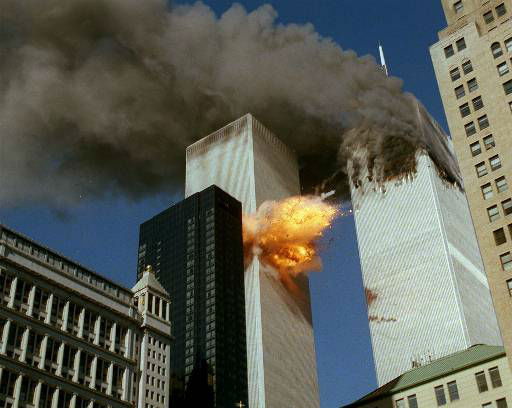
Not my photo. I had almost nothing on me except whatever I happened to have in my pocket. My Borders badge and lanyard, probably. Down in the streets near ground zero, and probably throughout most of Manhattan, no one’s cell phones were working. The networks were overwhelmed or somehow wiped out. We actually waiting in line at phone booths—a phone both! they existed!—somewhere near Fulton and Broadway to try to make contact with family. I left a voicemail for my brother. Marisa left one for her mom.
But then the second plane hit. That kicked things into a new gear, and we got moving again, away, and so did everyone around us.
Evil is real. It’s not just a hyperbolic term, not just a movie or book concept. We started to hear people saying things around us. Theories, speculations, maybe some facts sprinkled in. Something about the Pentagon. Suddenly the whole event was scaling up. It was coordinated maybe! What else would happen? People were fleeing toward the bridges, like wanting to escape the whole island city. But I kept thinking: What if all the bridges out of Manhattan were rigged to explode? What if once they were full of people, they’d collapse? Had I seen too many movies to be imagining this? Yes and no, I guess.
Evil. But then Marisa and I saw the humanitarian counterpoint. People were helping each other. It was not “every man for himself” in Manhattan. People who would either ignore or curse each other out on a normal Tuesday were openly weeping and holding each other. Helping one another along. Strangers were picking up people who were sitting on the ground. Honestly, so much of that part is a blur to me now. I think Marisa remembers more of that than I do. I know there were shop owners running out trying to give things to people, to help them. Shoes and clothing. She remembers shop owners giving more sensible footwear to women who had only heels on. This was still before the towers actually came down, but there was still dust and smoke about and people. Not nearly as much as there was going to be.
I remember some vivid scenes in my head as we turned north and walked uptown to where Marisa’s brother had an apartment. That became our only plan: Not to try to leave the city but get to a safer place within it. I remember passing a young businessman walking toward the World Trade Center on the phone (probably trying to get through to someone in vain) absolutely bawling. But as we all know—and should be remembering as much as the victims—tons of people ran toward danger simply to help, and many of them didn’t survive. I’m glad there are so many memorials out there. I’ve encountered some in places far from NYC.
We were almost at Greenwich Village, many blocks away, when the first tower came down. We turned and saw it. I remember having this stupid thought (that I probably was saying out loud), trying to rationalize what I was seeing. I thought, maybe they (the authorities? who is “they”?) were doing something to deliberately make the building fall straight down so that it couldn’t possibly fall sideways and do more damage. But that’s stupid. That makes no sense. There’s no way all the people in the towers were evacuated before the collapse.
Marisa and I ended our day at her brother’s apartment in midtown. We finally got to a TV and saw what everyone else had been seeing. More and more of the truth was coming out. In the end, our building, 5 WTC, was severely damaged but never actually fell on its own. And I’m pretty sure everyone in that building survived. In fact, 5 WTC was later used as a staging area for police and rescue operations. But many of the people from the building, many of our own coworkers, stayed way too close to the towers to watch. I know some of them so more horrific things than we did. Such as the jumpers.

I believe in both good and evil, today, as I did back then, but age and experience has given me a lot more context. But I still believe both forces were at work on 9/11 in the things we saw. The best really came out of New Yorkers. Well, some; most. That’s not an exaggeration when you hear locals talk about it. God was there, reacting to the evils his own children inflicted one another.
But in the years since, the worst has also come out of people. As a species, we haven’t really learned the lessons that we should have. Since about 2015, things have gotten so much worse, spiritually, here in New York and everywhere. It’s discouraging. Even today, listening to some of the speeches on TV, I’m reminded of the rot that’s weakening American society.
So I’m going to pivot. This will seem like a non sequitur to some, but not to me.
I see truths play out in fiction all the time. So I want to bring up two movie moments that I think about whenever I’m reminded of the sickening and slavish devotion so many people still have for real-life criminals in high places. Criminals who who don’t give a damn about Americans on the whole but do give a damn about their own status, wealth, and pride, and would just as soon see another 9/11 take place if they could benefit from it somehow. Criminals who have already used the 25th anniversary of 9/11 to platform their rhetoric. Some of them are the corrupt billionaire variety of criminals, while others are in positions of great political power here in 2026.
The first film is 1997’s Air Force One.

Even the most outrageous action films usually have one or two memorable lines. Anyone who knows this movie thinks probably thinks first of its famous one-liner, “Get off my plane!” When President Harrison Ford shoves terrorist Gary Oldman out the back of the aircraft.
But I think of the quieter moment when the unquestionably evil Korshunov (Oldman) does spout one bit of truth. Speaking to the president’s daughter, who he’s taken hostage, says, “Your father, he has also killed. Is he a bad man?”
The girl answers, “It’s not true.”
“Why? Because he does it in a tuxedo and a telephone call and a smart bomb?”
That’s the only good point Oldman’s character makes, whether it really applies to Ford’s version of the president or not. (I think most of us like the idea of a likeable president who’d beat up bad guys if they had to.)
I do think this applies to many presidents, though, even the not-so-terrible ones. Telephone calls, legislative signatures, and a whole lot of inaction destroys millions of lives in this country (and, frankly, other countries), often slowly. This is especially the case with the worst of presidents, like the one we’ve got now. It’s all far, far worse than just the commander-in-chief ordering bombs dropped (even though that’s true, too). The butterfly effects of his immoral leadership and actual are unfathomable, to say nothing of the continuous laundry list of personal sins. And it’s all the more disheartening because of how many citizens chose him and made it all possible. They’re all complicit.
But, moving on.
The other movie scene I think about is from 2000’s The 6th Day. In many respects, it’s a goofy Schwarzenegger sci-fi film, but it’s actually not half bad and it has a few interesting ideas to put forth. Sure, it steals a little bit from other films in the genre. It takes place in the near future.

There’s one moment that has stayed with me, even when I forget most of the story. The primary antagonist is a guy named Michael Drucker (played by Tony Goldwyn). He’s the ruthless CEO of a cloning corporation called Replacement Technologies with all kinds of unethical and evil plans.
Near the end of the film, Drucker is mortally wounded, so he has his right-hand man “warm up a blank”—which means a clone of Drucker himself will be prepped so he can transfer his mind, consciousness, and memories when its ready. This way he can live on, defeat Arnold Schwarzenegger, and continue his evil work despite his current body’s imminent demise.
But the cloning machinery is damaged by Schwarzenegger and Drucker’s clone wakes up a few minutes too soon—naked, gooey, and physically incomplete. Clone Drucker sees dying Drucker, understands the situation, and casually begins stripping dying Drucker of his clothing since he’s the new Drucker and needs something to wear to get back to business.

“Aren’t you even going to wait . . . until I die?” dying Drucker ask Clone Drucker. He’s genuinely horrified at the cold disregard his clone has for him. They’re the same guy, right?
“Would you?” the clone asks, as if it had been an absurd question.
Dying Drucker is stunned, mentally grappling with the sudden reversal, with being treated so callously by his other self. Now he’s just in the way, like all the people he’s stepped on or had killed. He should just die already.
Drucker’s clone goes on to tell Schwarzenegger in the final showdown, “You have absolutely no reason to kill me; I didn’t do anything to you. It was all him.” He points to the still-dying Drucker whose bleeding out on the floor. There won’t be any transfer of the mind, obviously. The clone’s already got what he needs, and he’s got the same evil mind.

Forget how the film ends (but check it out, maybe?). I barely remember it. But this particular moment is what I recall, where the bad guy experiences what it’s like to be treated the way he’s treated other people. It’s the most realistic part of the film. It never occurred to the wealthy CEO mastermind that he could be on the receiving end of the very evil he injected into the world.
The parallels of this to the real world are obvious to me. This is why I love speculative fiction. It’s never mere entertainment. Not when it’s done right.
Every day, more and more people realize the hard way that their dearest leader has no use for them. But hey, before you starve or die off, cast a vote for him and his puppets, okay? Then die already, you’re in the way.
Is there room for hope? I think there’s some. Years back, when we worked on the Foreshadows cyberpunk anthology, we got artist Talon Dunning to make black and white illustrations for every story in the book. Taken as a whole, the stories depicted a dark near-future version of Earth where life is dystopian but the human characters are still trying to be human and someone, or something, is still pulling for us all.
For one of the short stories, “Geist Threnodic,” I wanted the illustration to depict a Manhattan of the future. But even though this was a dystopian society with rampant, often sinister technology where multinational corporations were running the show, we wanted to find some way to represent the World Trade Center in the New York skyline. I don’t remember the details of the brainstorm anymore, but Talon agreed it was still an important element to observe, “the one constant in an otherwise transient world.”
The result is the header image above. (Thanks for that, Talon.)
This year more than any other anniversary of 9/11, I’ve been listening to more accounts about that day. This time, it’s not always from the survivors or the heroes—though I still want to hear those stories, and still feel humbled by the scads of heroes who were moving toward danger while the rest of us moved away from it. I only just learned about Charles “Chuck” Costello, the elevator engineer who was nowhere near the World Trade Center when the first plane hit, but the moment he heard about it, he ran to the towers and used his expertise to help people out of elevators (knowing the dangers they were in) and went on to saved a bunch of people, but of course never came out himself. Meanwhile he had no duty, only miraculous courage.
But this year I find myself listening to the accounts of people I’d never really listened to: the people who were little kids hearing about the attacks from school in all different places, and the impact it had on them. I may have been young myself at the time, but I wasn’t a kid; I may have been near the place, but I’m still just one of the lucky ones to have survived. It wasn’t a near miss. We had the time. Again, we were fortune. Roll the bones.
But I am increasingly humbled by the stories and legacies that endure, and now I’m newly interested in hearing the stories of strangers and friends who had different experiences than mine but are still deeply impacted. It’s been interesting telling my son about it. 9/11 was old news when he was born in 2014. Almost as far back in time in his life as the escalations Vietnam or maybe JFK’s assassination might have been for me to hear about.
But also, I got to get married and have a son. There were so people in, around, and after 9/11 who didn’t get to go on living or even say goodbyes. Most of them I didn’t know. Some of them were customers at Borders Books, and I had interacted with them plenty of times as a bookseller. I am still humbled, and sad, and it doesn’t take much to bring back a wave of memories and sorrow. Which is fine. I never want to be numb about this stuff.
To end this long very long post on a melancholic but wistful musical note, I would encourage anyone who hasn’t heard U2’s “The Hands That Built America” to have a listen, and in particular the final stanza.
It’s early fall
There’s a cloud on the New York skyline
Innocence dragged across a yellow line
These are the hands that built America

