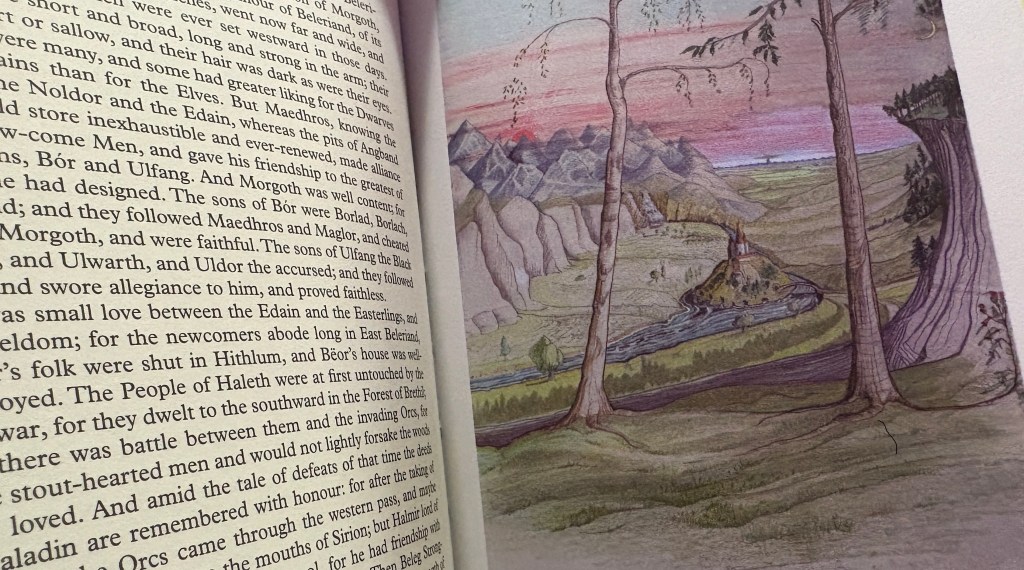
J.R.R. Tolkien was a master of restraint. Don’t believe me?
Oh, sure, the running internet-meme joke is that he describes every tree, but that’s precisely what he doesn’t do. Does that mean he doesn’t go on and on about the textures of the land? Oh, sure, he does do that sometimes but he does it with purpose.
So, these are the memes we’re used to. . . .

But I’ll stand by this: Tolkien holds back during some pivotal moments. I know that sounds weird to say. The Lord of the Rings is nearly 500k words long. Hell, The Silmarillion is about 130k. Unfinished Tales is about 190k. And the total wordcount of the 12-volume History of Middle-earth series (which features most of Tolkien’s drafts and essays and early versions, plus Christopher’s annotations)? It’s like 2 million words or something. No one’s saying Tolkien is short on words.
What I am saying is that, more often than not, he holds back and says only just enough to tell the story and allow us, the readers, to imagine what he isn’t describing—a process which makes us sink deeper into his world. I’ve said before that part of what makes The Silmarillion so evocative is how many gaps it has.
There are many examples of this—like how sparse a description we’re given of the Balrog! He gives us so little that it’s inspired all kinds of interpretations and even arguments about whether they have wings or not. (I mean, they don’t, but there’s also no harm in imagining ineffectual wings.) In Exploring the Lord of the Rings podcast/class, Corey Olsen walked through it and pointed out the few physical features we can even confirm it has: mane, hand, shadow “like two vast wings,” nostrils, and feet. We know it’s a “dark form, of man-shape maybe, yet greater,” and that’s about all we get. Can you imagine any author in 2026 describing a boss monster so sparsely?
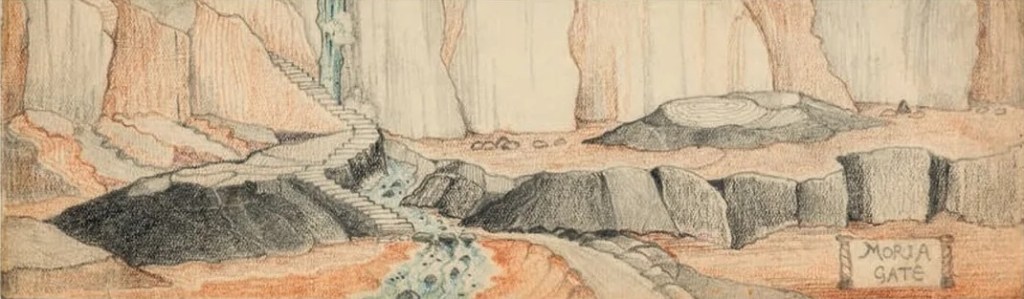
But today I’ll just pick this one brilliant passage. The company has just fled out the East Gate of Moria.
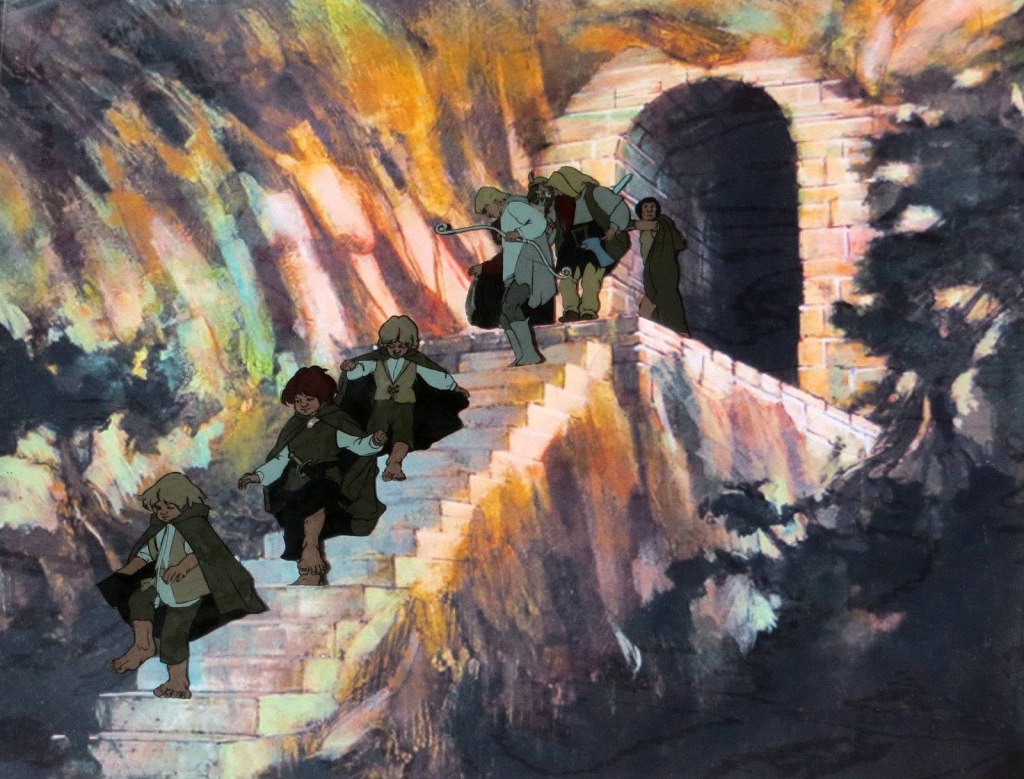
Gandalf has only just fallen into the abyss that lies below the bridge of Khazad-dûm, and the company, now led by Aragorn, has made it out into the sunlit world. The orcs aren’t pursuing yet only because of it’s daylight.
They looked back. Dark yawned the archway of the Gates under the mountain-shadow. Faint and far beneath the earth rolled the slow drum-beats: doom. A thin black smoke trailed out. Nothing else was to be seen; the dale all around was empty. Doom. Grief at last wholly overcame them, and they wept long: some standing and silent, some cast upon the ground. Doom, doom. The drum-beats faded.
See that? We get only a single sentence about the members of the Fellowship weeping over the loss of their leader and friend. Tolkien says “them” and “they,” referring to the whole group without specifying individuals. That’s all eight. He gives us no further details, no insight on how they are mourning. He is letting us decide the particulars, which is genius writing. It’s a restraint I wish I had myself. It’s a restraint writers do not today have.
If The Lord of the Rings was miraculously written today, with the same basic story and plot elements but written by anyone else, we would know who in the group was crying, how much, where they were standing relative to the others, and on what sort of ground. If it was YA? Forget about it; we’d get every emote and gesture. We’d even get the characters’ reactions to the other characters’ reactions.
What about the Peter Jackson’s movie? Well, unlike the book, it had to portray the scene visually so it made some choices. Good ones, too. The whole sequence, beginning with the moment we see the company exiting the East Gate and ending when Aragorn prompts them all to get up and move is approximately one minute long.
These are the choices the film makes (and in this order):
- Sam sitting down, crying.
- Gimli, absolutely beside himself, more in a state of denial and outrage. He’s held back back so he doesn’t go charging back into Moria to kill more orcs in vengeance (and get himself killed). For all the people who think Jackson only made Gimli a joke character, I disagree.
- Boromir, doing the holding back, and looking deeply dismayed.
- Merry and Pippin, both on the ground, crying hard.
- Legolas, confused, as if grappling with the loss. In some ways he seems the most hurt, because he (like Aragorn) probably has a good sense of how much Middle-earth has just been hurt by Gandalf’s fall. And he probably also hasn’t seen many people die.
- Sam again. Pure emotion. He’s most of us, the viewer, and the heart of the company.
- Aragorn, the most grim, but determined to keep things moving. He’s in full responsibility mode. He seeks Legolas’s help in getting them all back on their feet because they’re all still in danger. Legolas is the next likely to see the big picture here; it’s a good choice, but Aragorn has misread the Elf. Legolas himself is still processing; he only slowly starts to move.
- Boromir requesting, almost demanding, that Aragorn give them all a few more moments’ peace “for pity’s sake.” How smart was this move to let Boromir show the humanity we all know is in him (which, honestly, plays right into why he later goes for the Ring)? Very, is how.
- Finally, we get Frodo’s lingering reaction. He’s still on his feet but he’s crying, too, slowly. Of course: this whole quest began with just him and Gandalf at Bag End. He’s going to be hurting the most right now.
But that’s just one version of this scene. It’s so good that I know a lot of us probably have a hard time now imagining the moment any other way. But since the books were published in the mid-1950s, millions upon millions of readers have had their own private book adaptations running through their heads. Each of us envisions it at least a little differently from everyone else’s based on our own expectations, life experiences, and even personal biases. And that’s the brilliance of this.
So, again:
Grief at last wholly overcame them, and they wept long: some standing and silent, some cast upon the ground.
I am sure there are some men who read that sentence and probably think only one or two of the company—maybe only hobbits—fall to the ground, crying, and think that the taller, physically stronger folk like Aragorn and Boromir are big tough men who wouldn’t cry. But there are plenty of us who know better—that crying, weeping, and expressing intense emotion over the sudden death of a friend or companion would hit as deep as anyone’s. Gender isn’t even a factor.
There’s no “walk it off” for something like this, not until there is no choice. The closest thing we get to that level of stoicism is probably in Aragorn. He’s the unofficial leader now. He’s responsible, even though no one’s told him he is. He’s a Chieftain of the Dúnedain, Elendil’s heir, and the future returning king; he’s got the leadership skills to know they’ve all got to put some miles between themselves and Moria before it gets dark. The movie never shows us that orcs do in fact give pursuit (it merely implies that they might), but the book sure does. They narrowly escape.
I have nothing profound to add further. I just think this is clever writing. This is a big story and there isn’t really time to dig into those details, but the moment is still an important one, and Tolkien, by omission, invites the reader to decide. What if it’s Aragorn who drops to the ground and weeps before gathering himself up to move on? It certainly would be just as fitting.
In fact, you know who else cries in the book outside of this one moment? A whole bunch of dudes, mostly. Literally, the following people are described as weeping at various points of the story:
- Sméagol (in Gandalf’s description of his origin)
- Sam (when Frodo is grabbed by the Watcher)
- Sam and Frodo (both weeping in the dark right after Gandalf’s fall)
- Gimli (openly when leaving Lothlórien and Galadriel)
- Boromir (upon realizing what he’s done in trying to take the Ring by force)
- Aragorn (when Boromir dies)
- Gimli (or at least saying he weeps to leave the Glittering Caves)
- Gollum (quite a lot)
- Frodo (when the great host of Morgul is headed toward Gondor and he’s afraid that even if he’s successful in his quest )
- Sam (when he thinks Frodo is dead)
- Éowyn (before and shortly after Aragorn’s departure to the Paths of the Dead)
- the people of Minas Tirith (when they think Faramir might be dead)
- the people of Minas Tirith (when they see the heads of their people catapulted into the city)
- Éowyn/Dernhelm (when Théoden goes down)
- Merry (when Théoden is dying)
- Prince Imrahil (when he knelt by Théoden and Éowyn)
- Sam (when the minstrel of Gondor praises Frodo)
- Merry (at the burial of Théoden)
- Nár the Dwarf (at Thrór’s death, in the Appendices)
And don’t even get me started (again) on The Silmarillion and all that Tolkien doesn’t describe.
But now I’m curious. What other parts of The Lord of the Rings, or other books by different authors, have you found sparsely described in a way that has actually made it more memorable to you? What passage actually has engaged you for its lack? It’s a real feat.
 Foreshadowed and Foresung
2 responses to “What Tolkien Doesn’t Say”
Great article, Jeff, and thanks for articulating this so well. Far from finding it excessive, Tolkien’s descriptive writing, particularly in the Shire, always creates just the right mood and frame of mind for me. I, too, find him to be sparse in descriptions more often than not. The battles of the Hornburg and of Pelennor Fields are each only one chapter, for crying out loud! A modern writer would have stretched those out across a quarter of the book.
I find that writers Dashiell Hammett and Raymond Chandler (and Hemmingway, of course) are also very good at saying little and letting the reader’s imagination fill in the blanks. For instance, there’s a lot unsaid in Sam Spade’s words to Brigid O’Shaughnessy: “I’m going to send you over. The chances are you’ll get off with life. That means you’ll be out again in twenty years. You’re an angel. I’ll wait for you. […] If they hang you I’ll always remember you.”
LikeLike
Thank you, again, for writing these wonderful articles as I wholeheartedly agree. I’ll have to get back on examples, though, as there are way too many of them – and the way adaptations are going these days the “gaps” in Tolkien’s stories might be filled with one-option-only attempts that may very well,… well, fail. Let’s enjoy them as long as we can!
LikeLike