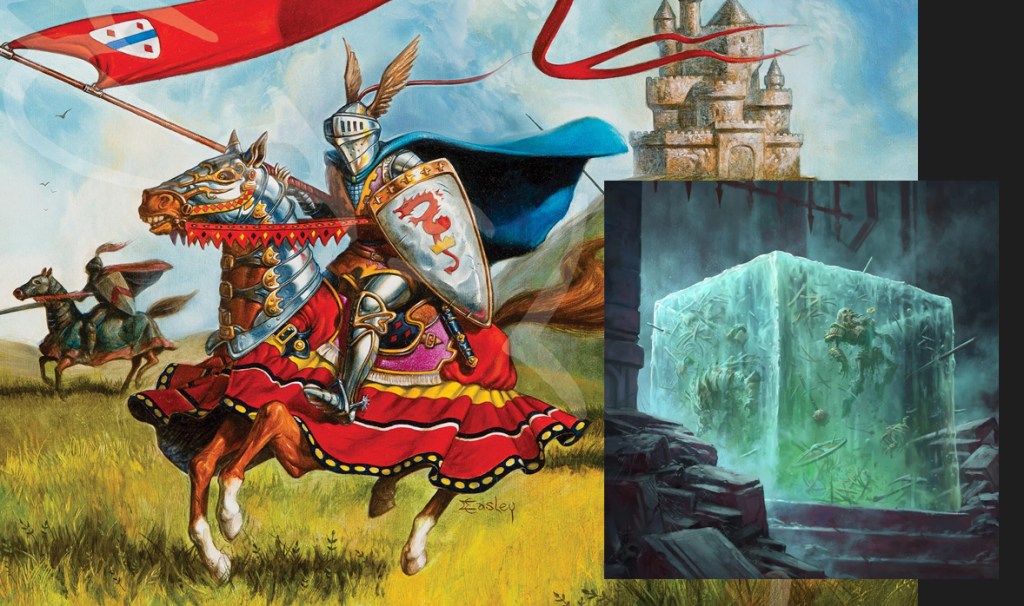
Did you know? If you owned a particular book that came out in 2003 (23 years ago!), you would read that Wizards of the Coast proposed that you could potentially ride a gelatinous cube in your game. No one at the time, that I can recall, protested that WotC had therefore sanitized or spoiled Gary Gygax’s original vision for the gelatinous cube. If you can imagine that.
Ohh, right: This is a post specifically about Dungeons & Dragons and lore adjustments. It might not make much sense to anyone else outside the hobby.
Let me sum up why I’m mentioning gelatinous cubes in this way. (Aside: Gelatinous cubes are 10′ x 10′ cube-shaped nearly transparent oozes that slide through dungeon corridors and dissolve most living flesh and leave only hard substances like bone and metal behind. They’re like “cleaners” for classic dungeons.
I’m bringing up gelatinous cubes as possible mounts because a loud but relatively small bunch of angry gamers are yelling D&D game designer Eric Menge on Twitter. Yes, Twitter, that platform for civil discussion and space for conversation, nuanced disputes. Imagine that!
Why are people throwing a fit at him? Because Eric had some NPCs rename their inn within the alternate storyline of an adventure he wrote for the Legends of Greyhawk (organized play campaign). To be clear, his adventure is not an official new Greyhawk campaign book; it’s a convention-play, non-canon adventure called “A Village Called Hommlet.” It’s not a replacement or official reboot of the original very iconic adventure module The Village of Hommlet (1979) or its sequel, The Temple of Elemental Evil (1985). It’s an alternate take on the original that presents essentially the same stage setting but goes a different direction with the adventure itself.

Right, so some oldschool D&D fans are upset about this. You can look at Twitter and find the outrage pretty quickly if you search for the relevant key words: “greyhawk” or “welcome wench” or “paladin prince,” for example. These people assert that Eric has defaced the original module, besmirched Gary Gygax’s name, or “distorted” his vision (just to name a few nicer-worded complaints). They’ve found a very insignificant molehill and are busy trying to cast the Enlarge spell upon it repeatedly to try to make a mountain out of it.
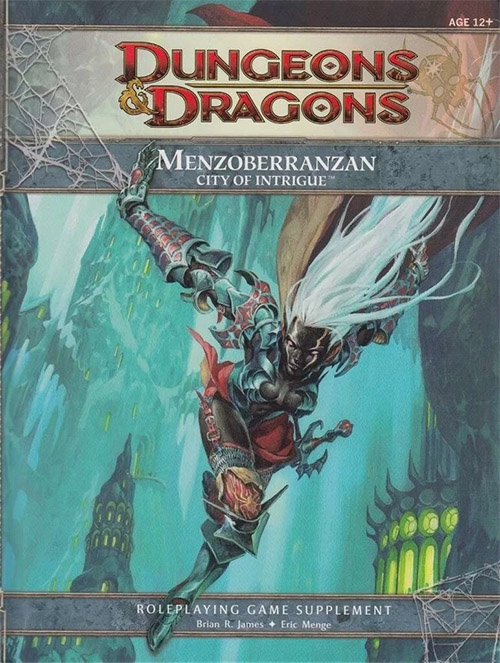
Eric Menge is a pretty cool guy. He’s a freelance game designer with way more RPG credits to his name than I’ve got, and he’s been involved with Greyhawk since, what, 2001? (Living Greyhawk was the name of 3rd Edition’s incarnation of Greyhawk’s campaign play.) Not to mention a ton of Forgotten Realms works, like this 4th Edition one he coauthored with Realms loremaster Brian R. James.
Eric might not say it, but I will: He’s clearly far more knowledgeable and passionate about Greyhawk (or the Realms) than any of the objectors at this juncture. While they pretend to care or be deeply outraged on principle, he just gets on the business with being creative and encouraging folks to engage in the setting one way or another. Not just to make a buck and move on, either; Eric’s been gaming in the Realms and in Greyhawk for ages, on his own and in some products. Believe me, I’ve worked with freelancers and authors who only briefly dipped their feet into lore for a gig and then moved on, and I’ve worked with freelancers and authors truly invested in the lore and gameplay. For me, both for Eberron and for the Forgtten Realms.
So what’s the outrage all about?
In the original Greyhawk modules referenced above, as written by D&D’s co-creator Gary Gygax, there’s an inn called the Inn of the Welcome Wench where the PCs (player characters) can go. Even back then, the inn’s name wasn’t a big deal; it’s just a name, then as now. Now, in Eric’s non-canon adventure, which begins in the place at the same location and effectively in a parallel timeline, the inn has been renamed by the owners to Inn of the Paladin Prince, in honor of Prince Thrommel, a local hero who once led forces against the Temple of Elemental Evil.
Okay, why did he have it renamed for this adventure specifically? Because this is tournament play. He explains it like this.
But also, Eric says, the change was for story reasons: to “center” the NPC character of Thrommel because that’s relevant to this adventure. Convention adventures are stand-alones. One-shots. Meant to be played for just a few hours, not as part of a campaign. Sometimes parent gamers get their kids involved.
I can understand both reasonings. I don’t know if I would think to make a change like this myself. But this is, again, a variant adventure and not some reboot of all Greyhawk. I can’t stress that enough. He’s not lobbying for some official retroactive change in the setting to be applied to everyone’s home campaigns.
Now, here’s the thing. I’m also a fan of oldschool D&D (I have the original World of Greyhawk Fantasy Game Setting books, and I love them to death).
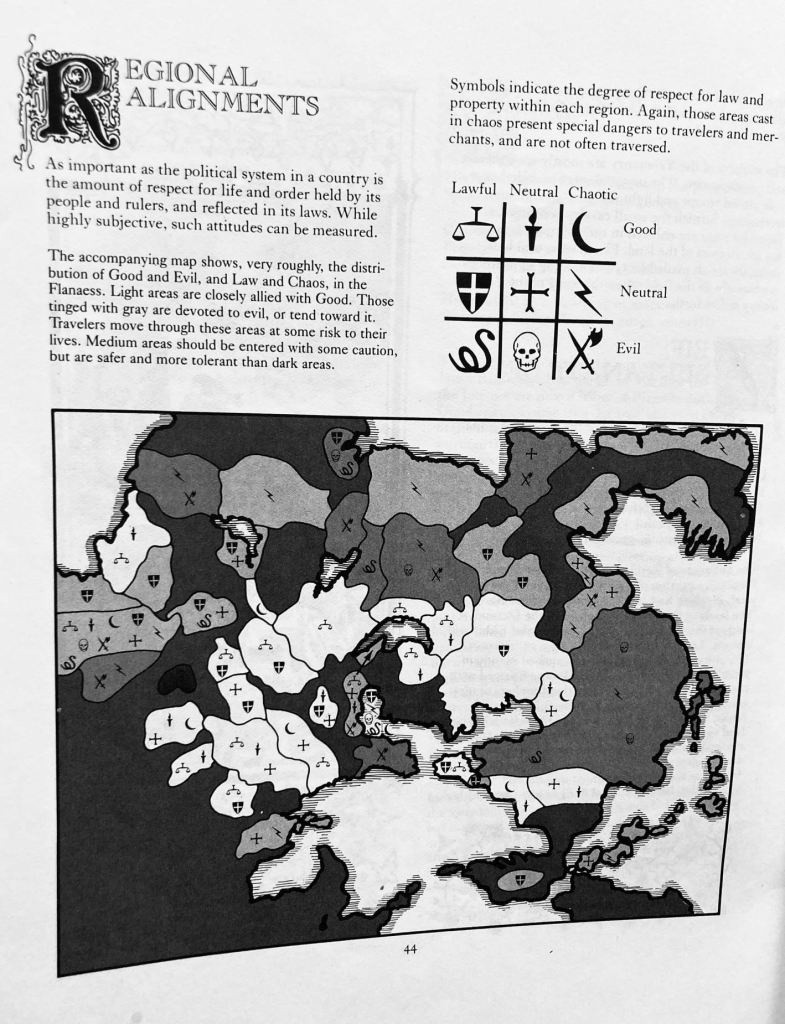
I personally love oldschool alignment in D&D. Look at this crazy map.
. . . and I’m also not particularly fond of arbitrary setting changes just for the sake of changing them or of a new writer trying to “improve” or reclaim the original. But I don’t think Eric is doing that with his convention-play adjustment.
I, too, can get grumpy about lore changes that Wizards of the Coast makes to its own settings. They’ve done it over and over again—from the nature and origin of certain creatures, races, gods, and even whole cosmologies, to the fundamentals of long-established campaign settings. And every time they do that, they piss of some existing fans and yet manage to rope in some new ones anyway. I don’t know the statistics. And God knows, I’m not a big fan of much of WotC’s D&D output since, say, 2020.
Here’s a solid example: I am not a fan of what Wizards of the Coast did with the 5th Edition incarnation of Ravenloft. (Ravenloft as a horror campaign setting was introduced in a boxed set in1990, during 2nd Edition, but it was itself a spin-off and expansion of the original 1st Edition standalone Ravenloft adventure by Laura and Tracy Hickman.) I loved nearly everything made for Ravenloft all the way up through 3rd Edition (and in 3E it was stewarded and expanded wonderfully by White Wolf). But everything since? WotC didn’t really know what to do with Ravenloft during 4E.
This should be a rant for another time, maybe, but it boils down to the fact that the new incarnation of Ravenloft is not just a continuance or even evolution of the original (that might have been okay), not even some kind of respectful homage to the original. It was a hard reoobt, a sweeping away of most of the original setting lore while keeping the brand name, and it did so with a considerable amount of contempt for the original (especially in the marketing and the way it was promoted). Much of the newer campaign lore was clearly written by freelancers largely unfamiliar with Ravenloft. And in the end it’s just a whole lot thinner (and, sure, had a few original and interesting ideas as well).
Eric Menge, meanwhile, is massively familiar with and passionate about the original lore of Greyhawk. The simple name change for the village inn (which was made without any haughty virtue signaling or judgement levied on the past)? It’s a silly thing to be upset about. The “iconic” Inn of the Welcome Wench (which was not deeply fleshed out in the original adventure anyway) has been . . . what? Stomped on? Twisted? Nah.
Nor is it sanitized, because it wasn’t soiled to begin with. Eric’s adventure redirects the “wait, what is meant by wench” curiosity for newbies who don’t that cutting into the very short convention-play window. Plus, again, Eric’s “A Village Called Hommlet” adventure actually acknowledges that the inn did bear that name previously, and he stated that NPCs would recognize that name if asked, but that the family that owns renamed it in this storyline for this particular series of events. I find it curious that there’s no outcry that the adventure itself takes different turns (and challenges and monsters) than the original? Why not? Somehow it’s just the name of one location in the village that’s so bothersome. “I want the word ‘wench’ back!” seems to be the tenor of these complaints. Not that a change was made.
Is renaming the Inn of the Welcome Wench to Inn of the Paladin Prince as egregious as renaming more famous D&D inns? I guess it depends. I wouldn’t be happy seeing some official Realms book asserting that Durnan the Wanderer’s inn was always called the Gaping Crevasse (instead of the famous Yawning Portal)—but I’d give it a chance if a new adventure merely proposes that some new villain had Durnan kidnapped and then renamed his Underdark-accessing inn in order to rebrand it, and the adventure’s focus was on that new villain’s scheme. Or, what if Dragonlance’s the Inn of the Last Home were altered? Okay, but why? Maybe Otik or his descendants had a reason? Let’s hear it. Maybe it’s interesting.
So what’s this about gelatinous cubes?
In 2003, Wizards of the Coast put out a book titled The Arms and Equipment Guide, a 3rd Edition publication no doubt inspired by the 1991 book of the same name in the 2nd Edition. It’s a book full of optional addition rules for the game with a focus on weapons, armor, gear, and magic items a DM could place in their game if they want. The operative word for this book—like most D&D books beyond the core Players Handbook, Dungeon Masters Guide, and Monster Manual—is ‘optional.’
Just as one example: One optional item in the book is the Amulet of Ooze Riding: a magical item designed to make its wearer a cube rider! The amulet bestows upon its wearer protection from the g-cube’s acid in the form of an encapsulating “force sphere” (think bubble) that the wearer is placed inside, and then said sphere can be “nudged” into the body of the cube-shaped ooze monster and it becomes a kind of “saddle.” Well, you can read about it if you want.
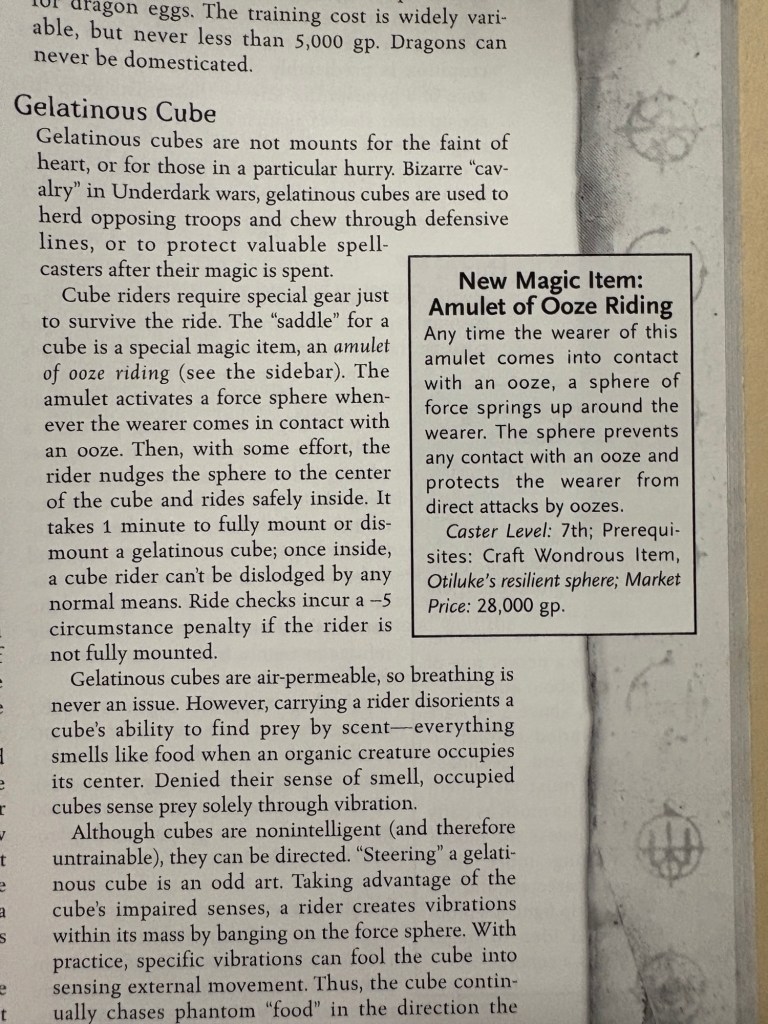
It’s ridiculous and fun. Who doesn’t like gelatinous cubes? PCs could use this, in theory, but so can enemies. Imagine a handful of kobolds or orcs “riding” gelatinous cubes toward you in a hilariously slow but still inexorable charge?
But now here’s an honest question. If the internet, especially Twitter, was as pervasive in 2003 as it is now, do you think there be a big outcry among fans over this (and other things) found in The Arms and Equipment Guide? Gelatinous cubes were originally invented by Gary Gygax, I’m pretty sure, for a Greyhawk supplement. Was 2003’s Amulet of Ooze Riding distorting his original vision of a monster that’s meant to be an obstacle in graphic-paper-based dungeons? You’re supposed to fight them, not ride them! Pish posh! Dogs and cats living together! Mass hysteria!
Or is it fine, and harmless, because nothing you do with a gelatinous cube is a threat from a gamebook taking away a gamer’s idea of a wench?
One can be pedantic about the word “wench” if they want to (and I can see that Eric is happy to indulge in the etymology with folks, but the fact is, the word is not a big focus in either the original module or alternate adventure. It’s a word with many definitions that, like all words, means different things in different times. That the more archaic definition of the word is clearly the more popular definition at hand (especially among a certain subset of gamers) is the reason Eric steered away from it in his family-friendly iteration. Outraged gamers are grasping at straws so they can be angry because, I guess, it was a slow news day when they discovered it.
An in any case, I don’t think Eric is being prudish. Here’s a Tweet from five years ago where he’s talking about playing the original module for his own group. No shying away from the inn’s name here; he wasn’t make a convention-play alternative adventure then, just playing the danged game.
I really could go on, but this post is already long enough. The truth is, there’s been so much arguing about D&D lore over the years and I, too, as a long-invested fan, also have my strong opinions about some of them. But . . . pick your battles, you know? This one is tiny, and harms no one.
Anyone want to talk about Ravenloft? Or what’s become of orcs in D&D? Or even drow. Those are bigger topics, in my mind. But I keep wondering if these same angry gamers would also lose their minds if they cracked open the 3rd Edition book Savage Species (also from 2003) and discovered that WotC game designers were suggesting you could play as a medusa, or a naga. There were rules of ways you can be a centaur or minotaur before it was cool, or a grimlock, gnoll, kuo-toa, sahuagin, or skum, and so on!
Seriously, check out these “arms of the naga”:
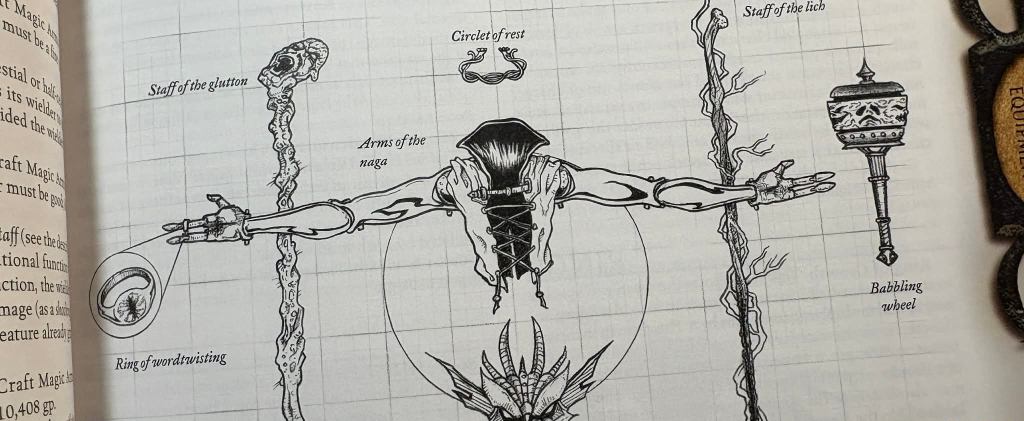
What party of adventurers expecting to face an everyday armless naga wouldn’t be freaked out when the naga starts making rude gestures with artificial hands or, you know, starts brandishing wands at them?!
But why stop there? 2002’s Masters of the Wild offered the idea of magic weapons that could be imbued with the “opposable” enchantment, which would allow creatures lacking opposable thumbs to suddenly wield a traditional weapon normally denied them. How can that go wrong?
Oh, crap . . . did that owlbear just pick up a bow?!
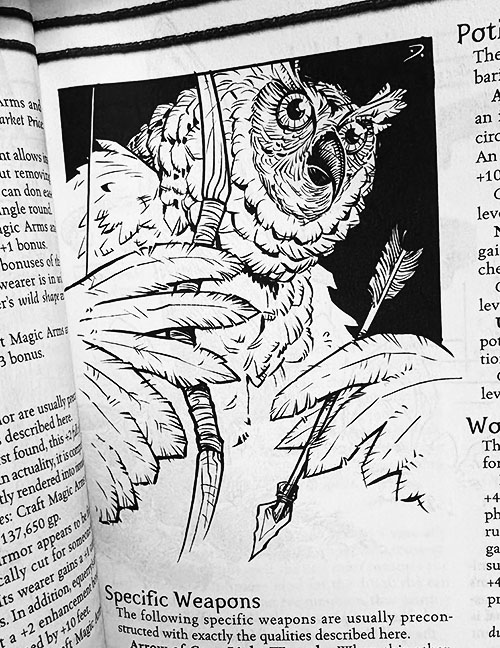
Gods of the Flanaess help us all.
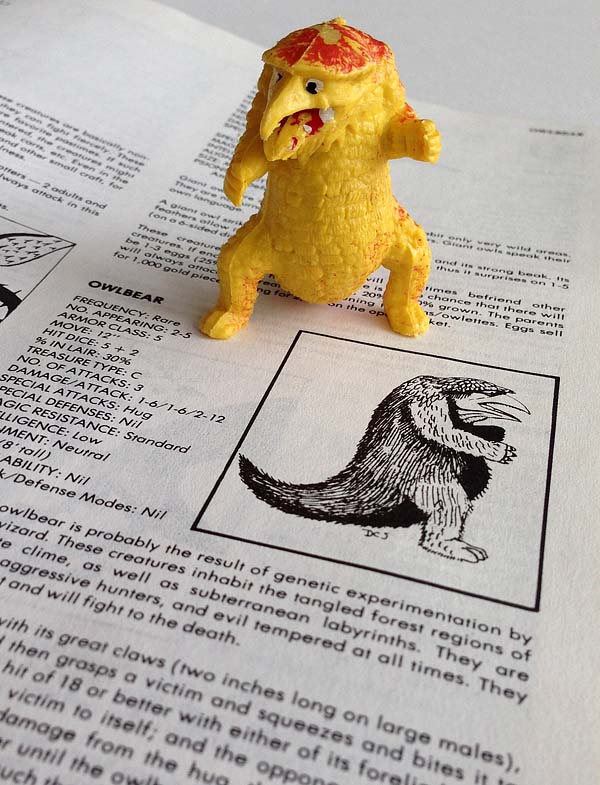
But wait—! Surely that is a spit in the face of Gary Gygax’s original vision for the owlbear.
 Foreshadowed and Foresung