Here’s another installment about some of the things I learned about Tolkien and The Silmarillion by writing a book about it. This one is about how the vast spans of time in The Silmarillion are easy to overlook (and lead to assumptions), and about how no group in Tolkien’s legendarium is truly homogeneous.
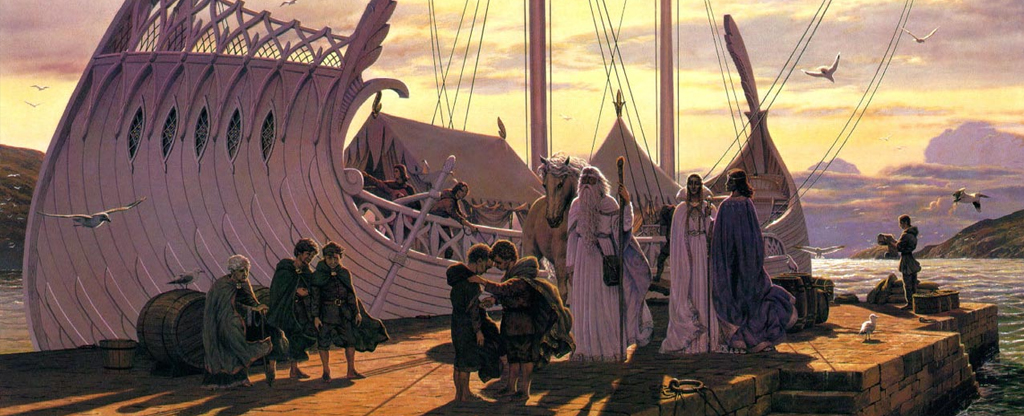
The events of The Lord of the Rings—from the day Bilbo starts planning his eleventy-first birthday party to when he boards a ship at the Grey Havens—encompass only twenty years. Meanwhile, Frodo’s journey from Bag End to Mt. Doom, plus the entirety of the War of the Ring, takes only seven months. These are eyeblinks compared to the events in The Silmarillion.
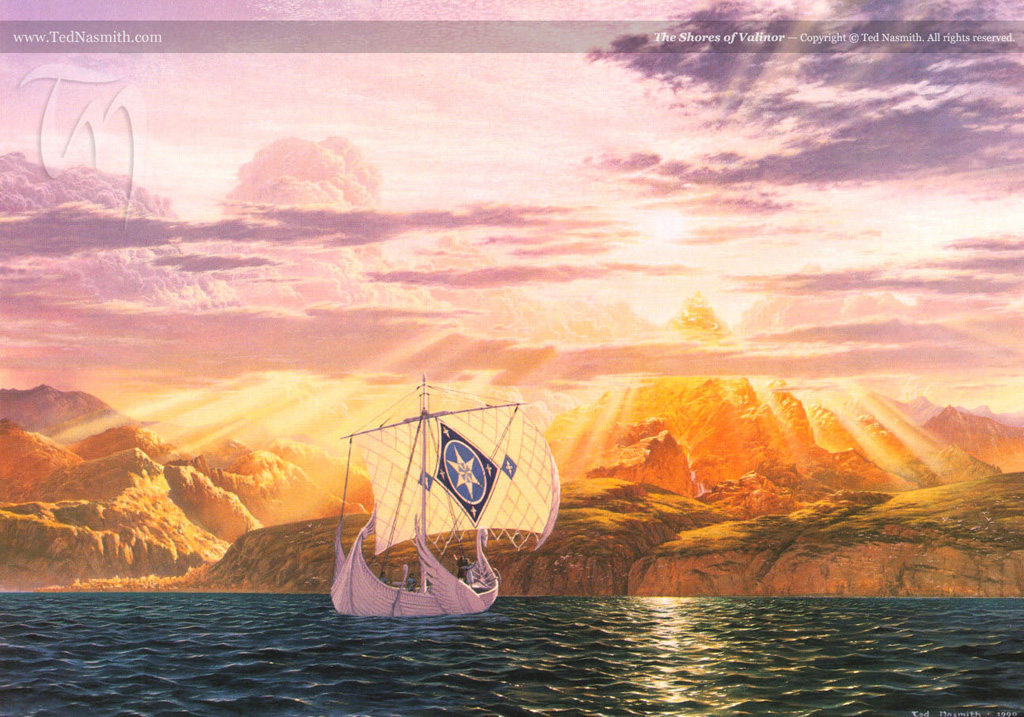
When walking carefully through The Silmarillion—with my goal of clarifying it for new readers—I came to realize something many readers forget. There are good times worth considering, but the stories the narrator provides don’t explore them. Tolkien explains why this is at least two times: In chapter 10 of The Silmarillion itself, the narrator tells us:
But of bliss and glad life there is little to be said, before it ends; as works fair and wonderful, while still they endure for eyes to see, are their own record, and only when they are in peril or broken for ever do they pass into song.
He puts this concept another way in chapter 3 of The Hobbit:
Now it is a strange thing, but things that are good to have and days that are good to spend are soon told about, and not much to listen to; while things that are uncomfortable, palpitating, and even gruesome, may make a good tale, and take a deal of telling anyway.
And that explains the events of The Silmarillion very well. It’s riddled with palpitating and gruesome things! The story about Beren and Lúthien wouldn’t be very palpitating if it weren’t for King Thingol.
That’s right, Thingol, the Elf-king of Doriath, father of Lúthien Tinúviel. (Here’s the guy that the Elvenking of The Hobbit was clearly modeled after during this portion of Tolkien’s unpublished writing career. That is to say, Tolkien borrowed from himself for that tone.)
Here is King Thingol sitting with is wife, Queen Melian, right in his own court in Menegroth, as depicted by the exceptional Donato Giancola. The scene is right out of chapter 19, where the king is about to have it out with Beren son of Barahir.
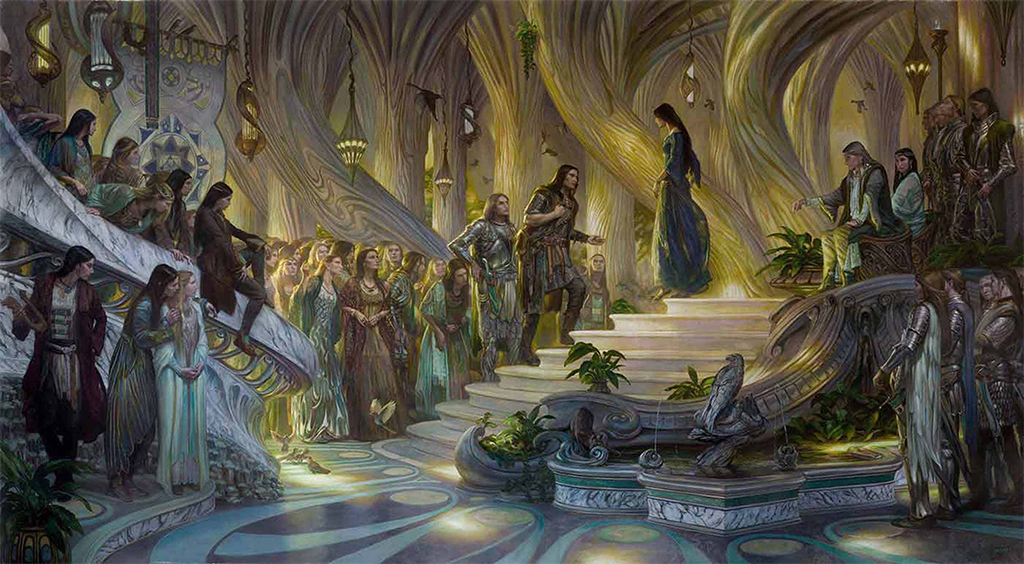
“Beren and Lúthien in the Court of Thingol and Melian” by Donato Giancola
But here’s my opinion: Thingol gets a bad rep. People like to rag on him for not listening to his very powerful and exceedingly wise wife, Melian. And yes, he does deserve it and it does catch up to him in the end. Yet in online discussions I’ve noticed how very many readers slander him as a jerk or straight-up call him a bad king. But if you do some loose math—which, to be clear, the narrator doesn’t encourage us to do—you see that he was the king of the Sindarin Elves for thousands of years, most of which passed before the rising of the Sun, before the counting of solar years in the First Age. The events that get “screen time” in The Silmarillion are just the last few centuries, the very tail end of his rule.
Thingol’s missteps drive the story once we reach chapter 19. They are the “uncomfortable” things that “make a good tale.” He is haughty and hostile to Beren, and he sends the Man off on an impossible quest, simply because he is enraged that a “baseborn mortal” would dare to court his daughter.
But in time, and after all the trials of both Beren and Lúthien, Thingol does come around. He goes from being a raging anti-Man racist to the Elf-king who accepts a mortal son-in-law, and who later goes on to foster the young mortal Túrin son of Húrin and raises him like his own son. Thingol has an arc. Yes, he does still get himself, and his whole kingdom, snared into the doom of the Silmarils. And in the end, he covets the Silmaril that he receives, that he requested, way too much. And it brings ruin to his kingdom. Thingol doesn’t listen to his wife in the most crucial of moments, when he really should. But my point is, those aren’t all his moments.
Hey, look. A pie chart!
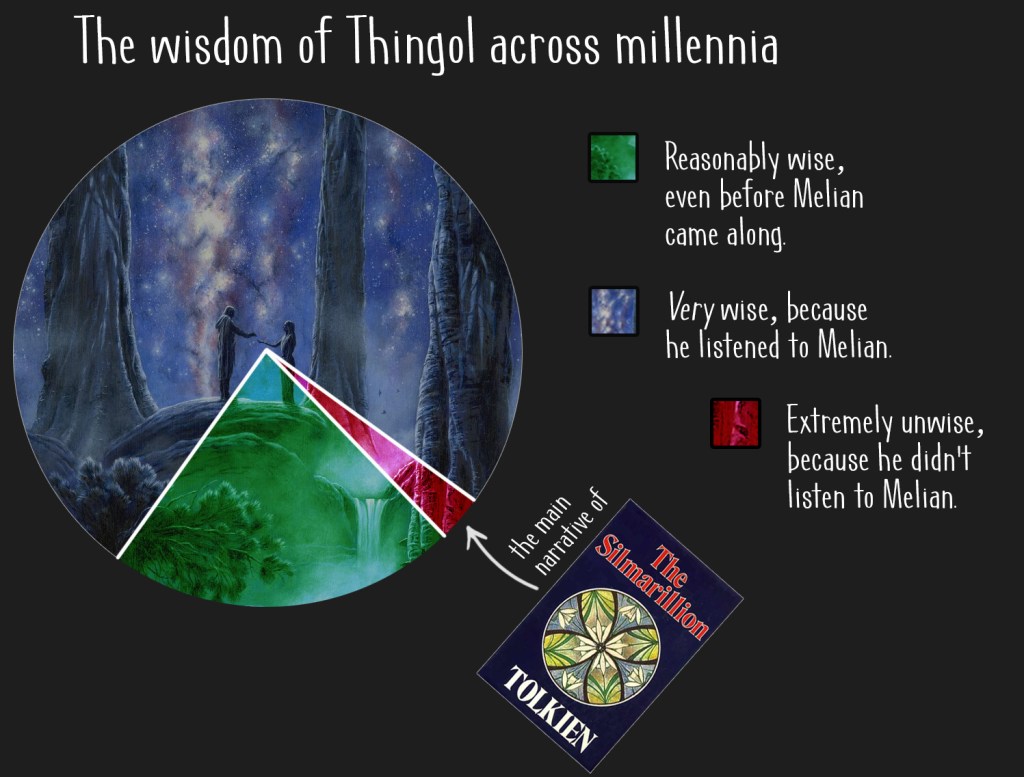
- The green slice shows us how he was probably reasonably wise, even before he met and fell in love with Melian and she became his queen.
- The blue slice is all that time the two reigned together for thousands of years, and he probably listened to her counsels. (Or else what was she even doing with this guy? I like to give Melian credit—why does no one else? She’s not foolish enough to choose a numbskull as a spouse. The narrator tells us that they loved each other.)
- But the red . . . ahh, the red slice is what The Silmarillion addresses most, and what everyone judges him on.
Thingol was from one of the early generations of Elves, born by the starlit waters of Lake Cuiviénen, where the Firstborn of the Children of Ilúvatar first awoke long before anyone even thought up the Sun and Moon.
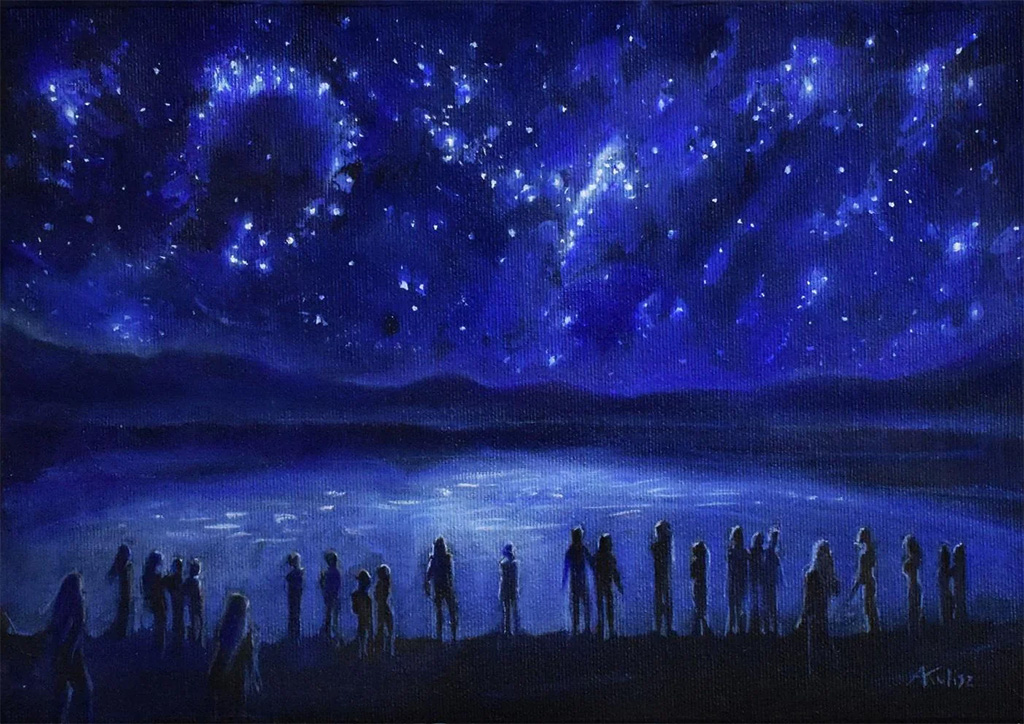
Thingol does right by his people for most of the time he is alive in Middle-earth. A casual read-through of The Silmarillion doesn’t truly paint that picture, but it’s more and more apparent when you pay special attention to the passage of time as I did while writing and then revising my Primer.
Okay, enough about Thingol for now . . .
Other patterns also emerge when reviewing The Silmarillion closely over and over. Here’s one that I latched onto: Tolkien saw no group or free-willed people as monolithic in mindset. Which makes seem rather progressive and open-minded for his time, not to mention willfully Christian. even if some of his passages in The Lord of the Rings (concerning Orcs and certain groups of Men) come across rather uncomfortably by today’s standards. (For more about how Tolkien really viewed Orcs, see this post.)
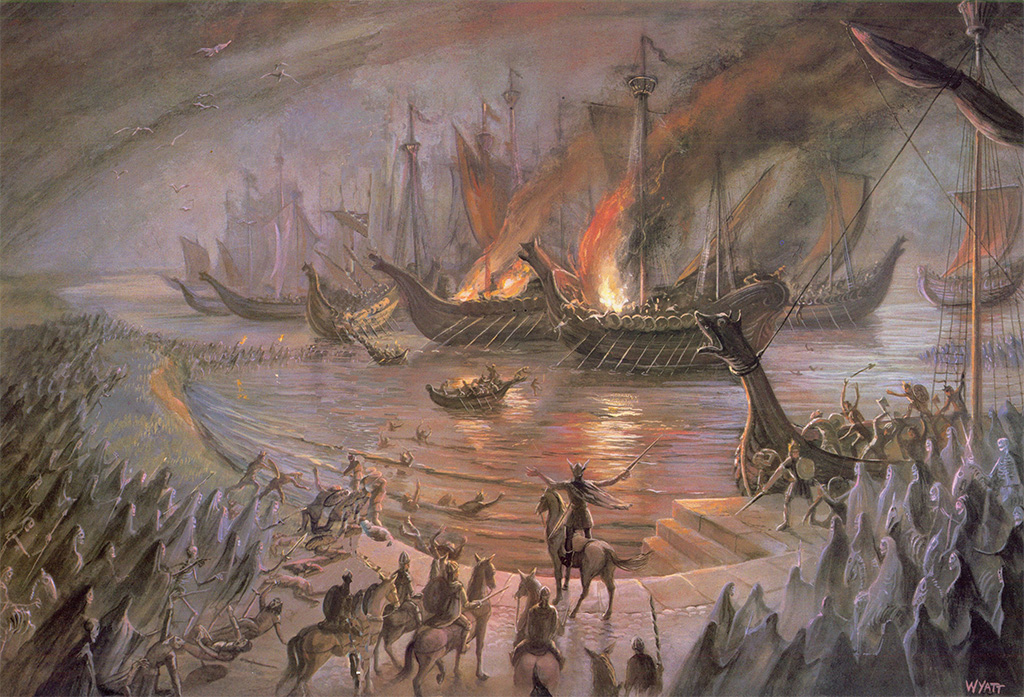
The Lord of the Rings: The Corsairs of Umbar © Joan Wyatt
We see this underlying opinion of Tolkien’s in various national and ethnic groups in The Lord of the Rings. Gondorians seem to be a noble people by and large, sure, but they still had their Kin-strife, a civil war spurred by racism and a disagreement of succession. The people of Rohan—who are valorous and filled with that “northern spirit” Tolkien admired and attributed to the Germanic cultures he based them on—still produced a Gríma Wormtongue.
Heck, the Istari, the divine wizards sent to Middle-earth to contest the rise of the second Dark Lord, still eventually gave us Saruman the Wise; Saruman Ring-maker; Saruman of Many Colours!
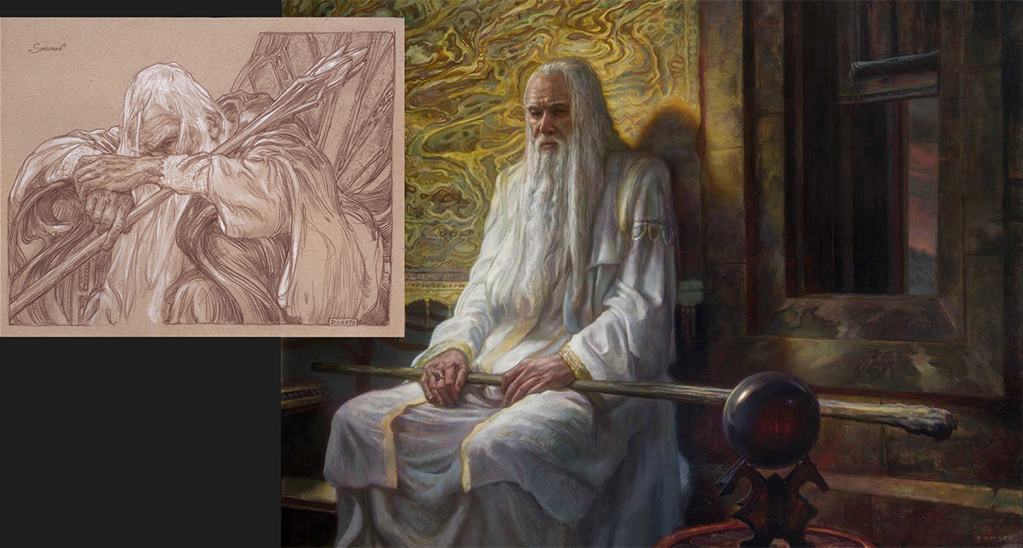
Saruman – Doubt” and “Saruman – Corruption by Donato Giancola
But, now, the Elves of Rivendell (though merry and learned) kind of all seem the same sometimes, don’t they? The same is true of the wary Elves in Lothlórien. A bit? How different, really, is Haldir from Erestor or Gildor or Galdor? Almost interchangeable, right? The more plot-central Elves are distinct from one another, of course—Elrond, Galadriel, Glorfindel, Legolas—but readers (or moviegoers) only familiar with The Lord of the Rings understandably regard all Elves as ethereal, maybe aloof. They often say they’re depicted as “perfect.” How often do we see Third Age Elves disagreeing with one another, really?
But the diversity of disposition casts a wider net in the Elder Days. For one, there’re just many more Elves on stage, as it were, and so there is a greater range of moral behaviors seen in The Silmarillion among the Elves of antiquity—which is really saying something, given the book is a series of histories and not a novel of heroic romance.
Each Elf-kindred contains a spectrum of its own. Take the Noldor, the High Elves who went to Valinor only to come back in exile to Middle-earth; even among their royals, we get the dangerously demiurgic Fëanor, maker of the Silmarils. But we also get the magnanimous Finrod Felagund, the nicest Elf to ever Elf. One leads a revolt and slays other Elves to get what he wants. The other works for peace and alliances and is the reason that Men first get along so well with the High Elves.
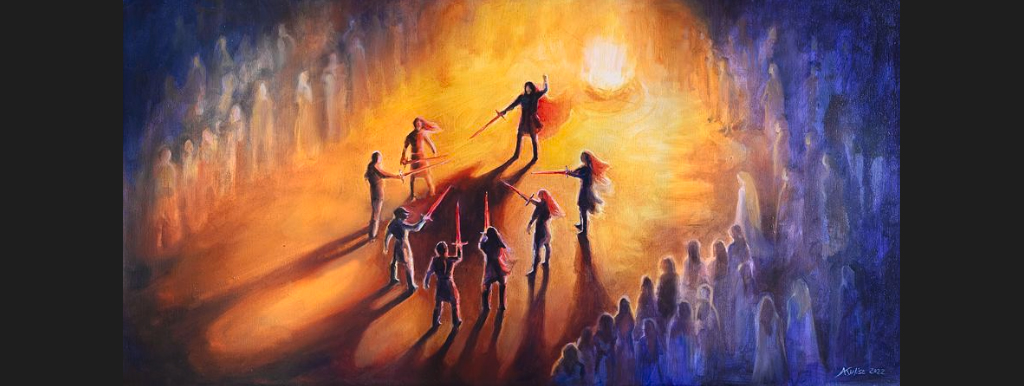
The Oath of Fëanor © Anna Kulisz Yoo
Speaking of mortal Men, when the ancestors of the Dúnedain first show up in the lands of Beleriand, they’re in three big ethnic groups, and each is not all the same. There is dissent among them on what they should do once they gauge the political and military status of the region. Some join up with the Elves in their war against Morgoth, the first and most powerful Dark Lord. Some turn away altogether. Others take a more neutral stance, like the people of the House of Haleth, who swear no service to Elves but still side with other Men against Morgoth and his orcs because they’re still on the right side of history.
Heck, the Easterlings in The Silmarillion have more range than those described in The Lord of the Rings. Two great Easterling houses among them, the people of Bór and the people of Ulfang, arrive on the scene already so manipulated by Morgoth that they’ll feign alliance with the Elves only to betray them at a crucial moment. The people of Ulfang comply, but the people of Bór refuse to follow suit. They are Easterlings who choose to remain faithful to the Elves and therefore deny Morgoth his complete victory. Imagine if in The Lord of the Rings the Easterlings who marched with the forces of Mordor had the same sort of division?
Imagine if a branch of the invading Men from the East or from Harad pivoted and joined Gondor on the Pelennor Fields? The point being, there’s further precedence for not all Men outside of Eriador and Gondor being under the domination of a Dark Lord. (And that is a comforting thought.)
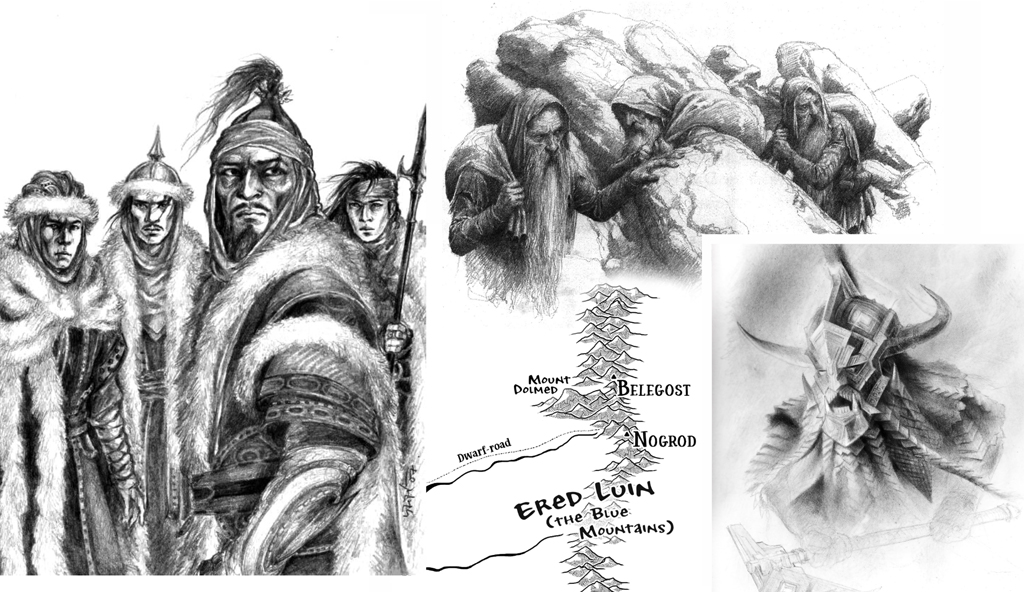
Bór with His Sons © Helena Stepanova | The Petty-dwarves © Alan Lee | Azaghal © Turner Mohan
And what about Dwarves? Also not a monolith. Just ask Mîm the Petty-dwarf, the at-times treacherous, at-times pitiable, almost Gollum-like tragic figure who features prominently in the story of Túrin Turambar. But then there are the Dwarves who set themselves up in the Blue Mountains. There are two cities who form trade relationships with the Elves: Belegost and Nogrod. After centuries of peace, an unfortunate event sparks a war with the Elves of Doriath. But only with the Dwarves of Nogrod. Riled up, they bring an invading force against the Elves and ask the other Dwarf-city to join them in their attack; but the Dwarves of Belegost say “nahh.” They don’t try to stop their brethren but they refuse to become part of the problem.
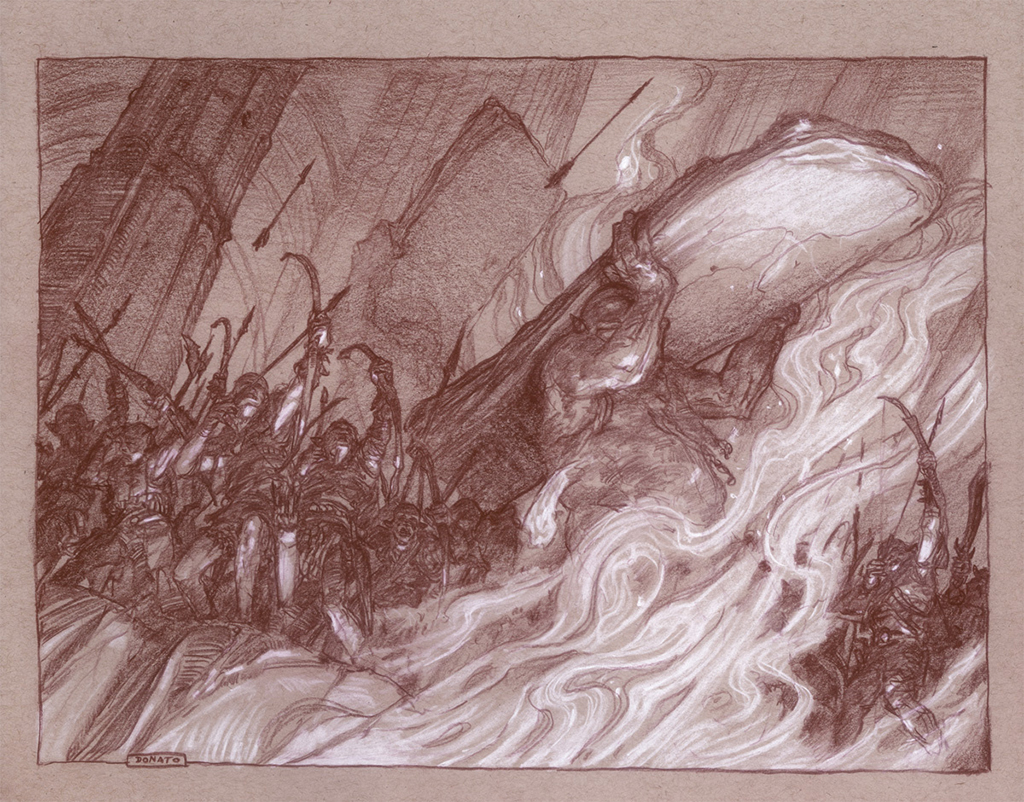
“Two Large Trolls” by Donato Giancola
Finally, even the bad guys aren’t always all on the same page. They often don’t get along. I love that for them. Which is to say, I appreciate that Tolkien added evidence of their own discord. I think most readers instinctively know that evil doesn’t always jibe well with other evil—we see it between various Orc factions during the War of the Ring and in Saruman’s uneasy alliance with Sauron—but in The Silmarillion, if you read between the lines, you can see the mistrust on various levels.
Take the scene where the Elf-princess Lúthien and her dog friend, Huan, beat the snot out of Sauron, they have him pinned to the ground, and at their mercy. Here’s how I explain that moment in my Beren and Lúthien chapter:
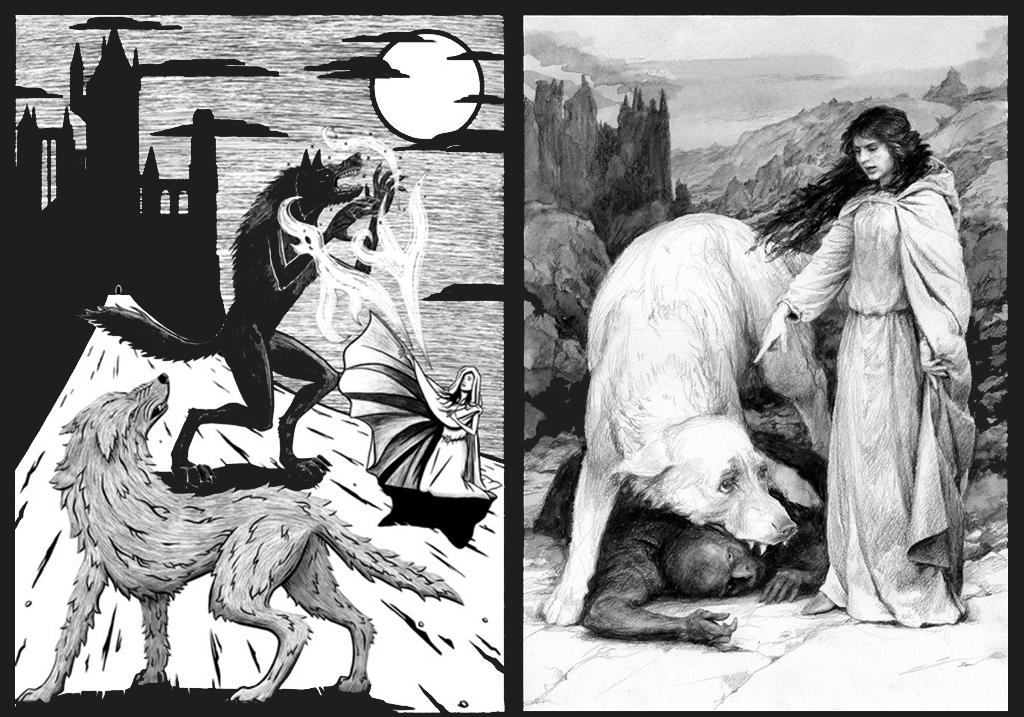
© Jim Carpenter | © Denis Gordeev
Sauron tries shape-shifting out of Huan’s jaws “from wolf to serpent, and from monster to his own accustomed form,” but it’s no use. His only way out is by doing something his minions cannot: forsake his physical form and flee as a spirit, Maia that he is. But Lúthien makes him an offer he might not refuse. She suggests that if he escapes in spirit form, it’s going to be totally embarrassing when he flees to Angband, defeated, before Morgoth. She says: ‘There everlasting thy naked self shall endure the torment of his scorn, pierced by his eyes, unless thou yield to me the mastery of thy tower.‘
Sauron concedes, gives up the tower, and flees in vampire form, retaining his physical body (that is, retaining a shred of dignity). Tolkien doesn’t give us those extra fun details that some of us want: Does he later go and bow before Morgoth in apology, or abase himself in some way? Does he ever get punished? I mean, Sauron’s failure to stop Lúthien and Beren leads to Morgoth losing one of his Silmarils—an embarrassment of its own. But the very fact that Lúthien’s threat works implies that Sauron is afraid of this level of defeat before his master. What are the power dynamics at work? As I suggested before, the scarcity of lore is even more intriguing.
Here’s another example from the same story. When Beren and Lúthien reach the gates of Angband, they meet Carcharoth, the great werewolf, who bars the way.
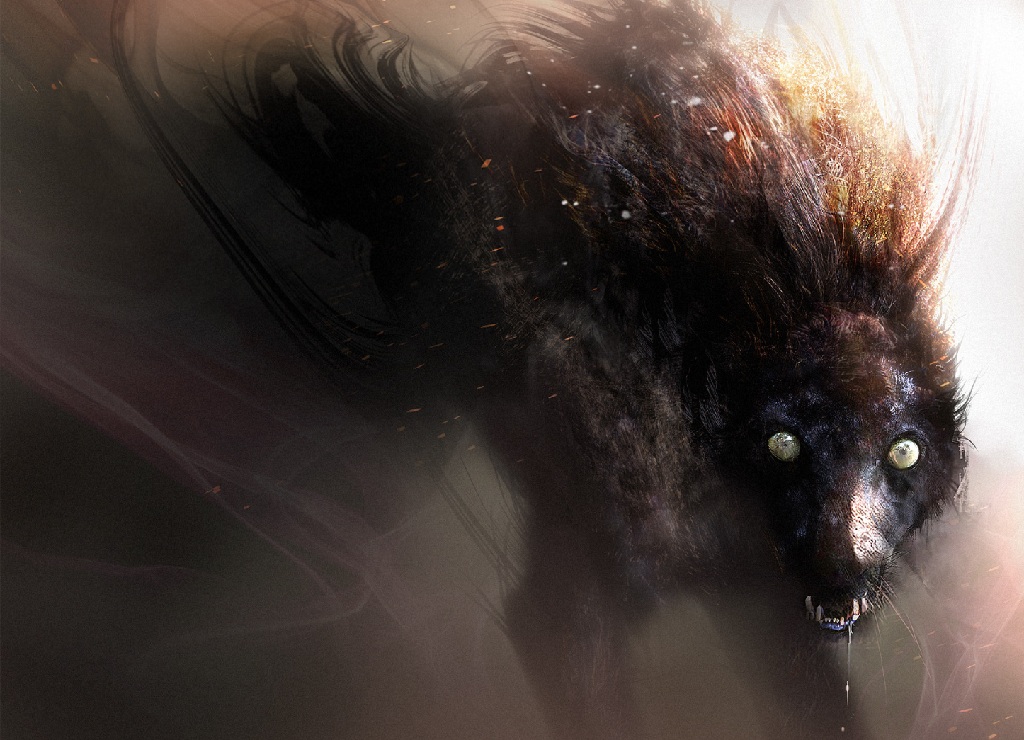
Carcharoth © Magdalena Katańska
See, earlier, in his fight against Huan, Sauron began the battle in werewolf form. He’s the freakin’ Lord of Werewolves, so why not? He’d deliberately made his body as big and terrible as he could because there’s a known prophecy that Huan, the hound of Valinor, will not die until he encounters “the mightiest wolf that would ever walk the earth.” In his pride, Sauron believed he could be that mightiest wolf and so slay Huan. Here’s how I put that in the Primer:
It’s a minor point the narrator doesn’t make, but Charcaroth’s very existence reveals the lack of trust between evil beings in Arda, even among the top brass. Had Sauron known his boss had cooked up Carcharoth precisely to fulfill Huan’s prophesied doom, he might not have tried to take on the Hound of Valinor personally, as a big bad wolf. Apparently even Sauron, the lieutenant and right-hand man of Morgoth, is on a need-to-know basis. Now, it could be that Sauron was aware that Morgoth intended Carcharoth as a foil to Huan and, in his pride, believed he could upstage his boss’s gambit. But even this betrays a disconnect among the governing powers of evil.
Right, so when Beren and Lúthien meet Carcaroth, he’s instantly distrustful of them even though they’re in disguise as bad guys. Specifically, they’re literally wearing the skins of Draugluin, the father of all werewolves, and Thuringwethil, a vampire (monstrous bat) of Sauron’s. Lúthien had used her “elvish magic” so that wearing these skins physically transformed them bodily into these same creatures. It’s a whole thing.
The Silmarillion only tells us that he denied them entry, because he smells something strange about them. Especially Lúthien. Apparently she smells way too good for a vampire. But some of the original verse Tolkien wrote about this moment gives us more insight, and it even has Carcharoth speak. He’s about to allow Werewolf Beren to pass the gate, but he’s got a problem with Vampire Lúthien. He says . . .
‘But what is this that crawls beside
slinking as if ’twould neath thee hide?
Though winged creatures to and fro
unnumbered pass here, all I know.
I know not this. Stay, vampire, stay!
I like not thy kin nor thee. Come, say
what sneaking errand thee doth bring,
though winged vermin, to the king!
Small matter, I doubt not, if thou stay
or enter, or if in my play
I crush thee like a fly on wall,
or bite thy wings and let thee crawl.’
See that? We’ve got bad guys threatening who they assume are other bad guys. (This tracks with the way Orcs treat each other in The Lord of the Rings, sure. See the words and deeds of Grishnákh, Uglúk, and Gorbag.) But here we’re talking about the literal guardian of Morgoth’s underworld insulting who he supposes might be the messenger of Sauron, who is Carcaroth’s own master’s lieutenant. To think that Draugluin, the father of werewolves and Thuringwethil the messenger of Sauron should have lived to be trash-talked by Morgoth’s watchdog as if they were selling buttons at the door!
Well, no, of course not really. Draugluin and Thuringwethil are actually dead, ex-werewolf and ex-vampire that they are. But Carcharoth doesn’t know that (yet). But do you get my point? Look at any group of people, monster, or divinity, and you will find they are not homogeneous. Just like real life. I refuse to take anyone seriously who claims Tolkien’s world is black and white.
 Foreshadowed and Foresung