This might be hard to articulate, but I’m going to give it a try. It’s not complicated in itself, just complicated to convey, maybe.
Now, I don’t mean “radical” in the way we used to use it in the 80s (which phased out in the mid-90s). I certainly don’t mean it the way idiot politicians say “the radical left.” I mean it the way Christopher Tolkien uses the word again and again in his History of Middle-earth books when talking about his father’s many drafts and essays.
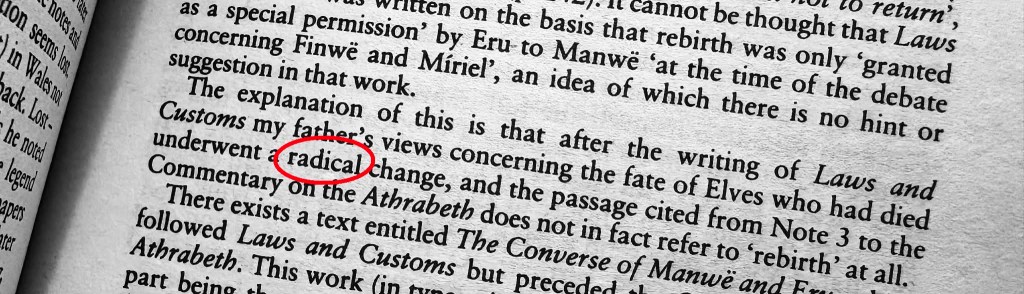
Radical meaning, essentially, “fundamental.” At the root.
If you’re only familiar with The Hobbit or The Lord of the Rings, whether book or film, then this will be irrelevant to you. But in Tolkien circles, Tolkien is commonly referenced as being conflicted with his own lore, as possessing so many different ideas and versions of his characters and stories. In fact, those differences of opinion within his own (to be clear, unpublished-before-his-death) writings are often used as justification for the very different version we get on the characters of Galadriel, Sauron, etc., in Amazon’s The Rings of Power series.
My take is, “Even Tolkien couldn’t make up his mind” is an unfair oversimplification.
Take The Silmarillion. Okay. First, what is it? It’s a compendium of some of Tolkien’s pre- and post-LotR writings, selected and published by his son Christopher after J.R.R.’s death, specifically about the “Elder Days” of Middle-earth. They’re the formative world-building legends and myths that take place millennia before the events of The Lord of the Rings. They’re arranged more or less chronologically, but they’re not even made up of the most up-to-date versions of those stories. They’re simply the ones that were complete enough to tie together in one volume in a way that keeps them “internally self-consistent” with one another. That was Christopher’s mission for himself.
Later, Christopher methodically put out the aforementioned History of Middle-earth books (a 12-volume set) to show the receipts. That series is a massive, meticulously curated (yet still tangly) collection of all the often-contradicting versions of Tolkien’s ideas and stories.
But back to my point: The existence of these books has created this widespread impression in Tolkien circles—often spilling over into pop culture through discourse around the Jackson and Amazon adaptations—that Tolkien himself could never make up his mind about anything, or that he would waffle constantly between ideas. While this isn’t wrong, exactly, he also wasn’t some kind of weirdo about it.
Writers possessing unfinished drafts and unrefined notes and charts that aren’t intended for the public (yet) . . . that’s just a thing about writers. That’s normal. I daresay most prolific authors are probably this way. Some are known (but not as talked about, maybe):
- Matilda in Roald Dahl’s Matilda is evidently kind of a mean-spirited kid in one version, and she dies in the end.
- Ernest Hemingway’s grandson asserts that his grandfather wrote out forty-seven different endings for A Farewell to Arms.
- Even Mary Shelley’s first edition of Frankenstein is said to have a more benevolent Victor, and a happier ending, before she went back and changed it.
Even some non-famous, non-prolific authors do this. I sure did. For example, my 2008 Eberron novel The Darkwood Mask featured a female human (detective) and a male half-elf (special ops warrior) as protagonists. These two:
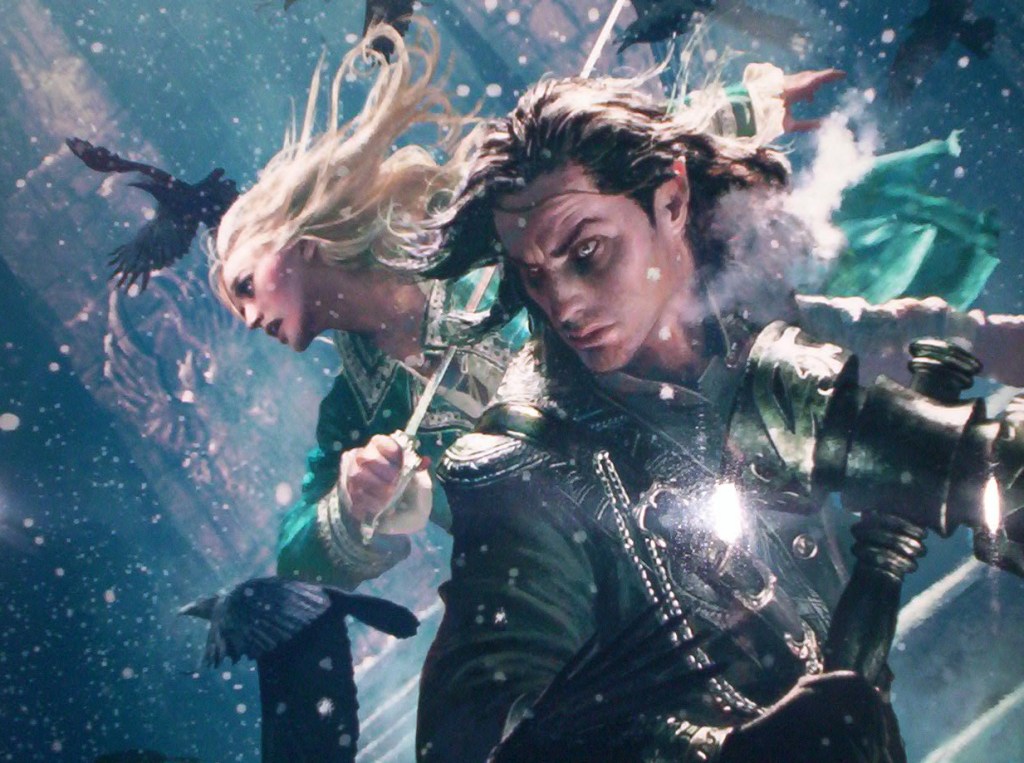
BUT! In my first synopsis for what would become that book—the summary that I initially pitched to Wizards of the Coast—featured a female gnome artificer as my main character. And the villain was very different. Hell, the whole plot got reworked a few times until I ended up with The Darkwood Mask as it now exists. Later, I wrote a whole second novel for the same setting/world, but that series was canned just as I handed it, so it never got any final polish—or published at all.
Okay, now imagine I got real famous later anyway. Don’t laugh! Then, after my death, imagine that my son took it upon himself to publish a bunch of my unfinished and half-baked ideas, my early Darkwood Mask synopsis and even my not-fully-edited second Eberron novel. (I would not wish this on him, FYI.) But in this scenario, my fans might well conclude that I could never make up my mind, and hadn’t yet settled on certain ideas. As if that was my defining quality.
When really, I’m just a normal human with a SFF writer’s brain with all kind of scattered thoughts and ideas, and simply couldn’t, before I died, get them all published in a form that I was satisfied with. I guarantee this would be the same with a number of actually well-known science fiction and fantasy authors right now.
Going back to Tolkien: It just so happens that his half-baked ideas were so brilliant, and the depth and beauty of his imagined world so good, that even unrefined passages and essays and unfinished stories still make for amazing reading, analysis, and discussion. If his central work hadn’t been so famous and beloved—that is, if The Lord of the Rings had only middling success—his son Christopher would not have been able to publish those additional unfinished, messier writings.
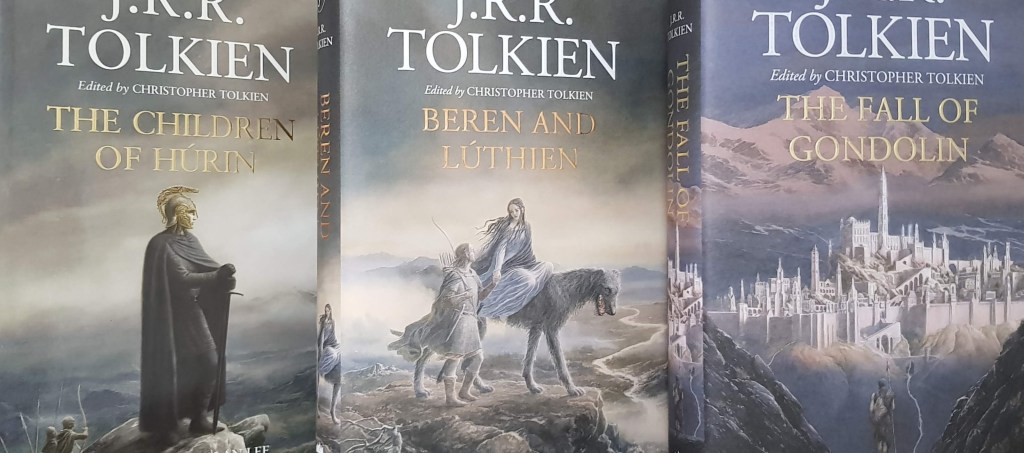
But he was, so he did. It worked out. I’m so glad.
Am I the only one to think it’s weird or at least unfair to conclude that Tolkien was some kind of especially fickle author? He just wrote down a lot of stuff, on physical paper where it could be later found (and not as lost as, say, digital files could be now). Back when he was trying to get his Silmarillion stories published, too, alongside LotR, the literary and editorial landscape (that his genius would one day dominate and reshape) simply wasn’t receptive enough for it yet. Not receptive to the sort of enormous and influential work he’d been plugging away on for decades.
I genuinely believe that if Tolkien was somehow resurrected, he would be somewhat horrified that so many of his own essays and notes written for himself ended up getting published just as he’d left them. Now, I KNOW he loved his children, and I’m sure he’d eventually grasp just how absolutely honorable Christopher Tolkien delivered his father’s legacy to the world, but for a little while I think he’d be embarrassed. I’m still glad Christopher did what he did because we have so much more than we would have if the only thing that made it into the world is what Tolkien himself saw published.
Okay, I want to give one more example before I leave this topic alone: Tolkien’s orcs.
Fans who’ve read beyond The Hobbit and The Lord of the Rings like to point out that Tolkien couldn’t make up his mind about the true nature of orcs. That’s actually correct. He couldn’t. But . . .
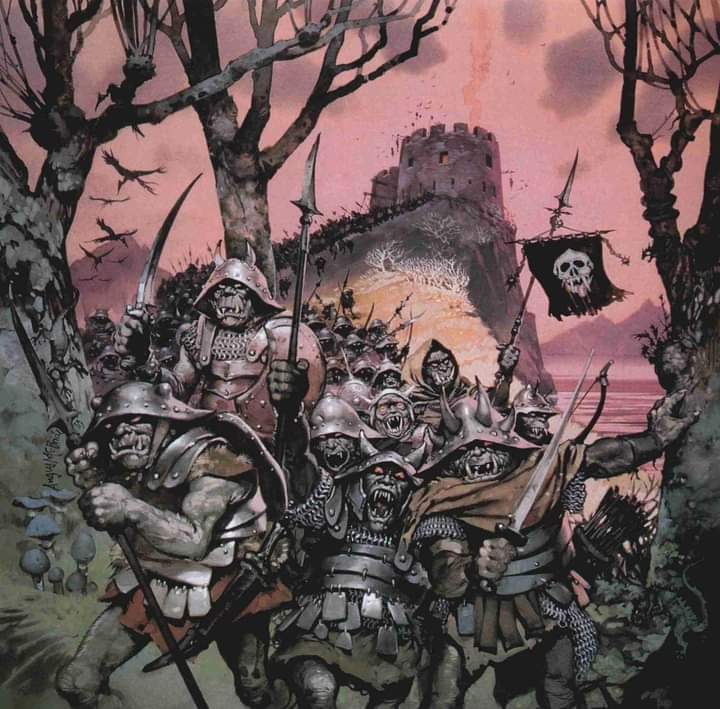
Tolkien was only inconsistent and undecided about orc souls across all his unpublished work. In the books that were completed and published by him while he was still alive, the true nature and society of orcs weren’t explored at all. There was nothing to debate.
The narrative of The Lord of the Rings only points out that orcs were living creatures who had to eat and drink like anyone else (Frodo tells this to Sam), but there’s absolutely no speculation about whether they could potentially be a redeemed people. We get that they’re under Sauron’s boot, yes, and though they seem ill-tempered, violent, and selfish by nature (at least, the ones we see), they don’t really want to go do big wars. But as we know . . .
“Where there’s a whip there’s a will, my slugs.”
It’s only when Christopher published The Silmarillion, then Unfinished Tales, then book after book in The History of Middle-earth series that the complexities and varying origins of the orcs even came up! Who’s to say what Tolkien might have decided upon at last? He struggled with it, for sure. But we cannot say any version is definitive or canon. He was just a writer with a lot of ideas who ran out of time. We’re lucky he wrote so much, and it was so good, that his own son was able to give it to us.
In one of Neil Peart’s books (I don’t remember which), he compared some old Rush songs to a child’s crayon drawings on a fridge. Something he was kind of embarrassed of way after the fact. As a hardcore fan, that actually kind of hurts to hear. I don’t know want to know which songs he’s referring to (though I can guess) because I love them. But I DO get it. I think Tolkien would see some of his own writings as crayon drawings, too, and would think, “Yikes, you published that, son?!”
Granted, I love all these crayon drawings anyway. Some of them might seem radical but they weren’t meant to be. They were meant to be refined, then presented to the world fully decided upon.
All the same / We take our chances / Laughed at by Time / Tricked by circumstances
 Foreshadowed and Foresung