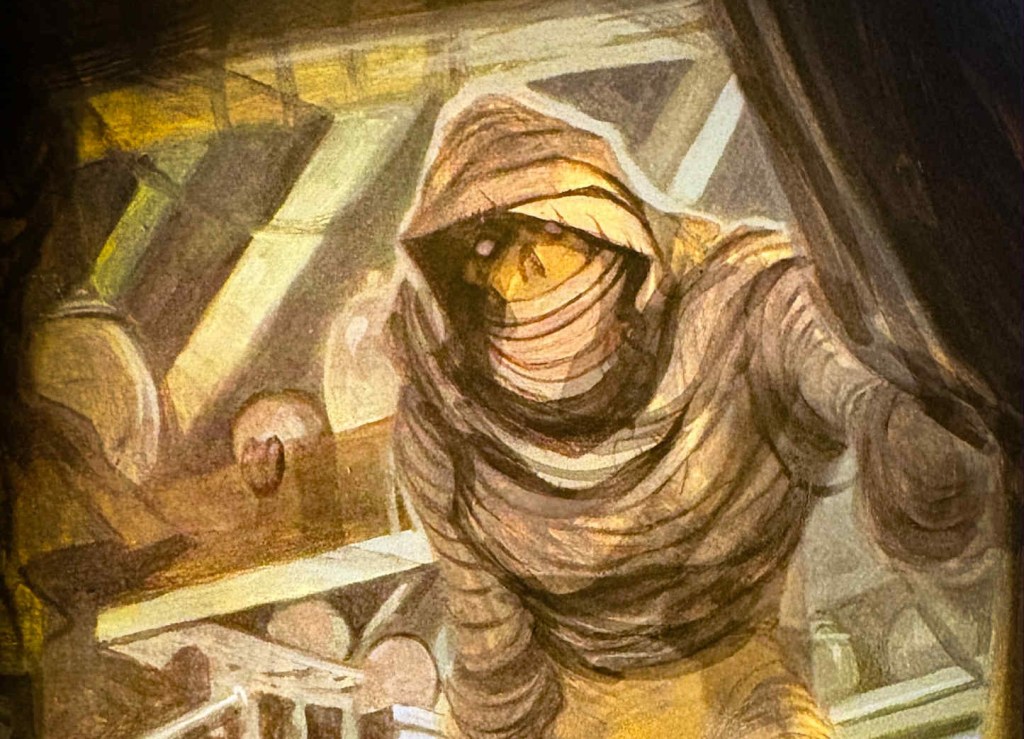
With Frankenstein fresh on the brain and in a lot of online media discourse, this seems like as good a time as any to float my pet theory about the monster. The recent Guillermo del Toro film (which I wrote about here) takes the popular approach on this matter.
But I don’t think Mary Shelley intended it this way. So what’s my theory?
No, not that theory! A different one, concerning the way Frankenstein’s monster was made, and would appear.
Surely this has already been discussed at length, or written about, by scholars of Mary Shelley. (Is that a profession?) If so, they can correct me if they want. Or anyone can. I’m listening, I’ll consider contrary evidence.
Now I’m not saying this is a hill I’d die on, but it’s at least a hill I’d build a windmill to burn on.
Here is my thesis statement:
The Creature is not made up of a bunch of patchwork body parts!
At least, not in the way we always see it. Not from Mary Shelley’s original. That’s all I mean.
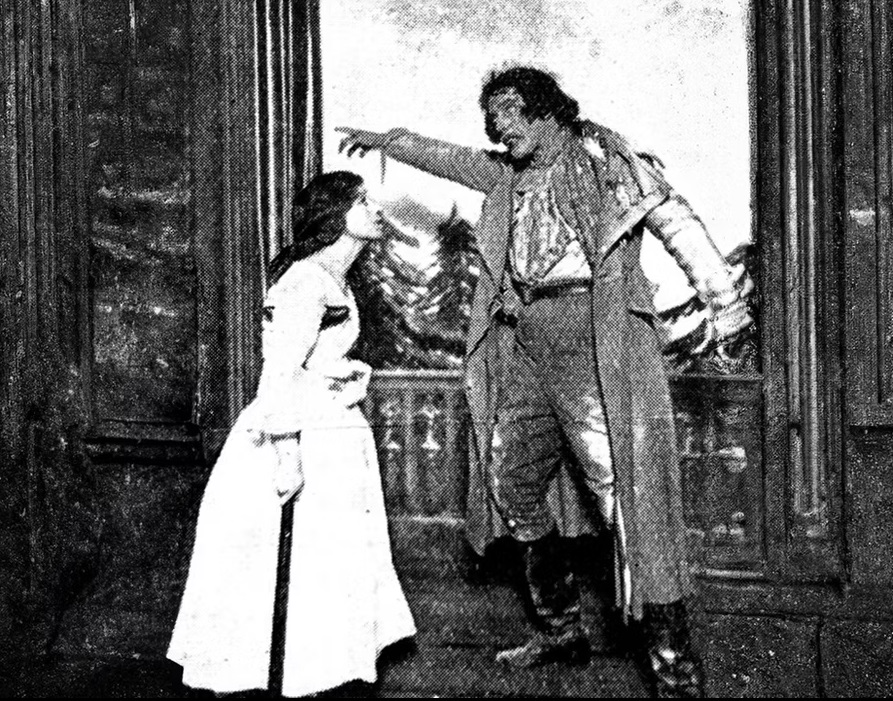
The depictions of Frankenstein’s monster in every production since Universal’s 1931 film are fairly consistent in that we see stitched-up scars swirling all around his exposed skin. That’s a Boris Karloff and onward phenomenon, I suspect. If you look at the old photographs from the stage play that the Universal film was based on—that is, Frankenstein: An Adventure in the Macabre by Peggy Webling—that story doesn’t seem to imply a stitched-up corpse-looking dude, either. I’m no expert on that particular play, but, I mean, look at this guy. He’s just being dramatic!
The stitches and neck bolts (and, of course, flat head) are the work of Jack Pierce, Karloff’s make-up artist, and then the image was carried forward many times over again.
In 1910, there was a short silent film of Frankenstein. The monster is goofy by today’s standards, but despite the film’s shortness, the premise is closer to the book than Universal’s. With no media precedent for having Frankenstein assemble his human creation from stolen parts, he just seems to grow it, chemically, in a vat or cauldron. Pretty good special effects for the time:
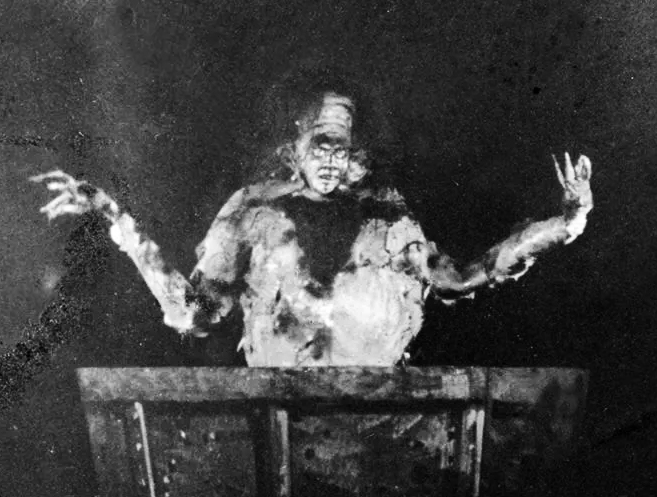
I think that’s at least closer to what Shelley imagined, at least in process.
Now, the words “stitch” and “suture” appear nowhere in Shelley’s novel. There’s nothing in the text that suggests that the monster is a patchwork sort of creature, like he’s some kind of walking skin-quilt. He’s seamless in form—literally. And if you look at any illustrations that predate Universal’s 1931 film, you’ll see a variety of depictions, but none of them have that sewn-together look.
Like this one based on the 1923 play, Presumption; or, the Fate of Frankenstein.
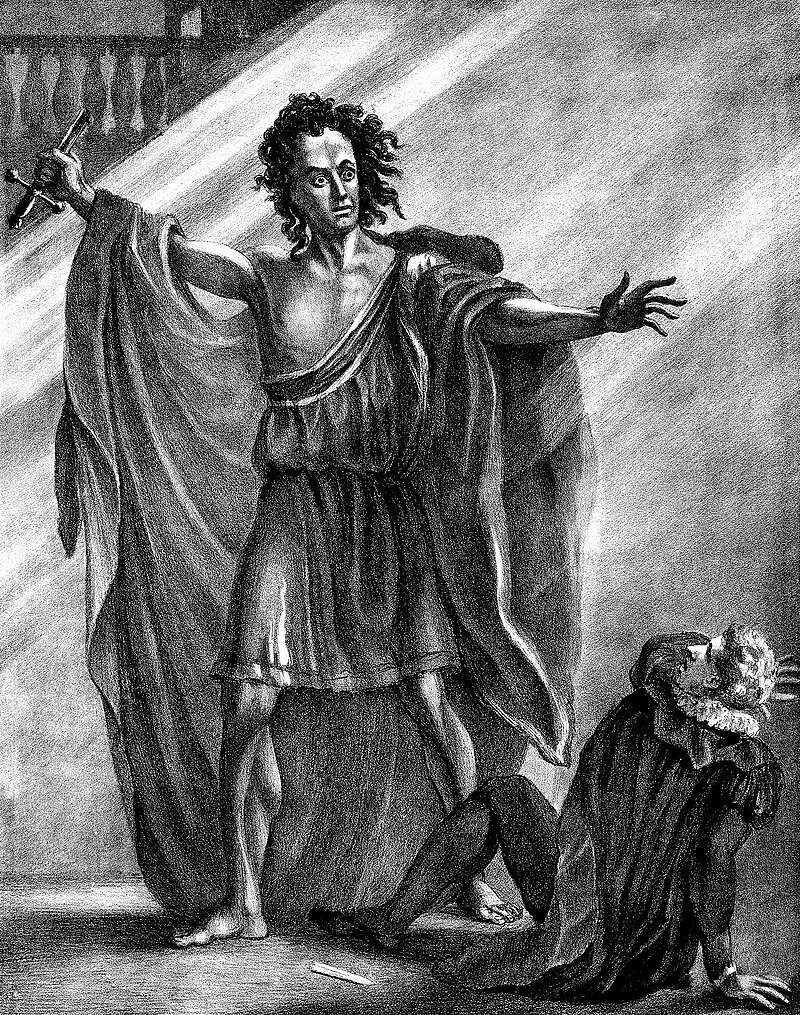
But hang on. Making the creature look like an assemblage of various corpses is a plausible approach for screen adaptations—I’m not saying it’s not. It’s a reasonable choice, if you stretch the wording in the text and make some stitches leaps of logic.
I realize that being a big sutured-up assemblage of corpses is kind of Frank’s whole schtick in pop culture, and has been for nearly a century. We sometimes use the word “Frankenstein” as a verb to mean “cobbled together” (it’s a useful word!) or turn “franken-” into a fun prefix. Even Merriam-Webster acknowledges this. The cultural impact of the concept has led to many awesome characters and abominations. Mad scientists and their created monsters are basically a subgenre of their own. Stitches and bolts and electricity galore! It’s all good.
I’m simply saying, I don’t think the patchwork-corpse monster is what Mary Shelley herself was imagining. It’s sort of like how there’s no Igor in her novel, either. That was someone else’s add-on later. Yet look how iconic the hunchbacked assistant has become, but there’s no such character in the book. (The 1923 play and the 1931 movie each included a bumbling assistant named Fritz, which later sequels revisited with Bela Lugosi’s Ygor, later Igor, etc.)
All right. Let’s take a look at the text, specifically in chapter 4, which represents Victor’s time of research and discovery. (Chapter 5 is when the monster begins its actual life.) During this phase of inquiry and investigation into the secrets of life and death, Victor studies both human and animal forms. His goal is to become “capable of bestowing animation upon lifeless matter.”
I became acquainted with the science of anatomy, but this was not sufficient; I must also observe the natural decay and corruption of the human body.
Again, he’s studying. He’s not assembling anything yet.
Although I possessed the capacity of bestowing animation, yet to prepare a frame for the reception of it, with all of its intricacies of fibres, muscles, and veins, still remained a work of inconceivable difficulty and labor.”
This passage still discusses the materials he’s learning from, not constructing with. He hasn’t begun to make creature’s body, which he’s admitting will be extremely challenging. However, by this point he has discovered the secret to imbuing life in nonliving matter. I find this fact fascinating! See, it’s not like he made a body first, then tried a whole bunch of different scientific processes and alchemical experiments to try and animate it, like we’re used to seeing. He already knows what to do. He’s figured it out. In fact, how he proceeds to make the body is dependent on his knowledge of how to animate it.
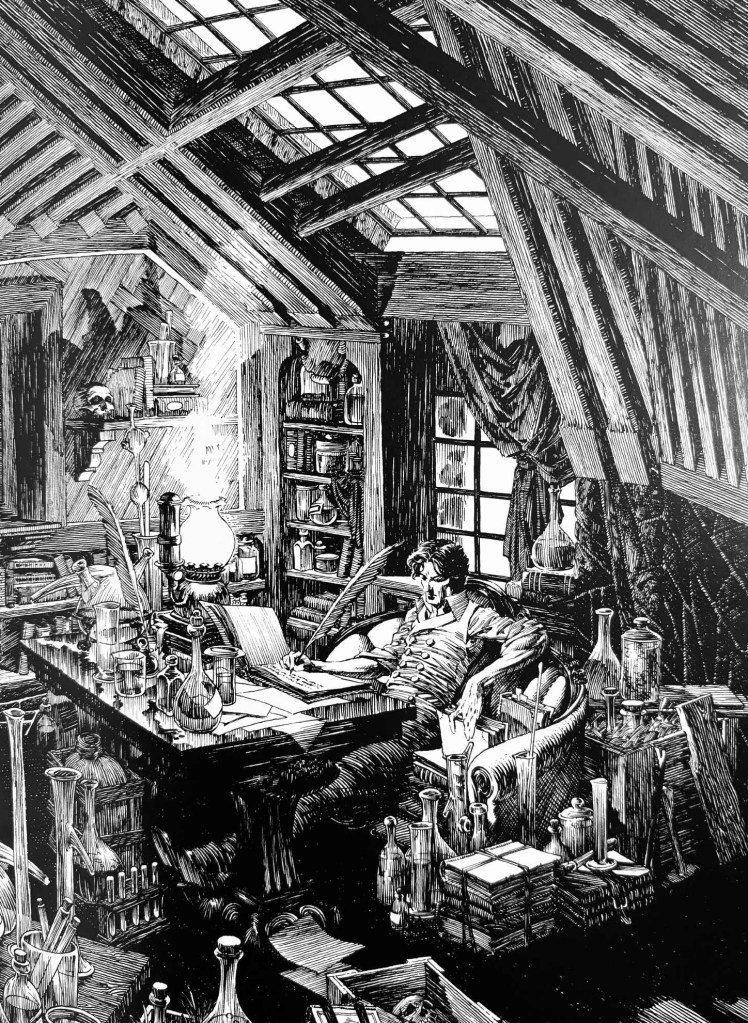
Illustration by Bernie Wrightson from his 1983 edition of Frankenstein.
And no, he doesn’t tell us, the reader, what that secret is. Certainly nothing about lightning. No talk of electricity, even. He specifically doesn’t tell Captain Walton (the sea captain he’s telling his whole tale to as part of the frame story). The point is, Victor doesn’t want the secret getting out. He says:
I see by your eagerness and the wonder and hope which your eyes express, my friend, that you expect to be informed of the secret with which I am acquainted; that cannot be; listen patiently until the end of my story, and you will easily perceive why I am reserved upon that subject.
Let me restate this: Before Victor even begins to make the creature’s body (the “frame for the reception” of “animation”), he already “possessed the capacity” to bestow it. He has yet to pull it off. Now he just needs a frame of sufficient size:
As the minuteness of the parts formed a great hindrance to my speed, I resolved, contrary to my first intention, to make the being of a gigantic stature, that is to say, about eight feet in height, and proportionally large.
So originally, he planned on making a person of regular human size. But he’s learned that to bestow life sooner than later, it would be easier to build a frame of proportionally larger size (so that all the intricate parts are larger, too).
After having formed this determination and having spent some months in successfully collecting and arranging my materials, I began.
Ahh, what are those mysterious materials? We don’t know exactly. We always assume it’s just a bunch of hacked-up bodies and strips of human muscle, tissure, blood, and skin. Del Toro went with that approach, too, as do most adaptations. It’s not necessarily off the table.
Who shall conceive the horrors of my secret toil as I dabbled among the unhallowed damps of the grave or tortured the living animal to animate the lifeless clay?
Right, so Victor’s definitely doing some graverobbing in his learning. No dispute there. It’s horrible business. And torturing living animals? Ooof, Victor’s sins must begin here.
I collected bones from charnel-houses and disturbed, with profane fingers, the tremendous secrets of the human frame.
Here again, he collects bones and studies the human frame for . . . secrets. For information, for knowledge. Not necessarily to be used wholly as raw materials for the actual body. It’s unclear. And then this is the last passage on the matter:
The dissecting room and the slaughter-house furnished many of my materials.
That line may be the best argument in favor of the cobble-together monster, but it’s still not much to go on. Note he says that the dissecting room and slaughter-house furnished “many” of his materials, not “all.” We see that Victor acquires materials from dissecting rooms (for human bits) and slaughter-houses (for animal bits). But nowhere do we read that whole limbs or half-limbs or strips of skin or muscle or tissue are sewn or patched together. There is no talk of stiches or seams. I think Victor is more meticulous than that.
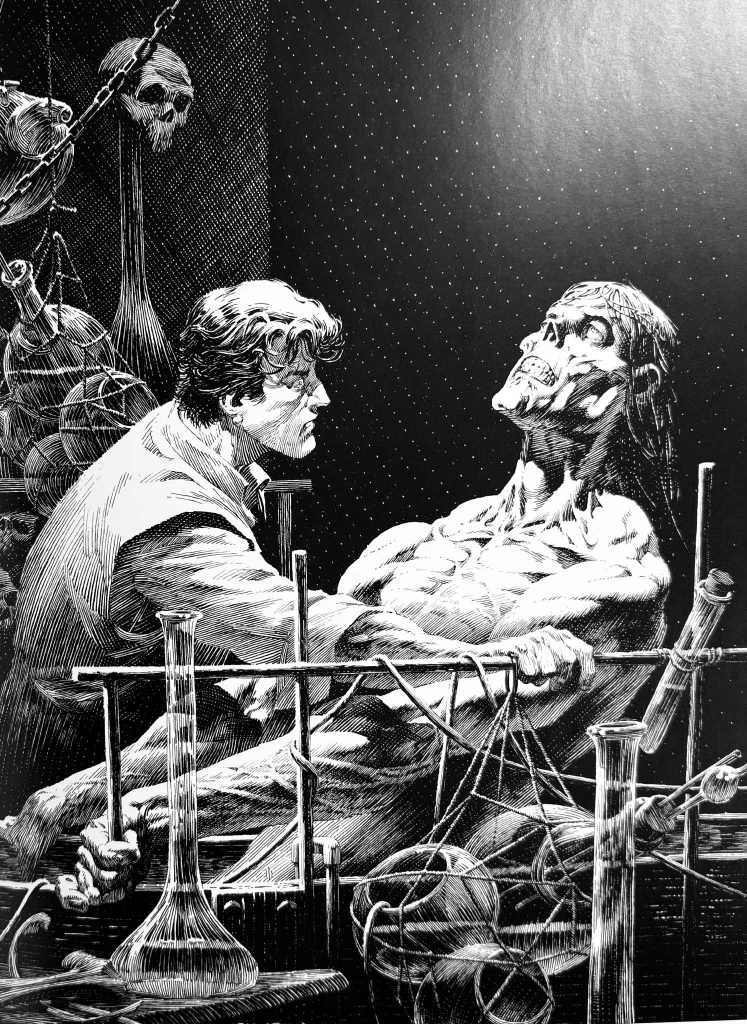
Wrightson’s depiction of the Creature is the best.
Take one part of the monster, like a hand. Victor builds a hand perfectly proportional to an eight-foot man’s. That’s a very large hand indeed. You can’t just take fingers from a regular guy’s fingerbones and skin to make it large enough. And now, all throughout the body, he’s got to achieve the same thing. So Victor formulates and assembles bones, muscles, organs, veins, nerves, ganglia—or materials fabricated or grown to emulate those things—on such a minute level that they eventually resemble that of a mature human far larger than the average man.
I personally imagine Victor growing his own as-yet-inanimate artificial tissue based on what he learned studying the decomposition of dead tissue. Like we see in science fiction movies about cloning, except this is during the Age of Enlightenment instead of some cyberpunk future. Frankenstein marks the beginnings of the genre, after all. See how many depictions show the tools of alchemy: jars, beakers, flasks, vials, tubes, retorts, athanors, and what have you. I think they’re on the right track.
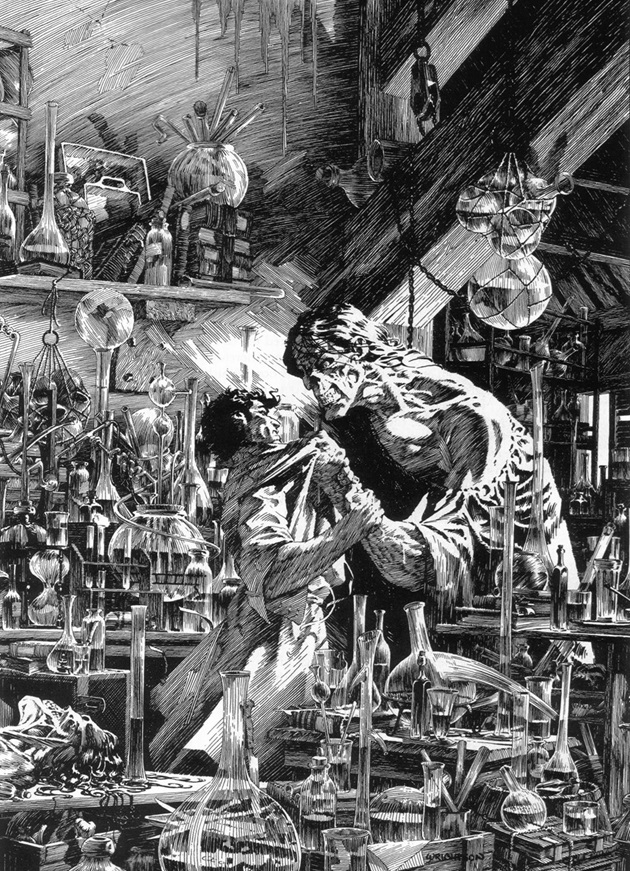
The popular image is that of a slaughterhouse of a workshop, with cut-up corpses and blood everywhere. But I’m doubtful of that. Yes, it’s likely to be a rather untidy and unpleasant place to be. Even if Victor is fabricating his own adult human components—he’s not making an infant—it’s not going to be aesthetically pleasing in that space. He refers to this “workshop of filthy creation” so even he acknowledges it’s not exactly an airy garden of freshness. This is a place of life unnaturally bestowed, not procreation. Mary Shelley made it clear this was not a place of parental nurturing. Nothing motherly or even fatherly about it.
You can well imagine lots of cast-off components in Victor’s attic-lab. But there’s not one mention of stink, or stench, or any odors at all. No talk of buzzing flies. Literally the day after the monster first awakes, Victor’s friend Henry Clerval arrives and sees the laboratory. He doesn’t reel from any grisly sights or smells. With the monster already gone, it’s not even obvious what was made there. He doesn’t know what Victor did yet. It’s not like there are diagrams tacked on the walls or strewn all over the place, or loose sketches of the creation process lying about. In fact, all of that sort of thing is in Victor’s journal only—a major plot point later.
Is the workspace still unclean? Probably. After the monster first comes to life, and Victor retreats (and the monster departs), Victor soon falls into a “nervous fever” for months. He’s neglected his health, and obsessed over creating life that he’s allowed his own body to waste.
I had worked hard for nearly two years, for the sole purpose of infusing life into an inanimate body. For this I had deprived myself of rest and health.
Victor didn’t pick up any bloodborne illness in all that time. He doesn’t get ebola, cholera, tuberculosis, or a gastrointestinal infection—the sorts of things you might contract if you’re around corpses and parts in various stages of decay for too long. To me, it just doesn’t add up to Victor’s laboratory being an abattoir of human and animal remains, completely undetected by other people for two years.
In 1994 film starring Kenneth Branagh and Robert DeNiro (which had a few innovations I rather enjoyed), there’s a scene where the Creature says to Victor:
“Who are these people of which I am comprised? Good people? Bad people?”
To which Victor answers, “Materials. Nothing more.”
“You’re wrong.” [picks up a wooden recorder] “Did you know I knew how to play this? In which part of me did this knowledge reside? In these hands? In this mind? In this heart? And reading? And speaking? Not things learned so much as things remembered.”
Fascinating idea! I don’t mind they went this approach, and explored it a little bit, since this is another creature-as-composite retelling. But still, it’s entirely separate from the book. Yes, the Creature is able to learn faster than any child of the same age, but the life within him isn’t just an assemblage of different brains. There’s no talk of brains at all. As I mentioned in my reivew of del Toro’s movie, in the book there is no deviant brain or “mistake” in the animation process that leads to Creature being the way he is. He came out as intended, essentially.
Well, that’s all. The creator and the created as depicted in pop culture is one thing, and Mary Shelley’s work is another. I think her vision was . . . cleaner, simpler, if that makes sense. There’s something about the messier, corpse-strewn, lightning-shot mad science extravaganza of most Frankenstein retellings that has a way of sending the wrong message, or distracting us with the wrong theme.
Namely, they sell us on the idea that the story is about man playing God, and he shouldn’t. I don’t think that’s right, or at least, I think the story is far less a cautionary tale to mankind in general (where as readers we can sit back and think the moral needn’t apply to us individually) and far more about the personal accountability we should have with the things we produce (which we should each think about).
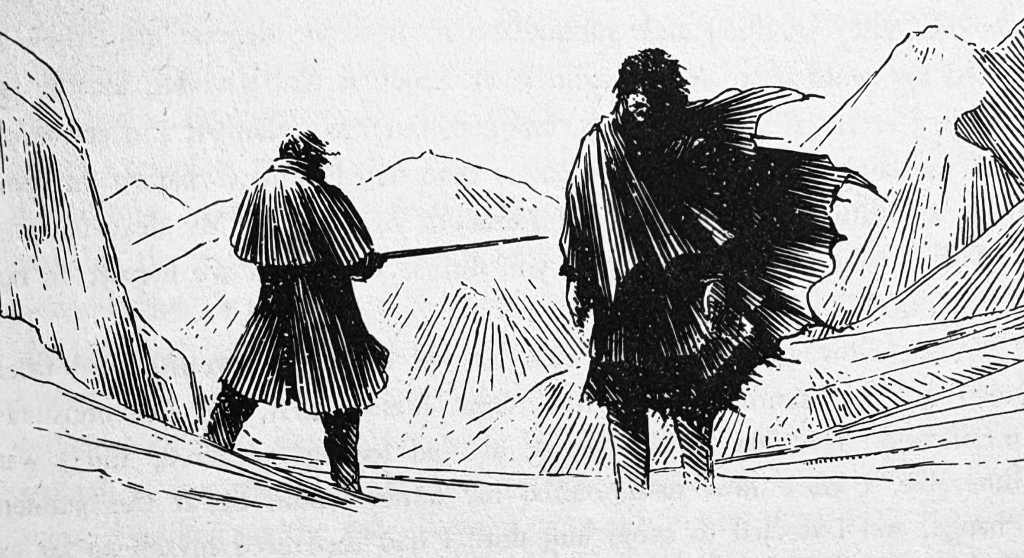
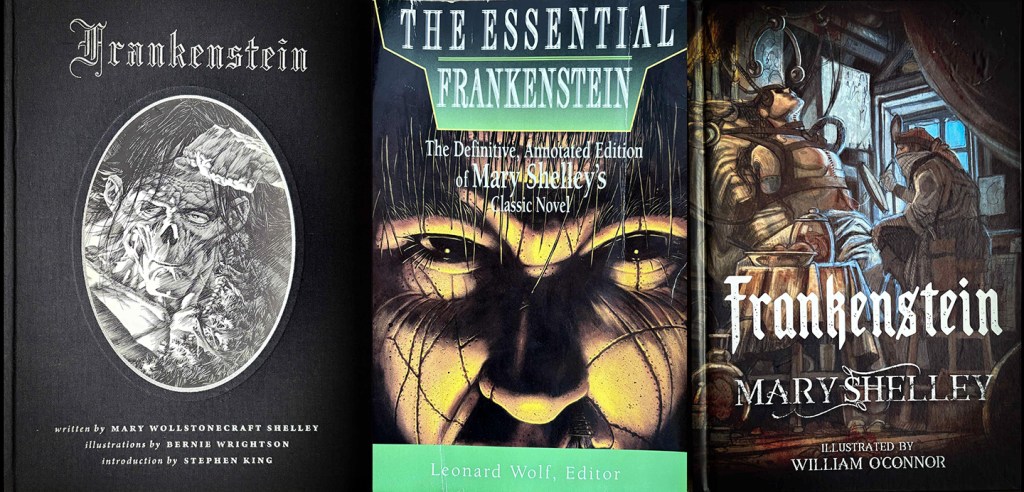
In one of my favorite books, The Essential Frakenstein, the editor (and annotator) Leonard Wolf includes quotes from a various science fiction authors, allowing them a little tribute to Shelley’s work. Author David Brin’s entry states my above point well:
From all the bad movie ripoffs of Frankenstein, you’d think the story’s lesson was “Don’t go meddling in the business of the Almighty.” The very word, Frankenstein, has become a metaphor for the price of overweening, over-reaching pride . . . a creator who tries to learn the secrets of God, and is destroyed by his creation.
As a kid, I always resented this moral. It sounded awfully like the stuff adults told youngsters, not so much to keep you safe as to keep you down. A lot of cultures tell scary stories meant to suppress hubris. Greek and Hindu gods were jealous, unwilling to share their powers, even with the worthiest of humans. Faust was punished mainly for wanting to know.
Then, as a teenager, I finally got down to the original Mary Shelly story, and learned that Hollywood had it all wrong! Despite his conceits, vanities, and lapses in scientific professionalism, Victor Frankenstain comes very close to succeeding . . . to pulling off something flawed but wonderful. What dooms him isn’t boldness, or his willingness to challenge the unknown, but a simpler character flaw—petty cruelty. Unable to feel for his creation, he treats the poor monster shabbily, teaching it how to be as heartless as he is.
Ever since then, the novel hasn’t been the same for me. Mary Shelley wasn’t saying, “Hands off!” She was saying, “Be kind, when you create. Godlike power demands godlike wisdom.”
I don’t think Victor Frankenstein in the book is especially cruel—only cruel by inaction, by absence and denial. I don’t think Shelley herself villainizes him to the degree popular criticism does. His actions are called out, in the end, his guilt and regret laid bare. Early on, Victor sets aside compassion when he conducts his super-science—for the sake of “sole occupation”—but at all other times he does feel emotion, and feels deeply. He loves his friends and family deeply, too. He is also moved by the powers of nature—he extolls the beauty of the land around him all the time. And it’s even for the sake of humanity that he reasons he cannot possibly create the female companion that the monster demands; he fears what it could mean. So, Victor feels a lot, but not for the thing he needed to most: his creation.
Victor Frankenstein is the OG deadbeat dad in the science fiction genre. By his inaction, his constantly refusal to face what he has done, and in running from responsibility, Victor makes the Creature into the monster he accuses it of being . . . when it otherwise would have been just an exceedingly rare and gifted child. The Creature wasn’t predisposed to go wrong—we get so much evidence to the contrary—and even when he does go wrong, he does so not against all humanity but only against Victor and his loved ones.
I will revenge my injuries; if I cannot inspire love, I will cause fear, and chiefly towards you my archenemy, because my creator, do I swear inextinguishable hatred.
But still, the Creature has not a stitch!
 Foreshadowed and Foresung
3 responses to “Frankenstein’s Monster Has Not a Stitch On!”
Thank you for this, Jeff, I wholeheartedly agree – it is the success of certain depictions / adaptations that has led to how many, if not most people see the ‘monster.’ And even though I love Pratchett’s Igors and Igorinas and they are a most excellent group of characters – but, then again, they are invention beyond the words of the book.
To me it feels a little like my personal take on the pointy ears of ‘Tolkien’ characters in the new millenium – and already before…:
Tolkien never really had this in mind, imho, but the amalgamation of Leonard Nimoy’s BILBO BAGGINS (and indirectly Star Trek), D&D and the Hildebrandts’ depictions led to those ears being taken as truth by the end of the 70s…
And nothing’s gonna change that anymore. 😅
LikeLike
Marcel, absolutely—the wild adaptations have spawned all kinds of fun and famous tropes and archtypes that are worth enjoying. I just wish more retellings would get back to the original. Mary Shelley’s book is alluded to and cited sometimes, but it feels like her actual words and themes get buried under other people’s “improved” ideas.
Re: Tolkien’s Elves’ ears. I know what you mean. It’s such a part of our cultural vision now, it’s impossible to escape. For my part, I don’t mind it, it has a way of being a visual shorthand for non-human. However, what I don’t like is the emphasis that’s grown with it. To the point (heh) that, in The Rings of Power, some Men actually have developed a derogatory term for elves, “pointies.” Ugh.
LikeLike
[…] it Victor or Victor Frankenstein. Gonna make a half-comedy that focuses on the creature, and will ignore the book but embrace the old Universal version? Call it Glitches Get Stitches, or maybe Dude, Where’s […]
LikeLike