
Go not to me for true film criticism, for I will say both “It was great!” and “It wasn’t that great” about almost anything. Almost.
But! It’s 2024, and I got to take my family to see a Lord of the Rings film in December just as it premiered. That felt . . . good, and a tiny bit nostalgic. I still have more enthusiasm in me than disappointment, and as always, more Tolkien is better than less Tolkien. Even poorly made Tolkien adaptations (which this wasn’t) is an excuse to talk about Tolkien . . .

This movie was fun, there’s no question.
But you know what were also fun, each in their own time? All three Hobbit films. They, like The Lord of the Rings: War of the Rohirrim, were nowhere near as amazing and life-changing as Peter Jackson’s original Rings trilogy, to be sure. The Hobbit films were completely enjoyable but were also riddled(-in-the-dark) with big and little problems.
The War of the Rohirrim had some story decisions I can quibble about, but it had no big problems. It also had no big emotionally devastating yet healing revelations. No overarching lore-crimes, either. No lore-crimes like making a beloved book character complicit in the works of great evil or having an inexcusable borderline romance with the villain . . . in case anyone’s seen that sort of thing happen before.
Here in this blog post, I will give this movie the same bullet-point treatment I gave each episode of The Rings of Power. There will be spoilers. But then, you had decades to read the handful of paragraphs from which this tale is lifted!

As An Adaptation
I guess the first question is: How was this as an adaptation of Tolkien’s work? Because this is essentially the movie novelization of a section of text from Appendix A of The Lord of the Rings: The story of Helm Hammerhand, the ninth king of Rohan, is roughly fourteen paragraphs of text and is written more as a historical account than as a story.
With that in mind, on a lore-breaking scale—where a 0 would mean 100% book accurate to the point of being a bit too stiff, and a 10 would be the sort of reimagining that The Rings of Power does with Tolkien’s text—this film would be a 5. It wasn’t half as lousy with callbacks as an episode of RoP but it did have some. Still, half of them were perfectly reasonable. I have to assume that TV and film studios run focus groups and the results always come back with a resounding, “Hell yeah, give us callbacks galore! We barely remember the original movies so anything you can do to remind us of them would be much appreciated.” Filmakers and TV show executives are under the impression that their audiences unanymously love callbacks. This is the world we live in.
Likewise, I suppose only a handful of us do not like callbacks and find them groanworthy. To me, as I’ve said before when discussing The Rings of Power, callbacks that aren’t well-integrated into their scenes—where they would be seamless and appropriate—come across as cheap or condescending. When they’re not earned, they’re little throwaways that the writers think will make you pump your fist and exclaim, “I got that reference!” And by then you’ve been jerked out of story immersion.
As an adaptation of the story of Helm Hammerhand, The War of the Rohirrim does just fine. It’s got some confusing quirks, but what film doesn’t? Despite the annoying callbacks, this film stayed in the lines. It did no harm to the larger Middle-earth around it, and that’s important. Not all adaptations can say that. I’m quite glad the story stayed entirely in Rohan and let Rohan be its own place. If anything, it was too focused on this story and didn’t show us much of the people or culture in a way that it could have.
The Characters
- Héra – I list her first because this was her story, not Helm’s. I liked her thoroughly. She was easy to root for, easy to tag along with. She wasn’t over the top, she wasn’t merely a recreation of Éowyn, despite the obvious parallels. She was not a “girlboss” in the way that insecure internet nitwits say that word. Héra is a skilled warrior and rider, coming into her own as a shieldmaiden, and perfectly in line with Tolkien’s world. Moreover, she’s a princess of Rohan surrounded by other leaders (her brothers, her father). She’s in a position of leadership that isn’t even a little bit forced. She’s no Mary Sue; she’s not unrealistic any more than Helm himself was. He’s larger than life, and she’s of his blood.
- All that said, I admit she comes across as a bit too generic as a warrior-heroine. Héra seemed more like an amalgam of other film characters—like Merida from Pixar’s Brave—than an entirely unique character out of The Lord of the Rings. Her feeding the Eagle was excellent, but the scene where she returns only to get scolded for having been out and not wearing proper princess attire (and now she’s expected to show up at a formal) felt like a scene I’d seen a million times before. But I do like her and the characters around her.
- Tolkien may have written too few female characters in The Lord of the Rings, but every one was distinct. Galadriel is nothing like Éowyn, who is nothing like Ioreth, who is nothing like Goldberry, Lobelia, or Rosie. But still, Héra is cool. I think if the film’s writing were a bit more nuanced, more of a unique personality could have emerged. If this was a TV show, I’m confident we’d get more from her.

- Helm – He was cool, to be sure! Though I kind of had a hard time hearing Brian Cox truly inhabit the role in the way that some of the other voice actors did. I appreciated the fact that he wasn’t as noble as Théoden, not as pivotol as Eorl the Young. Even in Appendix A, he’s a king who did right by his kingdom but aside from making a legend out of himself, he doesn’t leave a unique cultural mark on Rohan in the way that I think Héra would if she was written more about in the history.
- Just for fun, I now try to imagine recent McDonald’s commercials as Helm doing the voiceovers.
- Olwyn – How cool was she?! I wasn’t quite sure what her role was to Héra. She seemd both bodyguard and handmaid, perhaps even a governess. The fact that she was a shieldmaiden in a time when shieldmaidens were fading out was badass. I fully expected her to die early on (arrow in the back), and they didn’t do that. Really glad. They defied stereotypes with her.

- Freca – He was all right, and sufficiently “wide in the belt.”
- Wulf – He made a decent villain. He was sort of like a blundering, mediocre version of Túrin—minus the good intentions. Skilled and charismatic enough to have mustered a lot of people to follow him, but also really good at putting them all in harm’s way. Like Túrin, he’s completeley unable to heed the advice of wiser advice-givers. The scar on his eye was a bit stereotypical, even if he saw where he got it.
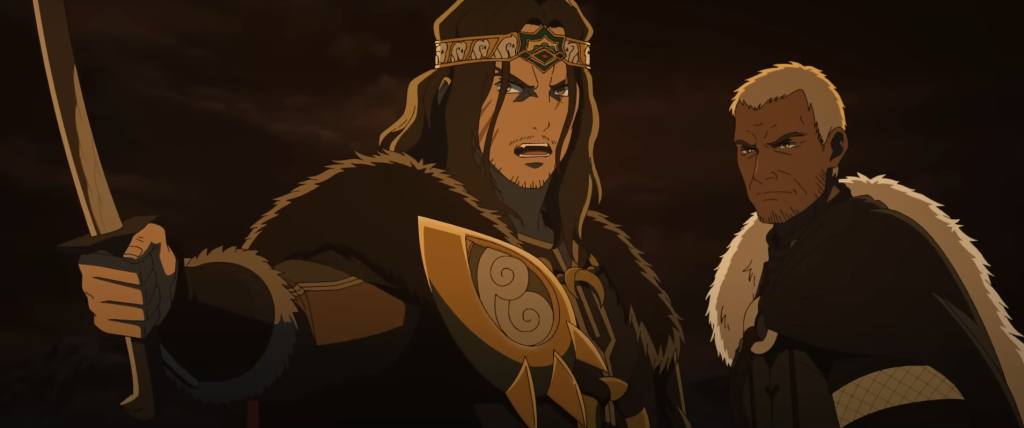
- Haleth – I guess the name Haleth is one of those unisex names (like Jamie, Robin, Sam, etc.), since it was first used as a warrior-chieftainess in The Silmarillion. This Haleth was cool, even though his death was a little less Tolkienian in the film than in the text. Tolkien loves the image of someone dying or being captured before some important doors. Like Finwë, Mîm, and Celebrimbor. Who am I forgetting? A bunch, probably.
Wulf took Edoras and sat in Meduseld and called himself king. There Haleth Helm’s son fell, last of all, defending the doors.
- Háma – Háma was even cooler, and therefore his death even more tragic. He’s a reluctant soldier. Háma reminded me a little bit of Maglor (an Elf in The Silmarillion who got caught up terrible events; a musician forced to become a warrior; even though he was on the bad side of history, he lamented it).
- Targg – I appreciate a competent bad guy who’s on the wrong side but doesn’t seem to be a total jerk through and through. He may be murderous, but he seemed to care about the general well-being of his army, unlike Wulf.
- Fréalaf – We didn’t get too much personality in Héra’s cousin, but what we got was great. He seemed Faramir-ish, even; noble, respectable. If anything, his loyalty led to a bit of Denethor-ishness from Helm, and really brought out the king’s flaws. He fit well into the understated but clearly faithful camaraderie between the cousins.
- Old Pennicuik – I don’t really understand who she was, but I enjoyed her part. She felt like the most Anime-ish character of them all; she could have on staff at the bathhouse in Spirited Away.
- Lief – Couldn’t help but keep thinking of Sam with clumsy but faithful Lief. Maybe because he was just the smallest.
- The Eagle – No strong opinions. It was cool to see, even if it seemed a wee bit too large, even for one of the Great Eagles. They could have overplayed the bird, but didn’t. It delivers Helm’s armor to Fréalaf, it doesn’t come swooping in to join the battle.

Having said all that, let me break this down into things I appreciated . . . and didn’t.
What I Loved
- The fact that they wasted no time on a love story for Héra. The fact that there is a female main character didn’t have to mean a romance was necessary. It’s refreshing.
- How they handled shieldmaidens. Like, they were an order. And the fact that Olwyn was one of them is so freakin’ cool. This is fine example of inventing new lore without pushing beyond Tolkien’s boundaries or making existing lore untrue.
*cough* Rings of Power *cough*
- Héra’s relationship with her brothers. They didn’t condescending to her, and she clearly loved them. Even Éomer does speak poorly to his sister sometimes. Now, Helm does regard his daughter with gender-based expectations, but he did need a character arc, after all. Yet his sons never shame their sister at all. Again, refreshing.
- Grief was well portrayed. You could feel it.
- The scenery was gorgeous. The architecture, the landscapes, the weather. It all looked amazing. Though, I was not wowed by the animation itself. I actually, weirdly, went in thinking it would look more fluid than it ended up. It looked, to my very uneducated-about-animation and untrained eye, like Anime of twenty or thirty years ago. No better (and no worse) than, say, Spirited Away. But maybe that’s intended; maybe Anime is meant to be consisent and not meant to evolve. Or, if it has, I just can’t see it.
- The Mûmakil of Harad were cool. I didn’t mind seeing them, though it’s a bit of a stretch to see them show up this deep into Rohan. They’ve come a long way.

- Some of the smaller story inventions were enjoyable. Particulaly the side characters we spent enough time with, even if they weren’t fully explained. Old Pennicuik and the chest, for example. I would have liked to know more about the secret door, the tunnels, or to have glimpsed the Glittering Caves.
- Háma’s horse, and the time spent showing how exhausted it was. Poor thing.
- That one scene near the end when the three women—Héra, Olwyn, and Old Pennicuik—share a moment before Héra enacts her plan. With no men around. A lovely moment of solidarity and loyalty.
What I Didn’t Love . . .
That some of the coolest aspects of the Helm story that Tolkien packed into it were downplayed when they could have been wonderfully depicted and dramatized. In part, this was just a consequence of just changing the story. Don’t get me wrong, some of the story deviations actually made sense, like . . .
- The fact that the writers had Helm’s “brawl” with Freca take place within the walls of Edoras (with many witnesses) rather than outside its walls (with no witnesses), as in Appendix A. In the text, no one else sees Helm’s single-punch death blow to Freca. In fact, there is no mention of there being a scuffle at all; Helm just hits him once, Freca is stunned, then “died soon after.” But in the movie, Freca does throw the first few punches and even hits Helm. This makes Helm’s retalitatory strike a little bit less savage. At the same time, having Wulf bear witness to his father’s death, and his subsequent attack on Helm, makes good story sense. This depiction served better to explain his obsession with revenge. I had no problem with that.
But what was downplayed and fastracked was this passage from the text (which is the best part of the story, if you ask me). For context, Wulf’s already returned, and taken Edoras, and the surviving Rohirrim retreat to the Hornburg. With his sons slain, Helm becomes “gaunt and fierce.” Then this awesomeness . . .
He would go out by himself, clad in white, and stalk like a snow-troll into the camps of his enemies, and slay many men with his hands. It was believed that if he bore no weapon no weapon would bite on him. The Dunlendings said that if he could find no food he ate men. That tale lasted long in Dunland.
- Now, I didn’t mind that in the film, when Helm went out, he snuck out without even his own people aware of it. That was interesting, and it certainly worked well in his relationship with Héra. Her discovering the secret door and following her dad . . . all very cool. Story inventions like this do no harm to the story at large.

- BUT . . . the film then deliberately conflates two very cool different aspects of Helm’s Tolkien’s version concerning the legends told about Helm. It mixes the snow-troll simile with the wraith concept. And that’s a big shame.
- To be clear, in the text, Helm goes out and stalks the camps of his invaders, picking them off one at a time, clad in white (not nearly shirtless!), with his bare hands, in the snowstorm. Here he is “like a snow-troll” because he’s perceived as monstrous and bearing no weapons but his own great and savage strength; saying that he ate men . . . this is talking snow-troll stuff. This is Helm being a goddamned Wampa. (In Tolkien lore, no one says wraiths eat people.)
- Then, later, when Helm is found dead, frozen in place, standing on the Dike of the keep, this moves to a later part of the legend. See, now it’s known that he’s dead. It’s public. He died standing upright and it makes him even larger in life . . . and larger in death. This isn’t snow-troll stuff anymore. This is something else. Note that in the history, this actually marks the end point of the war (whereas in the film it’s not, and Wulf is there, and continues to lay siege, and thus we have Héra part). At this point, winter has ended, Fréalaf shows up and attacks Wulf at Edoras (not Helm’s Deep).
- Now, with Helm dead, the wraith aspect comes in. In the text:
Yet men said that the horn as still heard at times in the Deep and the wraith of Helm would walk among the foes of Rohan and kill men with fear.
- In other word, no one thinks he’s still alive, munching on people like a snow-troll. In death, Helm’s even scarier, and now as the centuries go by, they say the wraith of Helm comes out of Helm’s Deep and scares people to death. With fear. Like a wraith does.
- But this film muddies up these ideas and just combines them:
- Future Éowyn narrates: “Whispers spread that Helm Hammerhand was human no more. He bore no weapon and no weapon could smite him. A terror born of madness and grief. A wraith.”
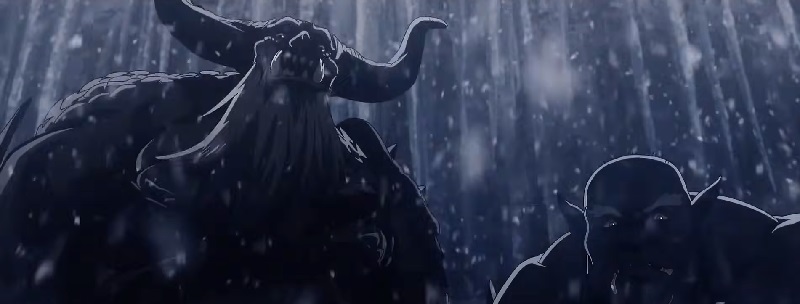
- The whole segment is mere seconds long. And then later we see an actual snow-troll show up, and Helm beats it up. So they’re kind of jamming in the snow-troll thing in a more literal fashion.
- All along, I’d been hoping we’d get a longer sequence of Helm stalking the camps, and the invaders discovering the bodies, only getting glimpses of a snow-colored hulk moving through white-out conditions. Oh well.

Another disappointing deviation this story introduced that’s also one big callback: The Watcher in the Water. Particularly in the where and how they placed it where they did; never mind the actual sequence of it eating a sickly oliphaunt.
- For one, the very name “Watcher in the Water” was what Ori called it in the Book of Mazarbul. It gets named that just once in the book, as Gandalf reads it: “. . . the pool is up to the wall at Westgate. The Watcher in the Water took Óin . . .” Yet this group of Rohirrim 262 years before the company of the Ring goes to the Westgate of Moria call it this already, as though that’s a well-known label. You know, those Watchers in those Waters! Hey, I gotcher Watcher right here! And this one lives in a lake in Rohan?
- In the book, Gandalf himself had no name for the creature. When Frodo asks what it was, the wizard answers, “I do not know . . . Something has crept, or has been driven out of dark waters under the mountains. There are older and fouler things than Orcs in the deep places of the world.” The implication is that the Watcher is just one of the nameless ancient things in the world, things probably bred by Melkor in the truly old days of Utumno or even earlier. Things Sauron himself never quantified. But here the Watcher just seems to be a species, one of the natural creatures of Yavanna; look, it’s even got a little tree-hat on to help camouflage it in this habitat. Adorbs.
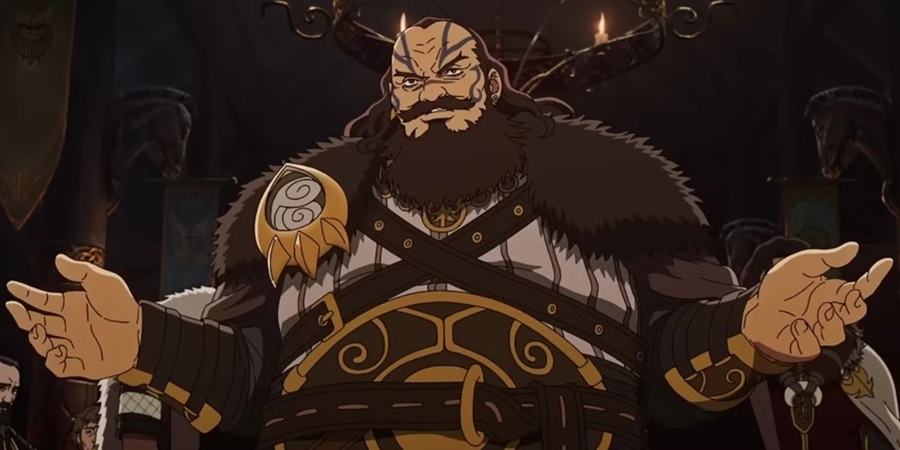
While the method of Háma’s death was used to heighten the drama at the Hornburg, and gave us necessary reactions from both Helm and Héra, I didn’t like that it felt like a retread of Fili’s death in The Hobbit: The Battle of the Five Armies.
I fee like we didn’t get enough time exploring the Rohirrim’s affinity with their horses. We got some good horse-riding action, yes, but the important of horses to the people could only be seen in all the artistic motifs. It would be like if had an Elf-centric story and never got to hear any Elf-singing. Singing is part of who they are.
Likewise, this felt like a missed opportunity concerning the Dunlendings. The films give us barely a look at them; only the Extended Edition of The Two Towers gives a few extra seconds showing them. It might have been helpful to show us where they live, why they’re marginalized and why they hate the Rohirrim so much. Other than making them visually a little more distinct (I did like the skull-helms), the film just kind of lumped them in with Freca’s and Wulf’s disenfranchised Rohirrim.
But you know? There’s also a lot they didn’t do that they could have that would have mucked with the larger Middle-earth story. If this movie had been made by, say, other hands, Wulf would have gotten a hold of the palantír in Orthanc and inexplicably been able to use it, Elves with modern haircuts might have shown up even just as a cameo, and Gandalf would have crashed the coronation ceremony and we’d have been treated to some cheesy foreshadowing words between him and Saruman.
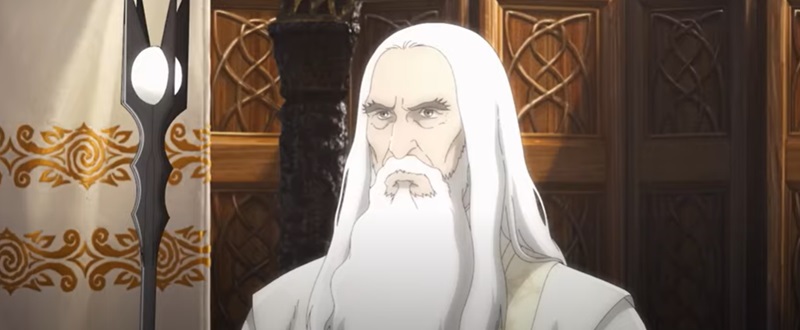
I did enjoy seeing Saruman at the end, in a friendlier context, but I wish the scene was more substantive. While it’s cool hearing actual Christopher Lee, I would have preferred to hear some dialogue (even if it meant another voice actor’s involvement) that better ties the moment into the story. Even if just to the live-action Jackson films.
Now, in the book . . .
It was at the crowning of Fréaláf that Saruman appeared, bringing gifts, and speaking great praise of the valour of the Rohirrim. All thought him a welcome guest. Soon after he took up his abode in Isengard. For this, Beren, Steward of Gondor, gave him leave, for Gondor still claimed Isengard as a fortress of its realm, and not part of Rohan. Beren also gave into Saruman’s keeping the keys of Orthanc. That tower no enemy had been able ot harm or to enter.
See that? Bringing gifts? We could have seen some of that! But also notice the detail that no one, until Saruman took up residency there, was able to even enter Orthanc. Which I’m pretty sure Wulf and his men were doing in the film, just hanging out there. Although I did like that statement that one of the characters made that became the name of that track in the score:

Still, showing Wulf and his alleys camping out in Isengard is one thing. That’s totally cool. But having them actually in the tower of Orthanc was a bit much.
All in all, this was a fun movie, but it was also sprinkled with a lot of cool little moments that could have been used for something more. Even that line, “Who dares occupy Isengard?!” was an opportunity. Why? Why is it an arrogant thing to occupy Isengard? Tell us! Have someone older and wiser (Olwyn, ideally) say something about it being a fortress made by Númenóreans, and that it belongs to Gondor, but that it has not been commanded for many years. Something like that. No need to explain Númenor, just link the moment to larger world and move on.
Anyway . . .
 Foreshadowed and Foresung
5 responses to “So I Saw The War of the Rohirrim . . .”
Hera may not have been a “girlboss,” but she (to my mind) definitely fit the “strong, independent woman who don’t need no man” stereotype to a fault.
My biggest disappointment was Haleth’s last stand was very underwhelming. When reading the book, I envisioned a scene reminiscent of Húrin, standing valiantly to guard the retreat as he kills countless enemy soldiers until he’s overwhelmed. In this version, he…attempts to stop the oliphant from destroying Meduseld? Which then gets destroyed anyway. And he’s shot from a distance in an almost anticlimactic way.
I think the film went on for too long (yes, I get the irony of calling a two-hour LOTR film ‘too long’). As in the text, it should have ended soon after the death of Helm. Everything afterwards feels tacked on and extra.
LikeLike
I quite agree about Haleth.
And as for Héra, I can well imagine how easy it would have been to conform to modern trends and had her upstage her brothers at every turn. Or even talk angrily to them, to assert her dominance. They didn’t do that. They could have had her doing a whole lot of grating things. But they didn’t. She did different things than they did; different heroics. She was more believable than Rey, than RoP’s Galadriel. She was, at least, more believable than Jackson’s Legolas feats.
LikeLike
spellchecker and grammerly could have made this more enjoyable 😉
LikeLike
A fair point. This was hastily written.
LikeLike
Don’t be Hasty!! 🙂
LikeLike