
The following is a list of bullet-point thoughts I have about The Rings of Power season 2 episode 2, “Where the Stars Are Strange.”
But first, there is one item I meant to include about the first episode but still relates to this one:
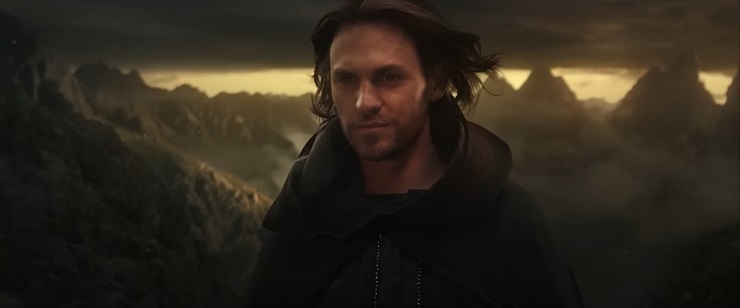
When the heck was this scene meant to portray? When Halbrand smiles evilly for the camera as he enters Mordor.
- Chronologically, this moment seems to takes place after Halbrand was revealed to be Sauron. Only Galadriel is aware of who he is at this time. Meanwhile, he left her unconscious by the stream in Eregion. . .
- I still wonder why he would allow her to live, if she’s (1) rejected his offer of joining him and (2) knows the truth about him and is sure to tell the Elves straightaway.
- Lucky for him, she doesn’t. RoP Galadriel really is perfect for RoP Sauron, isn’t she? She doesn’t call him out or try to hold him accountable. She waits until she’s hundreds of miles away from where he’s been using his influence and pulling some strings before she tells her immediate supervisor . . . and she does that only when she’s asked about Halbrand.
- So what’s Sauron doing simply walking into Mordor? Are we to understand or assume that, after putting on this cool, flowing, Sith lord cape—presumably worn so he can cut a striking figure for the last scene of the season finale—only to take it off, get grimed up, and then surrender himself to the Orcs (as the “king of the Southlands”) so he can be brought before Adar in chains as we see him in the first episode of the next season? Maybe the answer is simply yes.
- Now, if we someday get another flashback that fills in this scene . . . great.
Khazad-dûm
- Glad to be back at Khazad-dûm! It still looks amazing. 75% of the Dwarf stuff I think the show has done well. The particulars of mithril, the existence of two simultaneous Durins, the menace of the Balrog thousands of years too soon—I’m not so crazy about.
- I’m even happy to see Durin and his wife, Disa, doing some shopping in the market and clipping coupons, as it were. This scene is what really makes it feel like a TV show vs. a movie. There’s room to stretch. But I like all of this.
- But seriously, the interactions that Durin and Disa have, with each other and with others, are all great. More of that, please!
- I’m wary about the reasoning behind the earthquakes—surely it’s the Balrog stirring, and possibly coordinated by Sauron—but we’ll see where it all goes. Happy to forestall judgment on this until we know what’s what.
- I like that Disa is a stonesinger and has this cool ability to communicate with the rock of the mountain in this way. It made sense when it came up in season 1—to search out the proper tunnels to mine or not mine, and to assist in the safe recovery of the Dwarves in the collapse—but now it’s getting vague and maybe a bit too magical. Disa and her two companions sing just in one spot and it somehow encompasses the whole of Khazad-dûm in one go? That feels lazy. I’d rather have seen some kind of montage of them trying their song in various locations.
Lindon
- Galadriel is having visions, mostly bad ones. By itself, this is fine, because Elves sometimes do have visions and moments of foresight (like Glorfindel!), but the implication is that these visions are caused by her Ring of Power. Boo.
- I know I just have to square with the fact that the Three Rings, which were made first in this show (out of the sequence in Tolkien’s writings), are being used at all in the Second Age. And what the Three Rings do is going to be all-new. In the books, they’re about enhancing one’s natural abilities and powers, and especially about preservation and safety. In this show, I think they’ll probably just remain vague. Healing the tree in Lindon, saving the souls of all Elves, granting visions of the future, and whatever else serves the plot. Would Rings of Power fans be okay if they also generated glowing sabers for their wearers? I kind of wonder.
- In Galadriel’s vision, Celebrimbor is punctured by numerous spikes. Question is, is this forecasting his future (as we know Tolkien devised it, wherein Celebrimbor is turned into a gruesome banner by the Orcs and filled with arrows?), or is this another nudge-nudge-wink-wink from the showrunners, a little nod to the Unfinished Tales account that they can’t or won’t really use?
- I hope it’s the former. I hope Celebrimbor’s final fate (which is not given in LotR) is true to Tolkien’s writings. Because at least this vision of Galadriel’s will pay off.
Easter Eggs
A few words about Easter Eggs. They work fine in some media, such as in video games or anything lighthearted. But in a mostly serious fantasy epic for a beloved saga like Tolkien’s . . . they sting.
To me, the Rings of Power Easter Eggs are are nods to lore that the show isn’t exploring. They break me right out of any immersion. They’re instant reminders of what the show either doesn’t have the rights to go into for real or have chosen not to go into. To what they can’t or won’t show us.
To me they’re not respectful tributes; they’re crumbs that the showrunners are expecting will satisfy the book nerds. I know they do satisfy for some people. I acknowledge that. Some fans eat them up and are satisfied with crumbs.
Here are some examples. To me . . .
- Mean Elf-kids in Valinor throwing rocks at little-girl-Galadriel’s paper boat does not replace (and give full credit to the show) for the existence of The Silmarillion‘s Kinslaying.
- A big pile of helmets, while visually striking, doesn’t earn the show credit for somehow inserting the Haudh-en-Ndengin (the Hill of the Slain) that was heaped up by the Orcs after the Battle of Unnumbered Tears (the Nirnaeth Arnoediad). In the book, those massive piles were the dead enemies of Morgoth all heaped together and left out to rot. They did the heaping. The helmets in RoP is Elf-work, it appears.
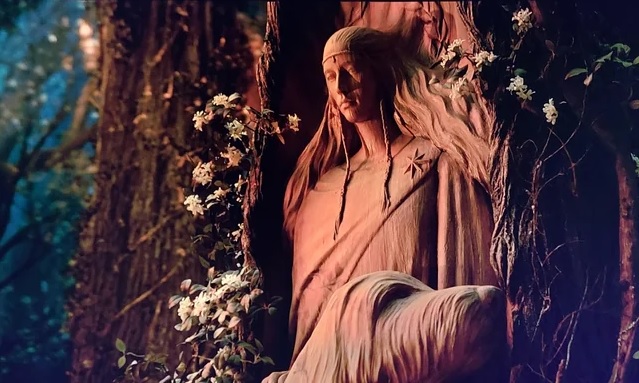
- A wooden carving of an Elf-woman and a dog does not earn The Rings of Power the full Beren and Lúthien story. It’s trying to shoehorn Lúthien and Huan in a matter of a few seconds. Yet in no other way does it connect to the actual Rings of Power story. In the book, Lúthien and Huan are part of the very story that involves the death of Finrod, Galadriel’s brother, and in this show, Finrod died some other way.
- Adar talking about being led to a mountaintop and getting chained and starved there does mean we somehow have the story of Maedhros and his chaining on the mountain face of Thangorodrim.
I wish they followed Yoda’s mantra: Do or do not. There is no try. In other words, show us the story at hand if you can. Commit to it . . . or don’t. If you don’t, then do a different story that you can do justice. Don’t just toss us crumbs from the story you’re not doing. I don’t mean to sound callous, but these things do bother me.
Back to Lindon
- Gil-galad is still being a jerk to Galadriel. Does nothing make him happy?
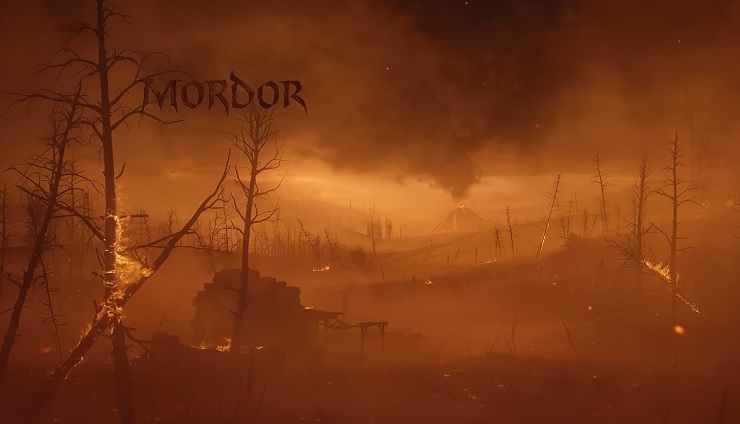
- Elves in both Eregion and Lindon are now casually referring to Mordor by that name. Did we miss the announcement of its naming? It’s an Elf-name. It would be fine if they’re the ones who called it that first. It was the Southlands until that title card changed, when someone in season 1 asked Adar what it would be called now and he didn’t answer. Who called it the Land of Shadow, I wonder? I mean, in the show.
- Gil-galad says “Sauron is alone, without army or ally.” Why? Why does he presume this? Where is he getting his information? Prior to Galadriel showing up with Sauron in Eregion, Gil-galad was confident that Sauron was long gone (as well as evil itself!) from Middle-earth. Elven intelligence doesn’t have a good track record.
- Knowing a siege will be coming to Eregion this season, I do appreciate that Gil-galad and Galadriel talk a little bit about its defenses. One of which are the two rivers around it. But then Gil-galad admits he’s having visions now, too. “Waters running dry.” Errr . . . put two and two together, Gil-galad! Why constantly talk like Eregion is so safe when you know it isn’t.
- Speaking of Sauron, Gil-galad says, “It is said that once the Deceiver obtains a being’s trust, he gains the ability to sculpt their very thoughts.” Based on what? Who said that in the first place? It’s exasperating. We never know what information the Elves have on their enemy. This is coming from the same guy who said Sauron was long gone, remember. Now he’s digging up some old intel he feels confident is at play?
- Are we to supposed to think that red-haired Fancy Sauron from a thousand years ago, as he was depicted in the prologue of the first episode, is the one Gil-galad is thinking of when he says “the Deceiver”? Was RoP Sauron known even back then as “sculpting” the thoughts of other beings in the First Age? That already sounds like Sauron’s famous for nuanced strategies, so why was he pitching some new idea to those Orcs?
- Círdan shaving. It was funny for just a moment, then undermined the rest of the scene. It’s not really an Easter Egg, but it’s clearly a joke from the showrunners. “You LotR readers will recall Círdan has a long beard at the end of the story. Well check it out, he had a beard in the Second Age, but look, we’re showing him shaving regularly. What a hoot!”
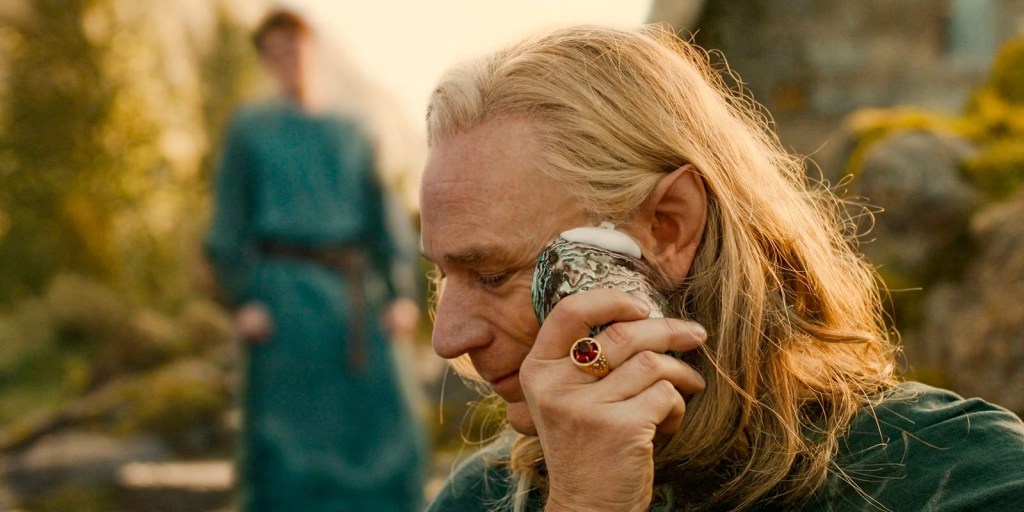
- Círdan name-drops both Rúmil and Daeron but doesn’t explain who they are. There’s no payoff. TV show watchers who never read The Silmarillion will have no idea, so this was for the book nerds. Are we to applaud and go nuts that we got a few more lore-crumbs? I guess so.
Eregion
- I’m so glad to get better eyes on Eregion, which still seems to be just the one city and that city is Eregion. It looks wonderful, I have to say.
- I’m not wild about a lot of the costuming, but that’s a minor point.
- Halbrand is back, awaiting to be received by Celebrimbor. He is denied! But he exhibits patience, and that’s more than fitting.
- But he flashes his injuries, and Celebrimbor’s personal assistant feels bad. Elf-women all seem to go gaga for this “low man.”

- Celebrimbor’s assistant is named Mirdania. A nod to Gwaith-i-Mírdain, the jewel-smith guild that Celebrimbor is part of? That is, an Easter Egg. Even though that construction has no precedence for a female Elf’s name.
- Celebrimbor tells Mirdania, “I promised Lady Galadriel before she left that I would never treat with him again.” That, right there, is probably the weakest link in the whole Elf-chain of events. That is all she told him? Again and again the writers are running over Galadriel with that bus. I can’t understand that level of irresponsibility on her part. Now it feels like her role in the War of the Ring and the helping of Frodo and the company is just atonement. Like, yeah, you’d better make up for the big mess you helped foist on the world.
- I think both Charlie Vickers and Charles Edwards are doing excellent with what they’ve been given.
- But man oh man, is Celebrimbor such a rube. Such an easy mark, as if he were centuries younger; a real whippersnapper of an Elf-smith, not the esteemed lord of a bunch of other smiths, certainly not the ruler of a city.
- When Sauron, in Halbrand form, delivers the line “They worked wonders,” speaking of the Three Rings . . . that is the kind of charming deception I would prefer to see all throughout. Instead, his well-acted manners and evil smiles that fool only Celebrimbor just make Celebrimbor seem like a dummy.
- But also, how would Halbrand know? Why does Celebrimbor, who is now discarding Galadriel’s meager warning, instantly believe that Halbrand has . . . what, been to Lindon, a realm of Elves and not Men, and while there he was allowed to bear witness to the “wonders” of the Three? And then he presumably rode back, all banged up with fresh wounds (without explaining how he got them) and without an Elf escort, to report how wonderous the Three Rings were? I’d feel a lot better if Celebrimbor was curious even a little about the sequence of events, or showed even a smidgen of doubt about . . . anything. He falls for everything.
- Before I write about the Annatar transformation, I need to address my biggest concern with this developing plotline.
How does Sauron convince the Elves to make rings?
The Lord of the Rings is vague on this point, and that’s why Amazon’s writers are making up reasons of their own. At the Council of Elrond we read that
many eyes were turned to Elrond in fear and wonder as he told of the Elven-smiths of Eregion and their friendship with Moria, and their eagerness for knowledge, by which Sauron ensnared them. For in that time he was not yet evil to behold, and they received his aid and grew mighty in craft, whereas he learned all their secrets, and betrayed them, and forged secretly in the Mountain of Fire the One Ring to be their master.
Which can be boiled down into: The Elves of Eregion were eager for knowledge, and Sauron gave it. The show has distilled all the Elven-smiths into simply one Elf: Celebrimbor, a particular famous artisan, who wants greater recognition than he already has, and he wants to produce something wonderful. It’s more about his ego and his legacy. There’s no “they” when talking about the Elven-smiths. Just him. Which is a shame, since at least “the Elven-smiths of Eregion” is right out of LotR which Amazon has the rights to work with.
But let’s be clear: Tolkien had a clearer and better reason for how Sauron “ensared” them into making rings. It was included in The Silmarillion by Christopher Tolkien in 1977.
Only to Lindon [Sauron] did not come, for Gil-galad and Elrond doubted him and his fair-seeming, and though they knew not who in truth he was they would not admit him to that land. But elsewhere the Elves received him gladly, and few among them hearkened to the messengers from Lindon bidding them beware; for Sauron took to himself the name of Annatar, the Lord of Gifts, and they had at first much profit from his friendship. And he said to them: ‘Alas, for the weakness of the great! For a mighty king is Gil-galad, and wise in all lore is Master Elrond, and yet they will not aid me in my labours. Can it be that they do not desire to see other lands become as blissful as their own? But wherefore should Middle-earth remain for ever desolate and dark, whereas the Elves could make it as fair as Eressëa, nay even as Valinor? And since you have no returned thither, as you might, I perceive that you love this Middle-earth, as do I. Is it not then our task to labour together for its enrichment, and for the raising of all the Elven-kindreds that wander here untaught to the height of that power and knowledge which those have who are beyond the Sea?’
It was in Eregion that the counsels of Sauron were most gladly received, for in that land the Noldor desired ever to incease the skill and subtlety of their works. Moreover they were not at peace in their hearts, since they had refused to return into the West, and they desired both to stay in Middle-earth, which indeed they loved, and yet to enjoy the bliss of those that had departed. Therefore they hearkened to Sauron, and they learned of him many things, for his knowledge was great. In those days the smiths of Ost-in-Edhil surpassed all that they had contrived before; and they took thought, and they made Rings of Power. But Sauron guided their labours, and he was aware of all that they did; for his desire was to set a bond upon the Elves and bring them under his vigilance.
That’s the official narrative. And Tolkien clarifies it in his 1951 letter to Milton Waldman:
In the first we see a sort of second fall or at least ‘error’ of the Elves. There was nothing wrong essentially in their lingering againt counsel, still sadly with the mortal lands of their old heroic deeds. But they wanted to have their cake without eating it. They wanted the peace and bliss and perfect memory of ‘The West’, and yet to remain on the ordinary earth where their prestige as the highest people, above wild Elves, dwarves, and Men, was greater than at the bottom of the hierarchy of Valinor. They thus became obsessed with ‘fading’, the mode in which the changes of time (the law of the world under the sun) was perceived by them. They became sad, and their art (shall we say) antiquarian, and their efforts all really a kind of embalming – even though they also retained the old motive of their kind, the adornment of earth, and the healing of its hurts.
- So that, of course, is what RoP is not doing. It’s quickly becoming a situation not about Sauron deceiving the Elves. Just . . . one guy. Celebrimbor. Stoking his ego. Puffing him up. Nothing about appealing to his/their desire to make Middle-earth more like Valinor, to exploit their conflicted hearts (half wanting to stay in Middle-earth, half wanting to return to Valinor).
- The interception and murder of those messengers was surely Sauron’s doing, but I sure would like to see how he knew when and where to watch for them, and who did the murdering.
- I did predict that since Sauron is retaining the Halbrand face, he would simply change to his Elf-like Annatar form right in front of Celebrimbor. That actually makes the most sense. But then his reasons for not appearing as Annatar from the start would need to be more convincing. Instead, it’s suspicious. Would a servant of the Valar really begin the relationship with Middle-earth’s Elves with deceit? Come now, is this Middle-earth or is this Westeros? And why Celebrimbor fall for it instantly?
- Annatar’s fiery reveal and Biblical-style transformation was, to me, over to the top. I’ve read many fans saying it was perfect. I can’t agree, even though it was cinematically well executed. It’s too on the nose, for one. Fire? I keep hearing Frodo’s statement from The Fellowship of the Ring in my head: “I think one of [Sauron’s] spies would — seem fairer and look fouler.” Here, Annatar looks fair and sure feels foul.
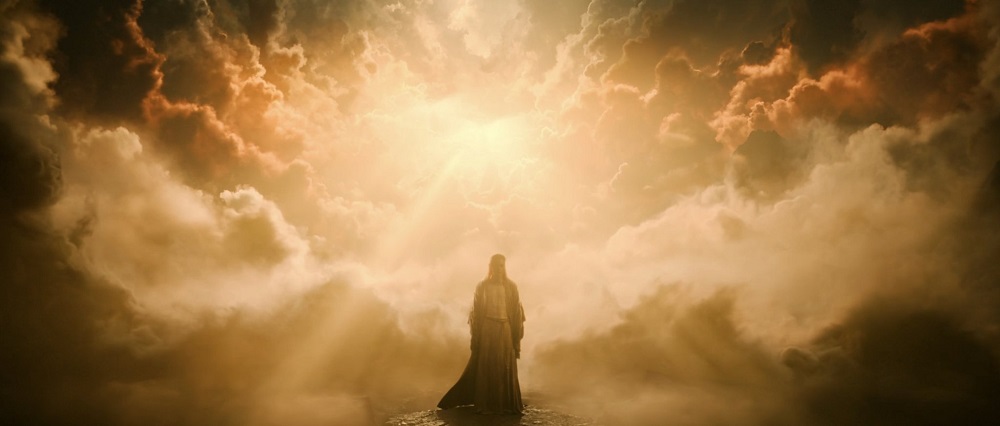
- But not to Celebrimbor, grandson of Fëanor, who in his lifetime ought to have already seen some wonders already. But I suppose this Celebrimbor may not have done all that much except make some notable works of art that have impressed his peers.
- I know Celebrimbor needs to be deceived—that in itself is expected—but I want him to be shrewd. I want him to be deceived only because Sauron is doing it, and doing it cleverly. This Celebrimbor would be deceived by anyone. There’s nothing subtle about this. Sauron should be offering Celebrimbor his heart’s desire—the betterment of Middle-earth, preserving it in bliss and beauty just like in Valinor!—not Celebrimbor’s name in lights. All RoP Celebrimbor needs is some smoke and mirrors and his name up on the marquee.
- If he’s thinking this is a messenger from Valinor, the sneaky I’m-just-a-wounded-Southlander Halbrand intro last season should be the big red flag.
- Here, Halbrand positions himself and Celebrimbor as blue-collar workers, like lowly tradesmen among others who are greater. “It’s the oldest tale there is, isn’t it?” he says. “The true creators toil till their knuckles bleed, and then they come along, take whatever profits them most, and forget all about us.” It bothers me that the show makes only Gil-galad lordly, leaving out the royalty of both Galadriel and Celebrimbor. In the Silmarillion stories, Celebrimbor’s grandfather would have been the High King of the Noldor were it not for Fëanor’s actions, which led his eldest son (Maedhros) to hand over kinship to his uncle’s line. Gil-galad’s line. Celebrimbor is called Lord Celebrimbor, so why fall for this particular act?
Rhûn / Caras Gaergion
- I have few very few gripes with the Rhûn plot so far. We just don’t know enough.
- The masked riders are freaky and cool.
- The “Dark Wizard” is intriguing, if a little bit generic at the moment. That said, I like Ciarán Hinds in everything he’s been. I’m looking forward to seeing what Ciarán the Beige will do next!
- I do hope the Saruman vibes he’s giving off are just a red herring, even though I’m tired of red herrings.
- The cultists, the acolytes, the “white wings” . . . all just the sort of invention I’m absolutely cool with. When the show fills in previously unknown zones, it does all right. How it connects to the Rings of Power plotline is the crucial part.
- What I don’t like about any of this is the idea that the Stranger—whether Blue wizard or, in fact, Gandalf—has been tossed into Middle-earth to help but doesn’t know who he is, what his proper goal is, how to use his magic, and when he does he loses control. All of that feels like filler, to extend the show.
- The Istari are already intentionally limited by being sent to Middle-earth in incarnate bodies and not just in some form of raiment (or fanar) for their Maiar selves. Now they also have to remember who they are first and learn how to use their power? Yikes. That feels like filler.
- Nori and Poppy hiding beneath an outcropping and using some camouflage. Cool by itself, well done and visually engaging. But I immediately think about Jackson’s hobbits hiding from the Ringwraith under the tree roots. Then I think about Frodo and Sam hiding beneath the Elf-cloak (which looks like a rock) from the Easterling in The Two Towers film. Two callbacks in one. Then I realize that’s probably the point, that the show wants me to do that.
- The Stranger pulling the two Harfoots when they were too weary to walk, then later their pulling him when he passed out, was innocent fun. I enjoyed that.
- The scene at the well was pretty cool. But the magic keeps getting flashier and flashier and feels less and less like Tolkien as it goes.


5 responses to “RoP : S2 Ep 2: Where the Stars Are Strange”
First, I want to apologize for leaving a long and winding piece in response to your commentary on the first episode of the 2nd Season of RoP.
Second: I think the writers are really leaning into the rings, especially Galadriel’s representing “temptation.” Or her “struggles with temptation.” Thus the choice of having the rings not only enhance but grant visions and even healing.
3rd: I’m wondering if the writers have fair use rights to Unfinished Tales? Something I also need to read. But keep hearing references made to Galadriel’s varying character arcs and how Christopher Tolkien struggled with this. It seems like some of those character arcs have Galadriel not meeting Celeborn until later as well as being away from him. One podcaster even suggested that when Galadriel meets Annatar there’s a possibility she might have also guessed he was Sauron besides not believing his story and didn’t tell anybody then either. And because she was scornful to him in the book she would not be as appealing a character as the calm annatar.
4. The last thing wanted to address is “the trembling moment?” Just recently learned of this from someone else who read Unfinished Tales…where Tolkien says all characters had to face “that Trembling moment.”
(That’s in relation to Morgoth I think) But This person pointed to RoPs Galadriel character arc as not only “balancing the conflicting accounts Tolkien gave of her,” but also allowing her to face “that trembling moment” from Adar to Sauron, where just like her brother said she touched the dark to find the light. And this person said they thought it was brilliant.
Any thoughts on all this?
LikeLike
Don’t apologize! I love discussion and exploration.
I have no idea what this “trembling” this is about. Where the heck is this coming from? In Unfinished Tales, that word only gets used 4 times and nothing in the context like you’re describing. Only literally. In Tuor’s story, pillars tremble. In the Túrin story, three people tremble at various points, all quite physically and literally. So I really don’t know what the podcaster is talking about.
The various versions of Galadriel in Unfinished Tales are great, and I even defended the idea of exploring a younger Galadriel in an article, but I’m finding The Rings of Power still missing the true beats of her character. She should be prideful, yes—no matter how you slice it, she was ambitious and wanted to rule a realm of her own in Middle-earth when she felt like she’d learned all she could in Aman—but this show has given her a whole new anger-based element which seems entirely misplaced. She is generally a wise and thoughtful Elf, and calm, and decisive, even in all her various origin stories that Tolkien couldn’t settle on. The only time we get anger from Tolkien’s writing is in response to Fëanor; she wished to counter him wherever possible. We don’t get anything nearly as volatile about Sauron himself.
But The Rings of Power has given her this vendetta that no other Elf seems to share, and that is odd. What, all the other Elves who were involved in the war against Morgoth are all just fine now, and not grieved, not mourning, for their losses? Worse, her vendetta seems based on the death of Finrod, just one brother (she had three others in Tolkien’s work), and they’ve made him nothing like the Finrod of The Silmarillion, who is even calmer and wiser than she is! He didn’t swear an oath with a sword and chase after Sauron; that’s so not Finrod.
LikeLike
Thank you for this! 🙏🙏 I feel
like I’m unintentionally repeating myself here and there but it does niggle on my mind. Something feels “off” to me about this take on Galadriel.
The person who mentioned this “trembling moment” was just a commenter under a YouTube piece. A lady. And there was a separate podcast guy who referenced Galadriel and Annatar. Sorry for the confusion (my Entish ramble or perhaps Tookish ramble haha!)
Anyhow, this lady was very passionate about this and I just wanted to be kind to her…try to be more like Sam…too much other vitriol out there alas!
But this commenter claimed (and I’m not sure where she came to this conclusion) that Tolkien says somewhere in his writings that every character or being “has to come to this trembling moment,” I’m not sure if this comes from his letters or what?
But even though Galadriel has conflicting character arcs…even when Sam describes her in Lorien he sums it up perfectly…and it proves that she is one multifaceted elf. And I love that.
So for me it feels more as though the show is “trying to correct or fill-in” what Tolkien didn’t do…or what they believe he didn’t do…
For me it just makes for more confusion and “what???” Moments.
When Christopher Tolkien said somewhere that Galadriel’s story had the most problems…then the show wants to take it and run with it and fix it?
I kind of prefer the idea that the story and her character were taking on life of their own…and as one person said even Tolkien couldn’t quite figure Galadriel out…
But Sam from the start even though her back stories weren’t written yet…to me he “gets it.”
Why not leave Galadriel her mystery? Why does she have to be “fixed?”
I was paraphrasing the commenter and without seeing that comment in full it’s hard to explain. I sort of think that some people, maybe just a few see the shows choices as focusing on religious parables and themes close to Tolkien’s beliefs and think well that’s more than Peter Jackson did…and it’s “great!!”
Though I think there are moments in the movies that also reflect those themes.
The trick for me is the reason Tolkien’s spiritual and moral themes worked so well in the book was because of subtly (and not all must agree) but I think he was brilliant that way because he reached more people than he ever imagined…
The truth is a lot of us out here came to this story as dreamers (well in my family’s case dreamers and educators—-my Dad read The Hobbit to his High School Math class on Friday for good behavior and hard work 🙂 They never forgot it either.
But those themes reach us deeply regardless. And I love that.
And also what fun to read about dwarves and elves and men and dragons!! And of course Hobbits!!
I think some people have accepted that the show has “created new lore.” But if there’s any focus on pride, redemption and temptation…that’s a “big nod to Tolkien!”
Whereas I feel more like you do about all the “Easter eggs!” ;-P
I still do really like other things in the show…don’t want to come off too grumpy…
John Howe for one…Khazadum…that’s a place to linger…Lindon…
I see Nori sort of as a nod to Belladonna Took but…
I like Durin a lot…he just feels more like Middle Earth.
The Stone Singing is a lovely touch since the dwarves deserve their due for ALSO having magic.
Arondir of late drew me in more…and was a breath of fresh air after some of the other things you mentioned. I both liked and questioned things about the episode you haven’t covered yet grin.
just sometimes feel that some of that romanticism and escapism that is a part of Tolkien’s work feels missing…but the visuals hint that it should be there…
The elves do have personalities but why do you have to tone down their “inner nature” to show that?
Why do you have to tone down that other side in Tolkiens work to make things “more relatable?”
Isn’t there room for And/Both ie mystical and flawed? I don’t know, everyone has a different opinion. Makes the world interesting! Laugh.
LikeLike
ok this is pasted from AI gleaned from several sources I guess of YouTube’s??? The trembling moment confused me too!
Tolkien’s “Trembling Moment” is a moment when a character nearly repents but does not, becoming more foolish and wicked in the process. Tolkien considered extending this idea to Melkor in a late, unfinished footnote
END Quote.
The jist of the opinion offered by the other commenter:
That it’s the moment whether or not you turn to the darkness or find out if the darkness is in you. To find out whether or not you will choose the darkness.
But I guess like “the trembling moment is a test.” And then RoP Galadriel passed it (sort of) I really don’t know. Shrug.
The funny part about the AI take is that the “trembling moment seems to lead to “non-repentance.”
Also odd is just as you mentioned Morgoth and those moments that’s literally “trembling moments” in relation to Morgoth not Sauron!
I think somehow it’s like creating a whole lot of drama to backup Galadriel’s line “you would have a dark queen”
So I’m betting that’s why the writers are pushing this much angrier version of Galadriel.
Because if she could have been a “dark queen” it has to be proven she was tempted by the darkness? So the writers felt they needed to exaggerate her anger etc to make that believable. (Sigh) and somehow those other innate qualities of her personality to the writers make the dark queen line less believable. So it makes it feel like they are trying to “fix” something Tolkien wrote. So she can “grow into wisdom,” because “no one can be wise at the beginning.” I find it sad:
really not used to how various things are adapted or re-imagined these days. *chuckle*
LikeLike
[…] Episode 2: Where the Stars Are Strange […]
LikeLike