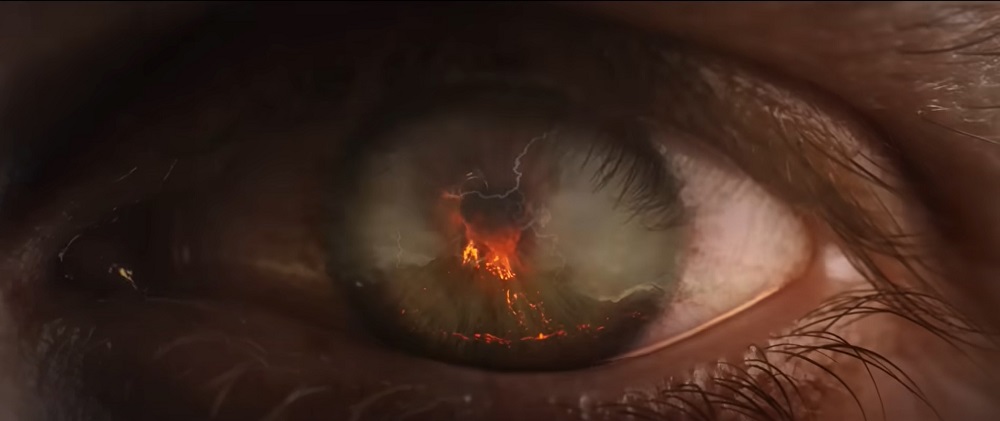
What did Sauron look like, really? What’s his deal? Was he ever a flaming eyeball on top of a tower? Probably not. Was he a creepy-as-hell humanoid with nine black fingers when he tortured Gollum? Yes. Was he a big guy in spiky black armor when he fought Gil-galad and Elendil on the slopes of Mt. Doom? Possibly. Was he a friendly Elvish-looking mentor when he was “cozening” the Elf-smiths of Eregion? Almost certainly.
He can, in theory, be all of the above. How about a handsome actor like Charlie Vickers? Or a, ummm, Jack Lowden? Apparently!
I keep seeing this phrase, “original form Sauron,” which I think may just be fandom phraseology and not used in The Rings of Power promos. It’s misleading, of course, because Sauron was on Team Evil for a very long time and would have adopted all kinds of different shapes during his tenure as the “lieutenant of Melkor.”
We don’t know when he, as a mighty Maia and a servant of Aulë, was seduced to evil, but it’s at least as far back as the days of Utumno, which predates Angband and the sun-measured years of the First Age (i.e. before the first rising of the Sun). He was known under a bunch of different names and titles, including Gorthaur (the Cruel) by the Sindarin Elves and Sauron (the Abhorred) by those speaking Quenya (Noldorin and Vanyarin Elves).
I do know by now that it’s a losing battle pointing out that both Melkor and Sauron would have hated Elvish forms and would only assume them when they absolutely needed to. This is a Hill (of Himring) that I’m at least trying to die on.
There is this disappointing assumption among many fans that both Sauron and Melkor (Morgoth), by default, look like handsome Elves in exotic dark armor or elegant robes, despite presiding over demons, orcs, and monsters galore who would look nothing like that and. Most of these monsters seem to have been reared to despise such beautiful forms. Heck, check out this note from Morgoth’s Ring:
For one thing Morgoth had achieved was to convince the Orcs beyond refutation that the Elves were crueler than themselves, taking captives only for ‘amusement’, or to eat them (as the Orcs would do at need).
Melkor is an ex-Vala and Sauron is a Maia. Both are considered Ainur, spirits who are the “offspring” of Ilúvatar’s thought, and as such possessed the ability to change their “raiment” or “hue” as they wished, or even go “unclad” (bodiless). At least for a long time; both of them eventually lose the ability to do this, each in his own time under his own special circumstances. In his deeper writings, Tolkien called these physical forms fana (fanar is the plural), i.e. “the ‘physical’ raiment adopted by the Spirits in self-incarnation, as a mode of communication with the Incarnates.”
Right out of the text, we know both Melkor and Sauron made for themselves “fair” fanar when they wished to deceive people. Particularly in deceiving Elves and Men. The first time we see this is after Melkor was dragged out of his Middle-earth fortress of Utumno and sentenced to the fastness (i.e. prison) of Mandos for three long ages. When he was released on good behavior, he adopted a “fair-seeming” manner and wore a “semblance” that matched. He was allowed to dwell among Elves in Valinor at the height of their bliss, so when he’s abiding among them, he’s of course not going to appear the same way he does when governing monsters and tormenting Elves back on Middle-earth. That fana in particular was referred to in The Silmarillion as “the tyrant of Utumno: tall and terrible.” But in Valinor . . .
he dissembled his purposes with cunning, and nothing of his malice could yet be seen in the semblance that he wore.
Then, later, he assumed his scary-ass tyrant form when the time came to visit and persuade Ungoliant to help him sabotage the Two Trees and steal the Silmarils.
In that form he remained ever after.
Ever after. Meaning he couldn’t change the way he appeared anymore; he’d spent too much of his power and lost the ability. This is a drum I do beat on a few times in my Silmarillion Primer.
So that was Melkor/Morgoth.

What about Sauron?
Sauron, ever the copycat of his boss, eventually did the same sort of thing. The stories started with him surely not looking “fair” at all. Although he was never captured in the Elder Days like Melkor was, Sauron was dwelling in the most horrific places on earth: first Utumno, then Angband the Hells of Iron. He was Melkor’s right-hand man, his chief lieutenant, and of course one day he will fill the power vacuum and become the new Dark Lord. But even before that, he controlled some of Melkor’s forces, seized towers, took slaves, murdered Elves and Men, and eventually tangled with some heroes of the First Age. He met his match when he met Lúthien and her friend Huan, the hound of Valinor. In that fight, he shapeshifted a lot just trying to flee.
But no wizardy nor spell, neither fang nor venom, nor devil’s art no beast-strength, could overthrow Huan of Valinor; and he took his foe by the throat and pinned him down. Then Sauron shifted shape, from wolf to serpent, and from monster to his own accustomed form; but he could not elude the grip of Huan without forsaking his body utterly.

Fast forward to centuries later . . .
The first text-based occassion in which Sauron adopts a “fair” disguise (i.e. pretending not to be who he actually is) is 1,200 years into the Second Age when he tries to “persuade the Elves to his service,” which ultimately results in his coming up with the Rings of Power scheme. At this time, for the first time ever, it makes sense that he would look pleasing to behold, Elf-like probably, and he does it with an alias: Annatar, the Lord of Gifts. His cover story to Celebrimbor and the jewel-smiths of Eregion goes something like this: “The Valar totally sent me here all the way from Valinor just to help you guys out. You want to make Middle-earth more awesome . . . more like Valinor, right? I can help you. It’s a shame that Gil-galad, Elrond, and Galadriel don’t trust me. They’re missing out.”
Up until this point in the Second Age, Gil-galad was only vaguely aware that there was some evil spirit rising somewhere: “a new shadow” and “servant of Morgoth.” By the time Sauron is doing his Lord of Gifts routine, the king and his friends (again, Elrond and Galadriel) are skeptical but they don’t know that Annatar is Sauron. This is a major plot point. If they knew he was Sauron, they’d have said so, and I think it wouldn’t take too much to convince the rest of the Elves of Eregion to maybe not work with the lieutenant of Morgoth who did a whole lot of awful things in the First Age.
But see, Gil-galad, Elrond, and Galadril don’t even know that Sauron, the aforementioned lieutenant of Morgoth, is even AWOL. He seems to have vanished during the great battle that brought down Morgoth himself, if not sooner than that. Just like the Balrogs, Sauron just sort of fell off the radar.
So yes, Sauron could totally look like Charlie Vickers in a blond wig at this point 1,200 years into the Second Age. That’s legit. I’ve got no problem with this. The text in Unfinished Tales is:
When he came among the Noldor he adopted a specious fair form (a kind of simulated anticipation of the later Istari), and fair name: Artano ‘high-smith,’ or Aulendil, meaning one who is devoted to the service of the Vala Aulë. . . )
Now, the Halbrand thing, the specifically reluctant “king of the Southland” human persona invented by The Rings of Power showrunners, who has the same exact face as this upcoming blond Annatar—well, that’s all new stuff made up. Amazon can do it, and even apparently have some kind of sign-off from the Tolkien Estate (now that Christopher Tolkien has gone), yes. But it’s not from J.R.R.’s book. I just wish that this all-new-alternative version of the story was formally acknowledged by the showrunners. I would respect the hell out of that approach.
Okay, so now I need to mention this guy, which we’ve only seen from some promo videos but who we will soon see in the show itself:
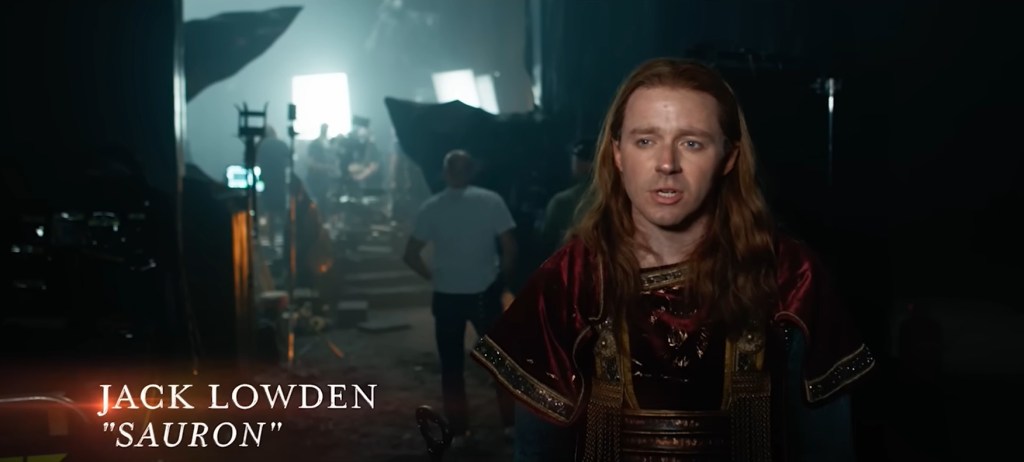
This is who people are calling “original form Sauron” (played by Jack Lowden), and it’s referring to Sauron’s shape at the end of the vague (but never properly identified) “war” against Morgoth. (Presumably the “war” is an amalgam of all the Wars of Beleriand, if we’re even to assume that the First Age even occurred in The Rings of Power timeline. They’ve not referred to it by that name.) I’m very curious to see how this red-clad humanlike Sauron relates to this form, which we’ve already seen in the canon of the show:

The new season may possibly explain all this to my satisfaction. I’m hoping it will, though I’m suspecting it won’t. But in the meantime, here’s my problem: This Elf- or Man-looking dude with long hair and aesthetically pleasing red armor seems to be presenting himself to the orcs as their “new leader.” As if he’s never been introduced to them before? As if Sauron was, at best, previously just an up-and-coming executive in Morgoth’s corporation before Morgoth himself got sent to prison? Sure, maybe it’s a new generation of young orcs Sauron is addressing, and all their orc parents who fought (and lost) in the unnamed war have been wiped out. A new face for a new crop of orcs?
But commanding scary monsters—who are monsters because they’ve all been bred in deliberate mockery of the Children of Ilúvatar’s and the beasts of the natural world—while looking like a normal-looking member of their enemy just feels wrong.
Let’s look at The Nature of Middle-earth (2021).

Before this book, there was nothing that properly explained this 93-year gap in the Appendix B timeline between the year Sauron forges the One Ring (~1600) and the year actual war erupts between him and the Elves:
c. 1590 — The Three Rings are completed in Eregion.
c. 1600 — Sauron forged the One Ring in Orodruin. He completes the Barad-dûr. Celebrimbor perceives the designs of Sauron.
[conspicuous gap of 90-ish years!]
1693 — War of the Elves and Sauron begins. The Three Rings are hidden.
1695 — Sauron’s forces invade Eraidor. Gil-galad sends Elrond ot Eregion.
The writings in The Nature of Middle-earth revealed that there were limitations to the Elves’ intelligence on Sauron, and that Sauron himself had physical and spiritual limitations as well. It’s fascinating, actually! Tolkien wrote that “it was one of the successes of his cunning and deceits that they were unaware of his actual weakness.” Gil-galad had no real sense of how powerful Sauron was or even that Mordor was the base of his power. Exactly where would Gil-galad march in great numbers to go after him? Yet Sauron had banked way too much of his power on the Ring gambit to eliminate his Elf-problems; he was ill-equipped for war.
Sure, Sauron did have orcs in both the Misty Mountains and the Grey Mountains that he could harness, but hadn’t been able to dominate the lands of Men in the far east—where Morgoth once had. This is not just because Sauron couldn’t go there in person, but because in his “fair-seeming” Annatar get-up he was far less effective at exerting his domineering power. We’re told he had emissaries out there among the “multiplying tribes of eastern Men” but that wasn’t enough.
But until the [S.A.] 1600 he was still using the disguise of beneficent friend, and often journeyed at will in Eriador with few attendants, and so could not risk any rumour that he was gathering armies.
Follow that? Sauron “often journeyed at will” without guards or armies, keeping up appearances, not wanting to do anything to risk appearing as the Dark Lord he was. So he would have just looked like some rando that, say, an ancestor of Barliman Butterbur might’ve passed on a country lane back in those days. Just some dude going down the road in a wagon like some wandering, friendly pilgrim. As always, Tolkien is painfully scarce on detail. Did he look like an Elf or Man on these occassions? His Annatar form, I guess?
This isn’t even the most interesting part.
Remember that talk of fanar earlier, the “raiment” of the Ainur? In being Annatar, Sauron has taken a charismatic fana, almost certainly Elf-like in form to be among Elves. But what’s really fascinating about this physical disguise is that he can’t just turn it on and off quickly like a switch, at least not without consequence. In order to have a strong enough military to attack Eregion later, he needed more orcs than just those in the nearby mountains. He needed the orcs “further East” that were more numerous and of “stronger kinds, descendants of Morgoth’s kingship.”
But those orcs, while he was doing his Rings of Power deceiving, were still “masterless.” They were unruly brutes, fighting each other and fighting Men. From Nature of Middle-earth again:
But not until Mordor and the Barad-dûr were ready could he allow them to come out of hiding, while the Eastern Orcs, who had not experienced the power and terror of the Eldar, or the valour of the Edain, were not subservient to Sauron—while he was obliged for the cozening of Western Men and Elves to wear as fair a form and countenance as he could, they despised him and laughed at him.
Catch that? So long as Sauron was gaslighting the Elves as Annatar, he couldn’t also assert his power and authority over the numerous and more powerful Eastern Orcs that he needed to wage war. Those orcs laughed at him in his fair form. But what Tolkien is saying here is, the moment he finally dropped the act (again, in 1600), “he exerted all his time and strength to gathering and training armies,” which literally took ninety+ years to do.
So in that 93-year gap, after he was outed as Sauron by his forging of the One Ring, could he finally drop the Annatar skin, then go on a tour of whipping Orcs and Men into shape, presumably adoping a far scarier and more intimidating fana. Building up his army. No Orcs laughing at this form. Then, and only then when he’d reasserted himself as the totally scary and powerful new Dark Lord, did the War of the Elves and Sauron of 1693 properly begin.
None of which, no doubt, would have played out much like we’re about to see in The Rings of Power season 2.
But I know. I get it. I know how the world works, and that all of the above requires some research and reading and explaining; that’s too much for Amazon’s executives or producers to do. Tolkien’s narrative as it exists is not as flashy, not as sexy, and involves no watercooler “shipping” and marketing. So it won’t ever really go this way.
In the very least, what I would love to see in The Rings of Power would be for this new red-armor-clad Sauron-dude (who looks like he’s going to get crowned / split apart by Adar) to stand before the orcs and then to have those orcs laugh at him . . . THEN having him shapeshift into the big black-armored Sauron form we recognize as Peter Jackson’s version, and finally scare those orcs into following him. Of course, even in doing that we’d still have the awkwardness of Sauron introducing to the orcs as their new leader like he’s some previously unknown nepo baby.
I do wonder: In The Rings of Power TV show canon, what are we to suppose Sauron did during the “war” against Morgoth that season 1’s prologue referred to?
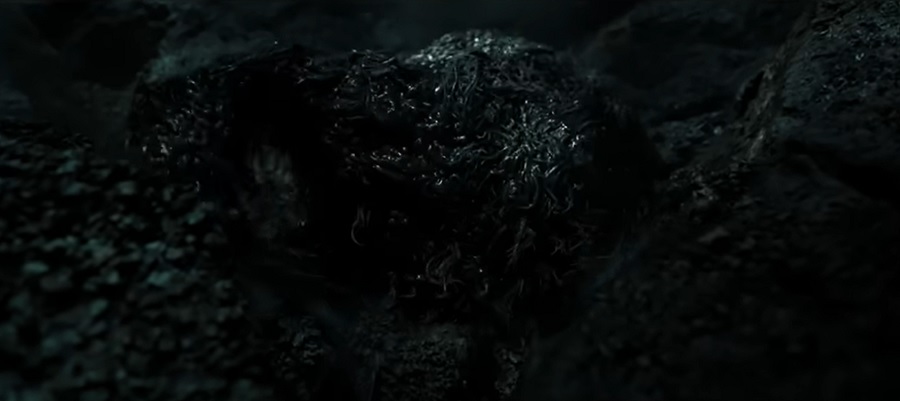
You know what? I hope that black writhing sludge monster is Sauron at some point. The more freaky and alien the better.
 Foreshadowed and Foresung
3 responses to “Sauron’s “Specious Fair Form””
I think that possibly Sauron adopted a fair form also when he went to speak with Eonwë after the War of Wrath, asking for pardon. Though given who they are they could also have had that conversation entirely “unclad” in any fana!
LikeLike
Yup, you’re totally right. He’d have taken a fair shape when approaching Eonwë. But excellent point. Why not emphasize their peership by being “unclad”? Then again, according to The Nature of Middle-earth, unbodied Maiar in Morgoth’s service stank! So maybe not a great idea.
LikeLike
[…] get a red-haired and smartly dressed Sauron who just looks like some guy. Could be a Man, could be an Elf. He’s very out of place, and […]
LikeLike