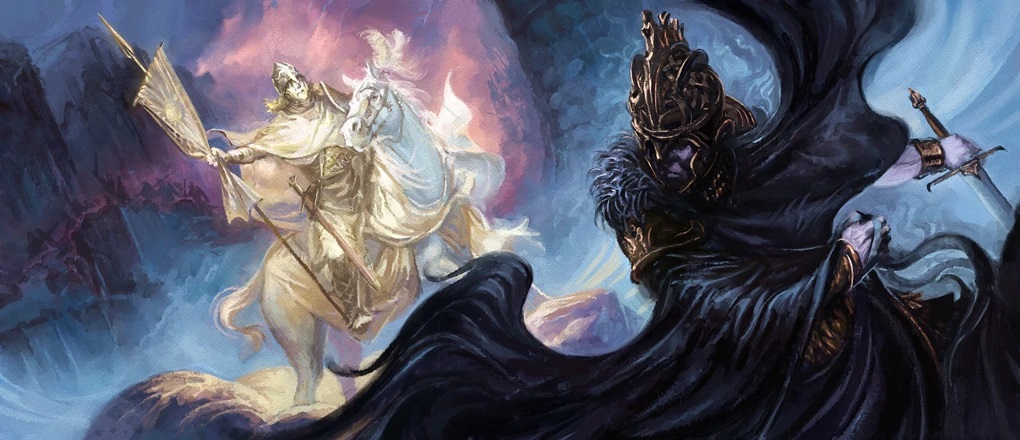
A musing on the Lord of the Nazgûl and his misunderstanding of the “no living man” prophecy that made him fatally smug. I think about this every time the topic of the Witch-King comes up, and I don’t see anyone talking about it, so now I have to. It goes something like this. . . .
Note: This is strictly a book-based post, not concerning any adaptation.
First, the relevant bit of history: Per Appendix A and B of The Lord of the Rings, in the year 1975 of the Third Age, after harrassing and eventualy destabilizing the Northern Kingdom for more than six centuries, the Witch-king of Angmar is finally defeated in the Battle of Fornost by the Elves of Lindon (led by Círdan), a massive army from Gondor (led by Prince Eärnur), and a force from Rivendell (led by Glorfindel). Angmar is no more.
In that final rout, rather than immediately turning tail, the Witch-king himself charges at Eärnur: Slaying the prince of Gondor would be his consolation prize. Eärnur stands to fight, but his horse freaks out (like many animals do in the presence of the Nazgûl) and it runs away with his master still in the saddle. Witchy laughs, then slips away as Glorfindel on his white horse rides up.
Eärnur, ashamed, tries to give chase. He’s a “man of strong body but hot mood,” and can’t stand the humiliation. But the Elf stops him. Having a moment of profound prescience (as some Elves do), Glorindel utters the famous words:
‘Do not pursue him! He will not return to this land. Far off yet is his doom, and not by the hand of man will he fall.’
We’re told that “many remembered” these words, all across the years. Over and over Glorfindel’s “not by the hand of man will he fall” phraseology is presumably repeated again and again, becoming a matter of legend.
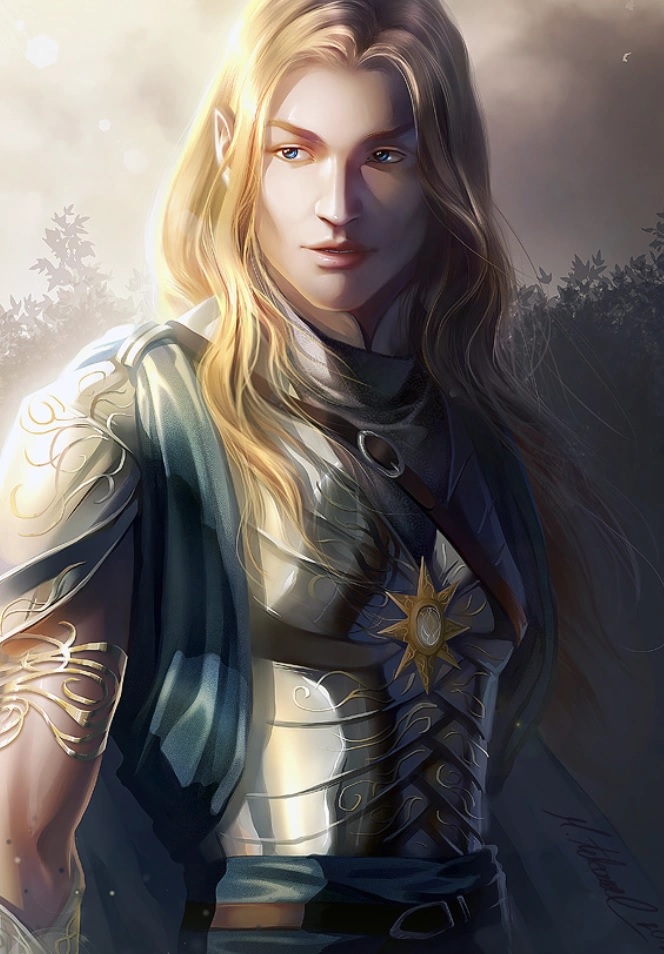
Naturally, the Lord of the Nazgûl hears about it at some point. When and how? He’d fled the battlefield, so he didn’t hear Glorfindel’s precise wording himself.
But here the game of telephone (also kown as “Chinese whispers“) proceeds across the centuries—in fact, more than a thousand years will go by before the Witch-king descends upon the Pelennor Fields to take out Théoden. Bit by bit, word by word, after many retellings, Glorfindel’s quote of “not by the hand of man shall he fall” seems to have morphed, at least in Mordor circles, into “no living man [may hinder him]”?
How’d that happen, I wonder? Did “the hand of man” gradually become “any man’s hand,” then “any man,” then “any living man,” then “no living man”? Did “fall” become “slip from his stirrups,” then “unhorsed,” “umanned,” “defeated,” “worsted,” “stopped,” “checked,” “stymied,” “thwarted,” “hampered,” “impeded” . . . hindered?
Of course, after felling the Théoden King, the Black Captain was just parroting back Éowyn’s use of the word “hinder” anyway in the Pelennor.
‘Do what you will; but I will hinder it, if I may.’
So that may not be part of it.
Still, was it the cummulative error of Glorfindel’s prophecy that led directly to the Lord of Morgul’s eventual demise, or was it just his hubris? Had the prophecy’s wording miraculously remained unchanged over the millinnium, would the Lord of Morgul have been more careful?
I do wonder if, in Tolkien’s mind, the original quote was actually still remembered and recorded in Gondor . . . but not in Sauron’s camp. Or might it be? Would there not have been at least one pedantic lore-master in Minas Morgul who came close to speaking up, perhaps after hearing some orc misquote the prophecy?
‘Actually, my lord, the Elf is quoted as saying “Not by the hand of man shall he fall.” Not “no living man . . .”‘
But then said lore-master didn’t speak up out of fear of getting “Force choked” by the Morgul Lord, in a manner of speaking? Which just goes to show: Both the Empire and the regime in Mordor had poor management practices. If you push fear and not respect, this is what happens. Had the lore-master liked and respected his boss, and not been a terrified yes-man, maybe he would have reminded the former Witch-king of Angmar that the wording of the prophecy is one he should be cautious of. There should be more than a fine line between “not by the hand of man” and “no living man,” right?
So was it just linguistics and semantics? Was there sexism involved? Did it never occur to the Morgul Lord that “man” didn’t necessarily mean “Mankind” in Glorfindel’s foresighted words? It seems when he took to the field, the Lord of the Nazgûl was never worried about any kind of mortal doing him harm. Or even hindering him. He would assume, based on the wording, that “no living man” meant no actual, non-undead human walking around could be a threat.
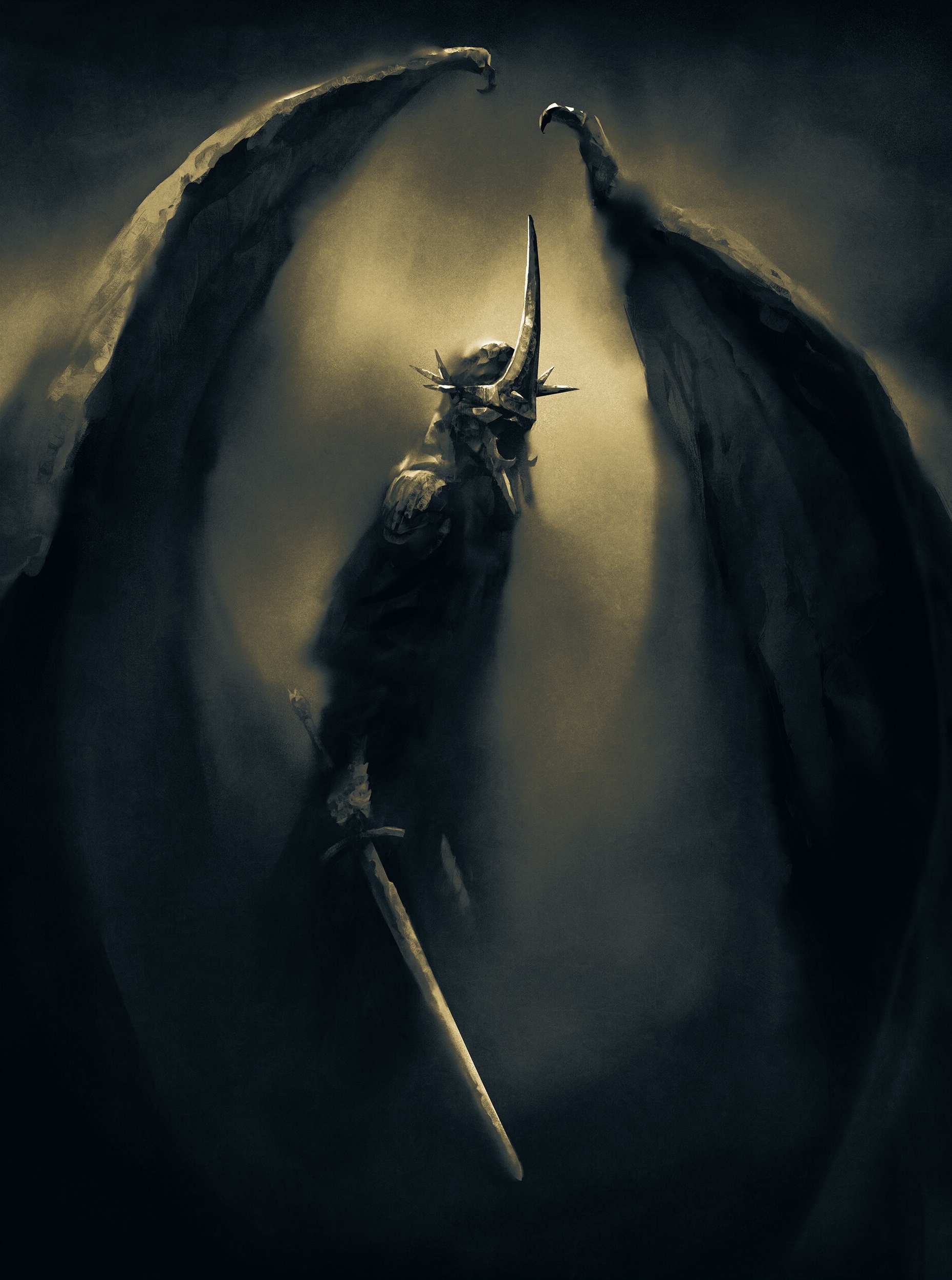
He’s super confident when he throws the words back at the Rohirric soldier he assumes is a lower-case man.
‘Hinder me? Thou fool. No living man may hinder me!”
Of course, Éowyn laughs at this, and now it gives him pause.
‘But no living man am I! You look upon a woman.’
Hearing this, Witchy is in “sudden doubt.” Like, holy crap did he miscalculate all these years? Is this a loophole that it’s a woman standing up to him? Or maybe just a coincidence, a fluke? Or did he, the boss Ringwraith—who’s been a servant of the Dark Lord for thousands of years, since 2251 of the Second Age—just have bad information all this time? Witchy probably very badly wants to bear Minas Morgul’s lore-masters to the houses of lamentation right about now!
And yet, we know from Tolkien’s later writings—notably, “The Hunt for the Ring” in Unfinished Tales and some quotes from The Lord of the Rings: A Reader’s Companion (Hammond and Scull)—that he didn’t necessarily think himself impervious to harm. Referring to the scene at Weathertop, Tolkien wrote in his own notes:
[T]he Witch-King, the great captain, was actually dismayed. He had been shaken by the fire of Gandalf, and began to perceive that the mission on which Sauron had sent him was one of great peril to himself both by the way and on his return to his Master (if unsuccessful); and he had been doing ill, so far achieving nothing save rousing the power of the Wise and directing them to the Ring. But above all the timid and terrified Bearer had resisted him, had dared to strike at him with an enchanted sword made by his own enemies long ago for his destruction. Narrowly it had missed him. How he had come by it—save in the Barrows of Cardolan. Then he was in some way mightier than the Barrow-wight; and he called on Elbereth, a name of terror to the Nazgûl. He was then in league with the High Elves of the Havens.
Escaping from a wound that would have been as deadly to him as the Mordor-knife to Frodo (as was proved in the end), he withdrew and hid for a while, out of doubt and fear both of Aragorn and especially of Frodo. But fear of Sauron . . . was the stronger.
When writing Book I, Tolkien probably wasn’t thinking too much about any prophecy (or, more likely, hadn’t come up with it yet), but in retrospect, I can’t help but wonder whether the Black Captain would have been. Would he be mulling over the phrase “no living man” when dealing with hobbits and even Aragorn? He’d have to be mindful about it when battling Gandalf! He knows that wizard is no joke, and probably no mere man.
Recently I had a conversation about this with Texan Tolkien enthusiast and deep-lore nerd Chad Bornholdt. Considering the POV of the Witch-king at Weathertop, Chad said to me, “If the Ranger wasn’t given the Ring, this small guy [Frodo] must be a badass.” And then, concerning the Pelennor Fields, he added, “Had he seen Merry at Pelennor, he’d have probably fled. . . . He wouldn’t have chanced fighting someone with the Barrow-blade. . . . But he would also think, ‘I wonder if hobbits are considered “man” . . .’ and he’d get the #@$& out of there. . . . It’s very fortunate that he didn’t see Merry. Most people think he’d have killed Merry had he seen him. I think he’d have fled from the blade.”
Ultimately, I just love the fact that Tolkien had Éowyn and Merry tag-team the takedown of the Lord of the Nazgûl. Both woman and hobbit fit into the prophecy well. People like argue about who it was who “really” beat the Witch-king, the Shield-maiden of Rohan or the future Master of Buckland. I think that’s nonsense. The victory is largely credited to Éowyn, deservedly, but she alone could not have done it. The fact that the deed was done by the two-person fellowship of Dernhelm and the hobbit is brilliant. Both of them had been overlooked by everyone, both ride with love for Théoden, and both burned with the desire not to be left behind. Tolkien gave them this moment of glory, achieving that which literally no man on the Pelennor Fields could have.
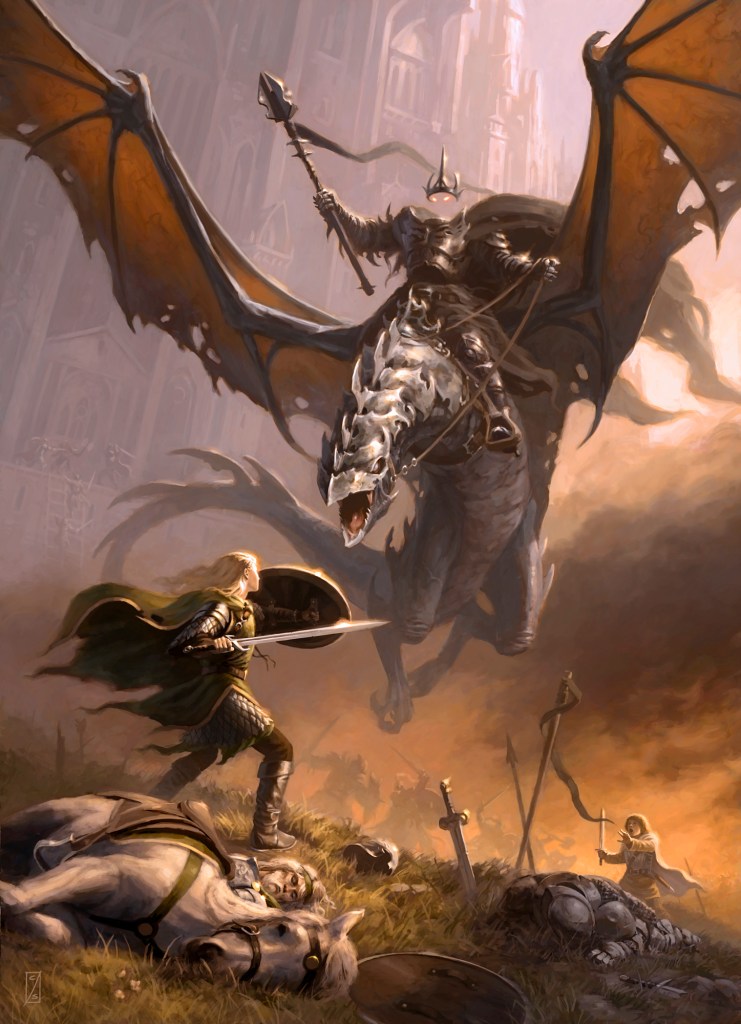
Tolkien himself says it was both their efforts, quite clearly, in The Lord of the Rings itself in a footnote about one of Éowyn epithets, the Lady of the Shield-arm:
For her shield-arm was broken by the mace of the Witch-king; but he was brought to nothing, and thus the words of Glorfindel long before to King Eärnur were fulfilled, that the Witch-king would not fall by the hand of man. For it is said in the songs of the Mark that in this deed Éowyn had the aid of Théoden’s esquire, and that he also was not a Man but a Halfling out of a far country, though Éomer gave him honour in the Mark and the name of Holdwine.
On a final note, I have to go back to Glorfindel, whose reaction to the Witch-king’s fate Tolkien denies us. How great would it have been to witness the moment when someone comes running up to him in Rivendell, relating the news? “Lord Glorfindel, you totally called it!”
But also, Glorfindel’s been around a long time—like, a looong time. He was an Elf of Gondolin, and even before dying in his battle with a Balrog and being reembodied and sent back to Middle-earth, he was one of the Noldor in Tirion and seen the light of the Two Trees. Of course he was able to predict the Witch-king’s eventual defeat! He was important. But given how long he’s been around, how many other, perhaps less consequential prophecies, might Glorfindel have spouted over the passing millennia? Just essays in the craft.
‘Do not finish that store-bought mac ‘n’ cheese! It will not satisfy you, for it is filled with preservatives. Far off yet is its decay, and not by the stomach of man will it be destroyed.’
 Foreshadowed and Foresung
3 responses to “The Words of Glorfindel and the Witch-King of Angmar”
Another great read, Jeff.
Am I remembering correctly that Tolkien liked Glorfindel’s name so much that he developed the re-embodying of Elvish fea to retroactively explain it after re-using the name in LotR? I wonder if that means Tolkien imagined Glorfindel had a further purpose? I can’t think of any other re-embodied Elves returning to Middle-earth. But Glorfindel doesn’t seem to do much after the fall of Angmar. Does he even leave Rivendell during the War of the Ring? Is he explicitly on a boat to the West after the War?
I think my head-canon now is Glorfindel makes an appearance in Tolkien’s abandoned sequel, and does whatever it is he returned to Middle-earth to do.
LikeLike
I don’t recall specifically, but I do think Glorfindel’s different appearances weren’t originally meant to be the same Elf, but that he later connected them after all. I DO greatly wish we had more concrete examples of Elves being sent back, to sort of prove the rule of Tolkien’s fëar/hröar methodology.
And yeah, I also wish we had more of Glorfindel at least after the War of the Ring. I think it would have also been helpful if Glorfindel’s appearance in Books I and II at least mentioned his involvement with the war against Angmar.
LikeLiked by 1 person
[…] By itself, this is fine, because Elves sometimes do have visions and moments of foresight (like Glorfindel!), but the implication is that these visions are caused by her Ring of Power. […]
LikeLike