After my relative disappointment with Del Toro’s Frankenstein*, I established in my mind—and in a post on the subject—a new expectation, a new rule, that I absolutely know Hollywood would never follow because cash is king and brand recognition is everything. Even so, this would be my rule (and I’ll be disappointed every time the world doesn’t conform to it):
(more…)Category: Uncategorized
-
In the real world, what we in the Tolkien fandom call the primary world, Orcs are not a race. They’re a mindset, an ideology, the basest outlook of humanity. Tolkien certainly thought so.
(more…) -
With Frankenstein fresh on the brain and in a lot of online media discourse, this seems like as good a time as any to float my pet theory about the monster. The recent Guillermo del Toro film (which I wrote about here) takes the popular approach on this matter.
But I don’t think Mary Shelley intended it this way. So what’s my theory?
(more…) -
I am a big Frankenstein fan. The novel foremost, but also its legacy. A few years back, I went to the Morgan Library here in NYC and got to see an exhibit there all about Frankenstein, marking its 200th-year anniversary.
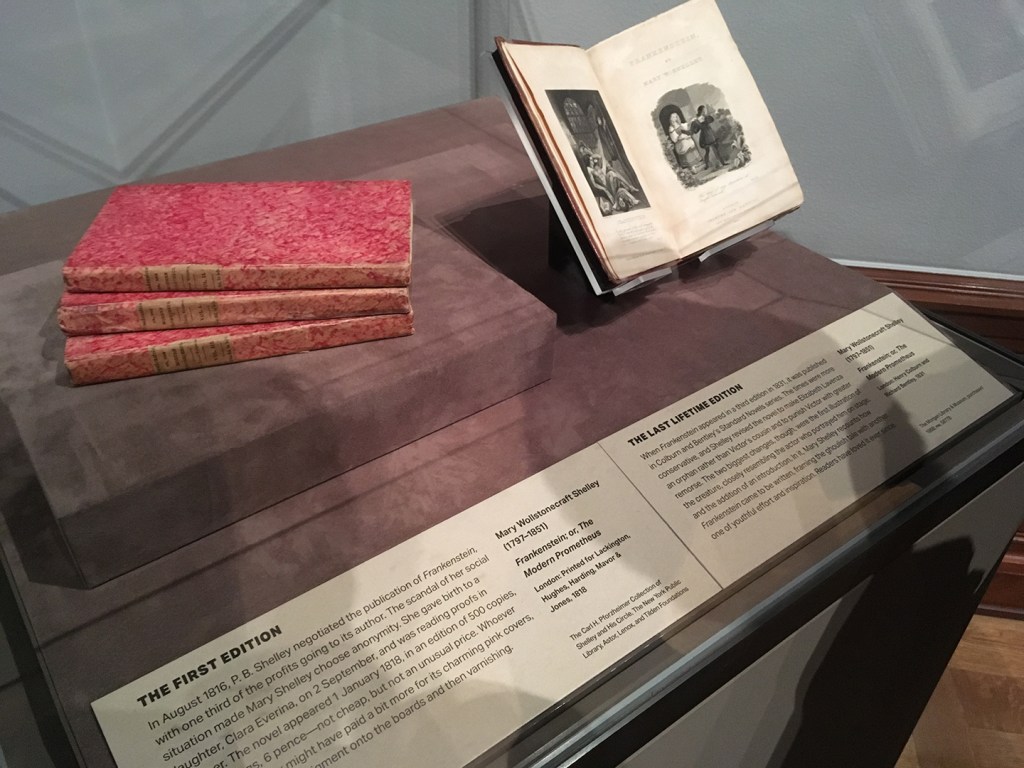
I’m invested in its ideas, and where it came from, and how it ties into other legends and folklore, like the Golem of Prague or Talos of Greek mythology. And ultimately, these stories tie back into what makes us human, and what mysteries drive us. So I care about how the concept of the created man plays out in each new incarnation.
Like Guillermo del Toro’s new Frankenstein. I admit, I’m a bit surprised at how polarizing it seems to be. All the buzz, but especially all the criticism, has revealed how many book fans are out there, I guess, which is great. If there was no book at all, and this was just a film in isolation, it would be fantastic all by itself. But Mary Shelley did write an amazing novel, a richer story than this film gives us, and it’s impossible not to consider the source.
This isn’t Boris Karloff’s monster. Or Robert DeNiro’s or Bela Lugosi’s or Christopher Lee’s. When it comes to the monster, visually, this film is probably closer to “accurate” than we’ve ever seen before. But the more I think about the film, and all the other characters we’ve been given, the more I think about the book.
(more…) -
Although J.R.R. Tolkien famously disliked allegory, he admitted there is always applicability to be found. Anyone who reads his work with any bit of care or critical thinking can find a thousand applications to the troubles of our real world—what he called the primary world. Here is just one I recently across again.
(more…) -
The short version: I hopped into the NoName Storyteller Podcast for a couple of episodes. The first episode is “From Dice to Darkwood” and the second is “Unlocking Middle-earth.” Available pretty much anywhere, like Apple Podcasts or Spotify.
(more…) -
There is now a project page for The Silmarillion Primer on the Signum Press website. Right here, in fact: https://press.signumuniversity.org/2025/07/01/the-silmarillion-primer/ Thank you to Shawn, Alan, and Tom for your quotes! They do me great honor, and I am increased by your good will.
In due time, I hope only a few months from now, there’ll be an entry for the Primer in the Signum Store, too.
-
This posts blends Dungeons & Dragons, religion, and today’s political climate—that last one being a topic I would like to generally avoid here. But this one eats away at me so I just need to work through it “out loud,” as it were.
So, a long, long time ago while working in a career far, far away, I did a bit of freelance writing for Wizards of the Coast. At one moment in time, I got to cowrite (with my good friend Ken Hart) a D&D article titled “Faith & Heresy” (in Dragon issue #387 from 2011). It was essentially roleplaying advice for players or DMs and it proposed the idea that not all clerics, even those serving the same god, have to be the same, or even believe all the same things.
(more…) -
So, I made some Middle-earth Valentine’s “cards” in years past. They have to go somewhere for posterity. Grab ’em, if you want . . . orc else!
(more…) -
Continuing the theme of talking about the good things in life . . .
This is just a short post mostly to redirect folks to this awesome and insightful new article in the “Overlooked No Mere” series in The New York Times—which I’d never heard about before. It doesn’t appear behind a paywall, either. I guess that makes sense, since it’s an obituary series. Anyway, it’s this one:
Overlooked No More: Karen Wynn Fonstad, Who Mapped Tolkien’s Middle-earth
And here’s my quick followup opinion.
(more…)
 Foreshadowed and Foresung