
This is the blog post version of the talk I gave at the New York Tolkien Conference last summer (2025). It also revisits a few of the things I said in my Mythmoot talk from a few years before. But all in all, it’s about the writing of The Silmarillion Primer, a book which I promise is about to drop soon. Since it’s a bit long, I’ve made this just part 1. This one’s about the characters in The Silmarillion.
First, here is a reminder of what The Silmarillion Primer is (or is about to be, when it’s out in the world):
Several years ago, I wrote a batch of Tolkien-based articles for Tor.com, a free online magazine of sci-fi and fantasy. At first I wrote one-offs—like “The Unquiet Voice of Saruman,” “The Trial of Galadriel” and “The Eagles of Middle-earth: Manwë’s Special Ops”—and then I started a long-running series called The Silmarillion Primer.
The goal was to entice new but hesitant Tolkien readers to tackle the famously daunting Silmarillion, despite its historical mode, its lofty narrative style, its complex genealogies, and and all the freakin’ Elf-names that start with Fin.
So I would do this by walking my readers through the whole book, chapter by chapter, story by story, age by age. I used humor to make things more memorable; I made loads of graphics and diagrams and maps, and probably too many Gen X–flavored pop culture references. I also kept wondering while writing the series: Was I only addressing new readers who tried and failed to get into The Silmarillion on their own? Or could I have something for the people who already knew and loved the book? Well, I’ll come back to that point.
A few years after I finished the series, at Signum University’s annual Mythmoot conference, they asked me if I wanted to turn the Primer into a real book to be published by Signum Press, which was about to launch. I had never seriously considered it before, for a number of reasons. But in 2022, I considered the offer and thought, “What the hell?”
Well, I’m wrapping up the book now. It was a whole lot more work than I first imagined, because I needed to remake all my graphics in higher resolution for a print book, and because I did a heck of a lot of revising and rewriting of the text itself. I consider the book a hefty upgrade from its original form. A reforging, if you will.
Here, I’ll just share some of the things I’ve learned in the process of writing and then rewriting this thing—the sorts of things one discovers about Tolkien’s legendarium by describing, or paraphrasing, or otherwise explaining a book as supremely complex as The Silmarillion. Things I myself missed the first few times as a straightforward reader and fan of the book—things even overlooked when I was writing the original series of articles.
First, to be 100% clear, my Primer isn’t like a CliffsNotes version of The Silmarillion. CliffsNotes are short study aids. Students famously use them to bypass books they’re supposed to read for school. I’m actually trying to convince my readers to read The Silmarillion all the way through, for the pure joy of it, either side by side with the Primer or else afterwards.
So maybe my book is more like . . .
But if so, then I was a dummy, too. Because the truth is, I never grasped The Silmarillion so well as when I sat down to help simplify it for others.
And that, ultimately, is all that I want: to entice others. This project satisfies my natural desire to share my enthusiasm about things I love with other people; to draw in those who’ve only dipped their feet into legendarium waters through The Lord of the Rings or the movies and TV shows. My goal is a full dunking into Tolkien’s text.
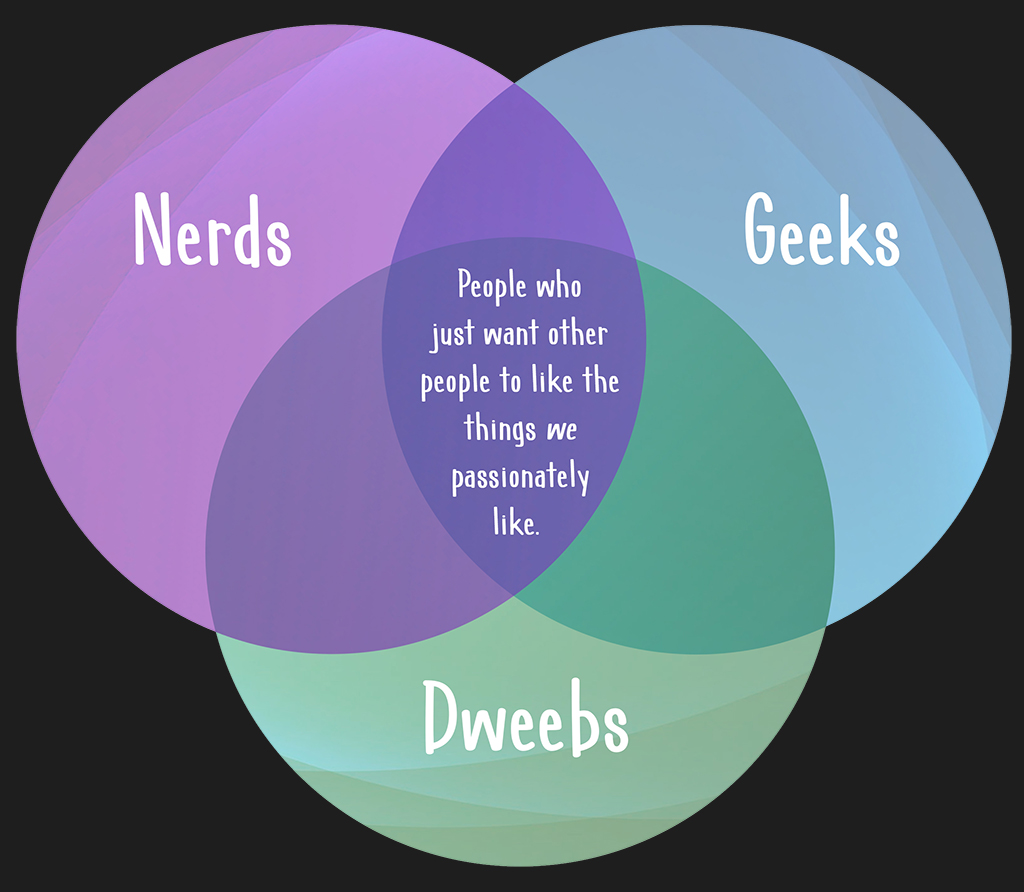
See, in the Venn diagram of nerds, geeks, and dweebs, there is a place where we just want other people to like the things we passionately like, right? But . . . this is Tolkien. It’s something more. So much deeper than mere entertainment. It’s more than just wanting others to enjoy a TV show, a movie, or a game that we also enjoy.
So as I think many of us know, in Tolkien’s writing there is an elegant applicability to the primary world; the primary world, what he called our world. Now, The Lord of the Rings contains all the elements that Tolkien espoused in fairy tales: recovery, escape, and consolation. And I guess I just want more people to know that The Silmarillion has all of that, too, in spades; they’re just dressed up differently. Wearing different raiment, as The Silmarillion’s narrator might put it.
But, the question I have been grappling with from the start of this project is: Who exactly is my audience? Only Tolkien newbies? Or people who just know the Peter Jackson films, or Amazon’s Rings of Power—people who may be intrigued just enough to take a peak at the stories that came before the ones they’ve seen adapted to screen? Or is my audience mostly readers of The Hobbit and The Lord of the Rings who are already sold on the books but haven’t been able to take a deeper plunge? Can it include veteran readers who do already know The Silmarillion, who in fact never had much trouble with it at all, people who probably already know the History of Middle-earth books and beyond? Like actual Tolkien students, scholars, and professors?
In the end, I have accepted that I’m trying—like the jewel-smiths of Eregion in the Second Age—to have my cake without eating it, as Tolkien worded it in a letter. I’m trying to have it both ways. I’m trying to appeal to and encourage new readers . . . but I’m also trying to entertain and recontextualize familiar narratives for those dyed-in-the-wool loremasters of Middle-earth among us.
Here’s how I look at it. Have you ever heard someone read out loud from a book that you already know well, but something in the way they read it—their inflection, their pace, their pronunciation—is different from how you “hear” it in your head? And in hearing it different you find yourself discovering something new about it. Some new angle or perspective you hadn’t considered. Or, to put it another way for my fellow geek parents: Have you ever gotten to re-watch a movie through your kids’ eyes and that somehow changed it for you? Allowed you to look at it differently? Like viewing Labyrinth or The Neverending Story or the original Star Wars as an adult and getting to re-experience it from your kids POV? That’s what I’ve been going for with The Silmarillion Primer.
But, you know, with jokes. And pictures.
Now, there have been challenges. Fun challenges. There are elements in The Silmarillion that are easy to overlook, but you have to grasp all the clearer if you’re going to explain them, or illustrate them on a map. I found that walking through certain passages slowly let me think through some things that quiet, in-my-head readings passed right on by.
One of the things that The Silmarillion lacks—because of course it does—are enduring characters we can care about naturally. I don’t mean there aren’t characters we might choose to care about. Like, I suppose . . .
Finrod son of Finarfin! Finrod Felagund, Hewer of Caves, King of Nargothrond. Finrod, friend of Men, big brother of Galadriel, the neighborliest of neighbors. Or the mortal woman Haleth, who became Lady Haleth, chieftainess of the Haladin, who “had been a renowned amazon with a picked bodyguard of women.”
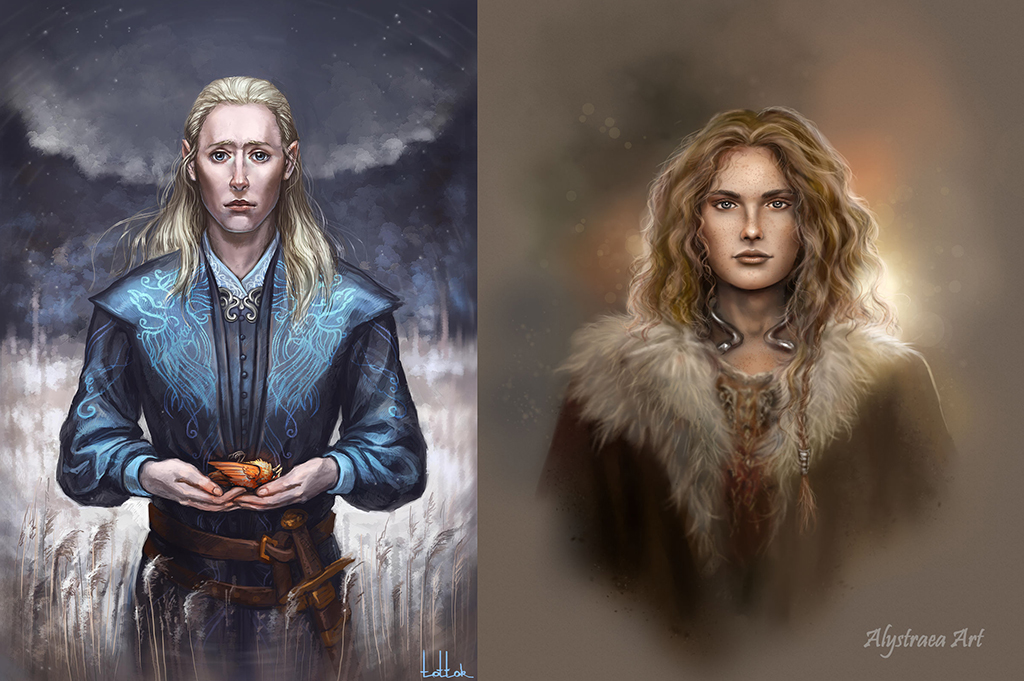
“Finrod: The First Winter of Exile” by Tottor | “Haleth” by aylstraea
Obviously, we want to care about some of them. Plus, most of our favorites don’t make it to the end of the book, not by a long shot.
But compare this to The Lord of the Rings, where it’s much easier to engage with them. There are hundreds of named characters. Of those, we get to spend considerable time with dozens. And of those we get to know at least nine really well. . . .
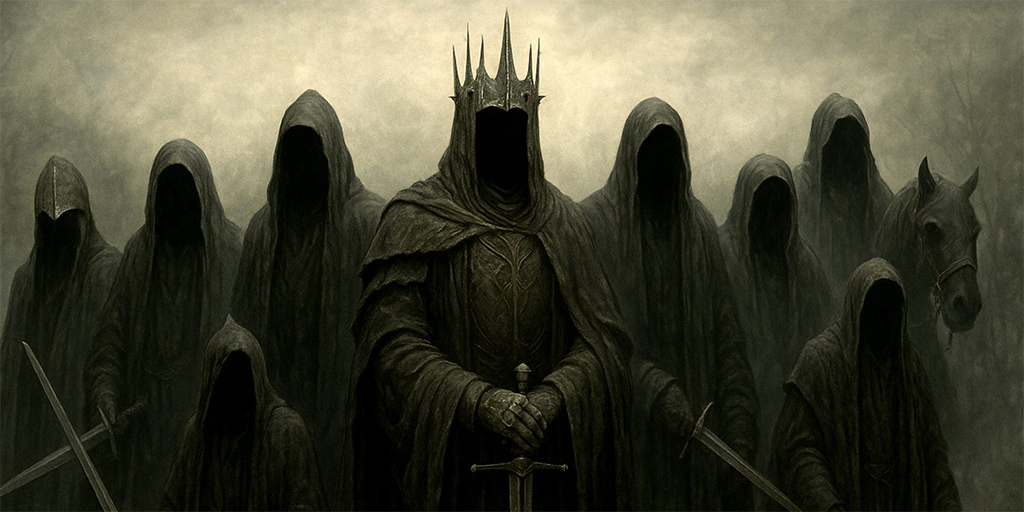
No, no. Not those nine.
These nine:
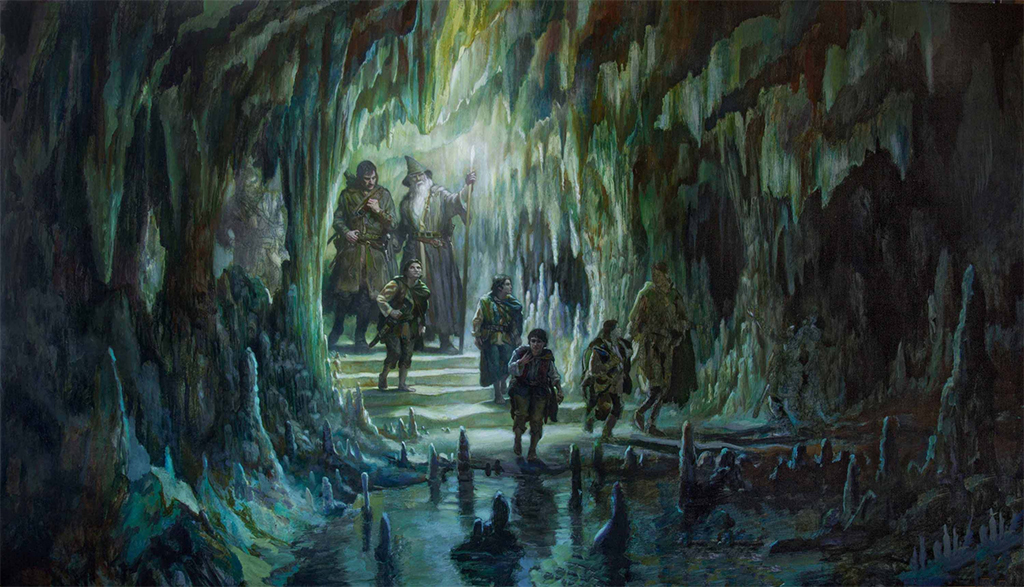
“The Fellowship of the Ring in Moria” by Donato Giancola
Our connection to the members of the Fellowship (and many more) is earned, both by Tolkien’s storytelling skill and by our own investment. We both put the work in—him and us. But Tolkien considered The Lord of the Rings to be a “heroic romance”; it’s infused with emotion and feeling. Allies, enemies, landscapes, and events aren’t always described in great physical detail, but the language does convey how they make the point-of-view characters—and probably ourselves—feel.
The Silmarillion doesn’t do this; it can’t. It’s really just a collection of myths and legends assembled by Christopher Tolkien from a whole slew of different versions of his father’s work.
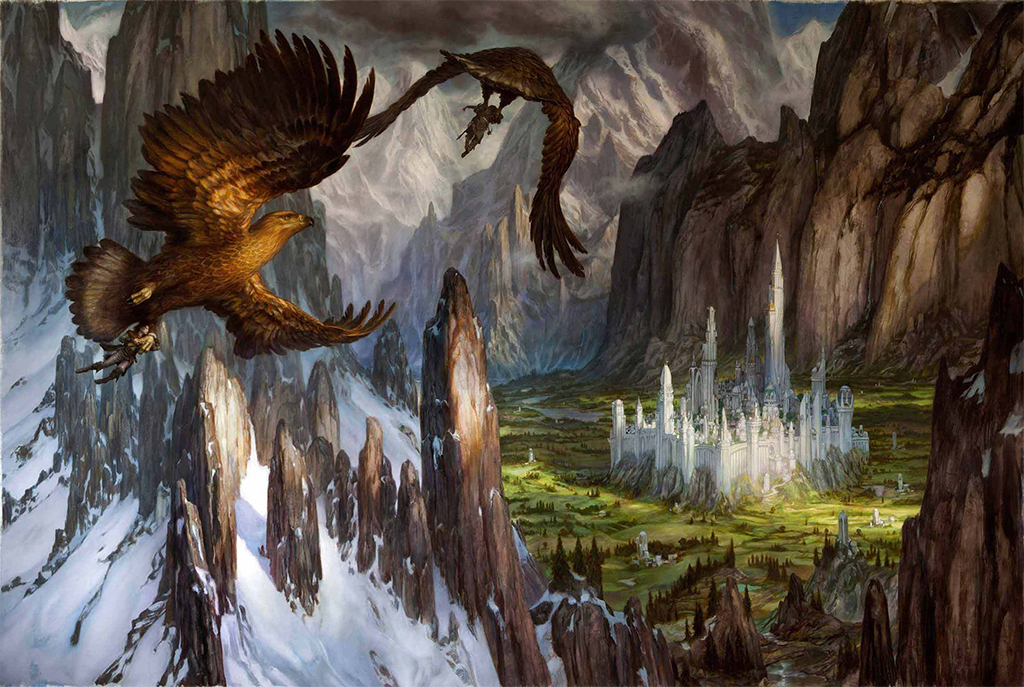
“Huor and Hurin Approaching Gondolin” by Donato Giancola
It prioritizes historical consistency, not perfect narrative cohesion and emotional satisfaction. And yet! Yet it turns out that when you revisit it again and again, you come away feeling that there is a subtle power in what’s not written. Precisely because the narrative leaves an opening for our imaginations. It actually does this way more than The Lord of the Rings, especially because there are huge spans of time involved in every chapter.
So my point is: The narrative gaps in The Silmarillion aren’t an intended feature; they’re bugs. But! They’re good bugs. They’re still amazing. Tolkien’s world is so compelling that when he leaves us only morsels and crumbs, we’re almost more fascinated, because we’ve already bought into his secondary world. It’s because Tolkien placed the gardener Samwise Gamgee into Middle-earth precisely the way he did, and made him courageous yet humble, and had him become a great hero of the Third Age . . .
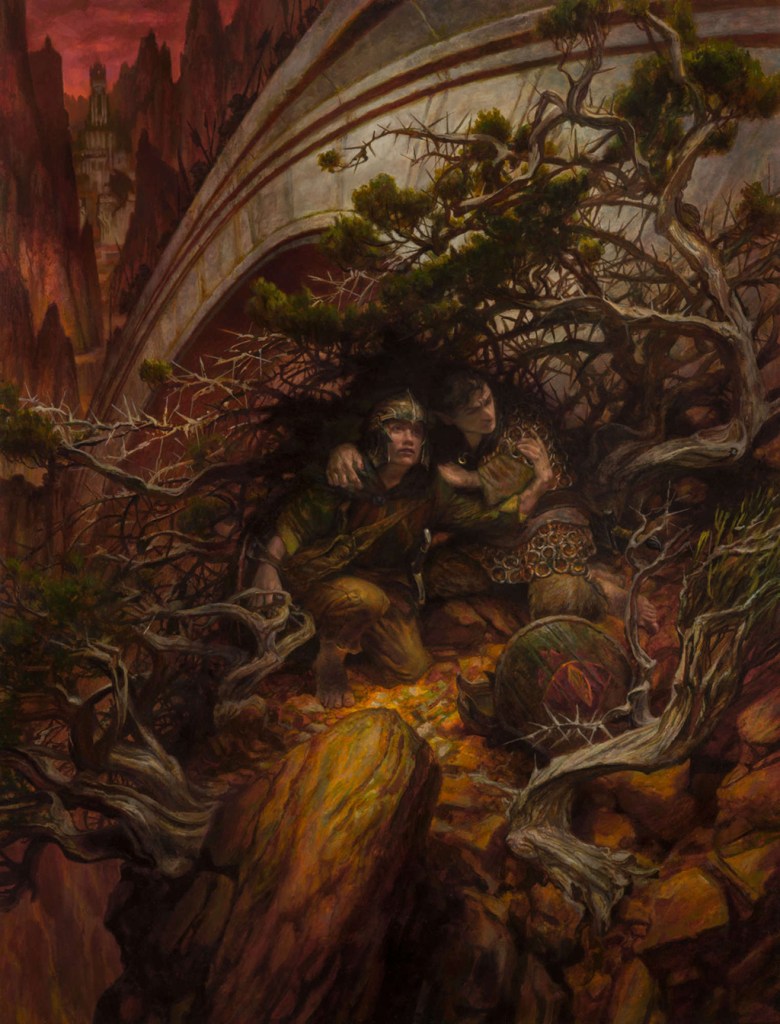
“Morgai Thorns” by Donato Giancola
It’s because he says things to Frodo like, “Don’t go where I can’t follow!” when he thinks his master is dead, or quotes his old Gaffer in saying “It’s the job that’s never started as takes longest to finish” . . . it’s because such a character exists the way he does, we know that even the “minor” characters in The Silmarillion matter. Even the tragic ones.
Like Gorlim the Unhappy. Who is cruelly deceived, tricked into betraying his friends, and then slain wickedly by Sauron. Or Finduilas, the ill-fated princess of Nargothrond, whose life—if he had chosen to save her—might have given Túrin son of Húrin a chance to be free of his doom. Or Elenwë of the Vanyar, who perished during the crossing of the Grinding Ice.
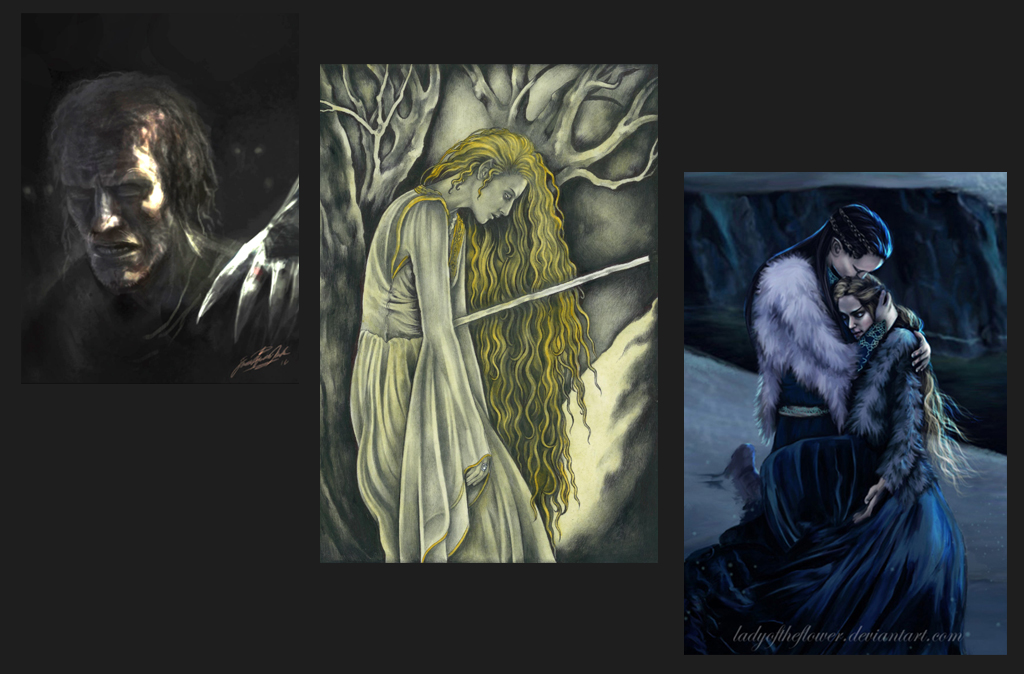
“Unhappy Gorlim” by Turner Mohan | “Fastened to a Tree” by ebe-kastein | “Helcaraxë – Death of Elenwë” by Sara Morello
These characters play small but vital roles. We know they would have as much depth and believability as Sam Gamgee if only Tolkien got around to them. So the few we get seem real enough. Often they are intriguing for what we don’t know about them. In other words, the cursory passages and barely described characters of The Silmarillion leave us the space to imagine. I think Tolkien would have fleshed them out if he’d had a few more decades to do so. He did try to revisit the Elder Days in the same fashion as The Lord of the Rings but he ran out of time. The “gift of Ilúvatar” . . .
I’m reminded of this concept whenever I hear a Tolkien fan ask another something like, “Who is your favorite Vala?”
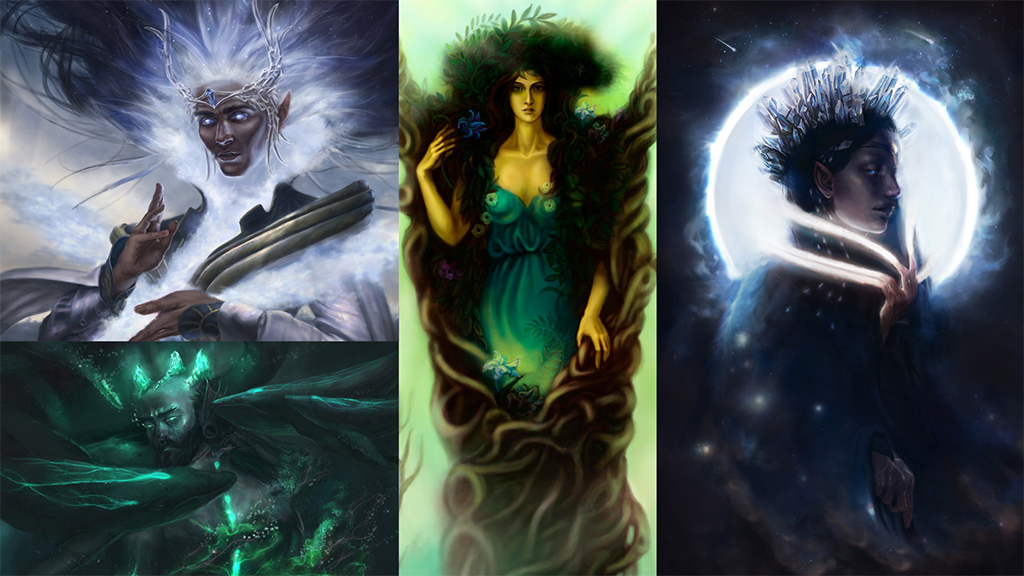
“Manwe, “Ulmo,” and “Varda” by Dymond Starr | “Yavanna” by Meraclitus
If you know your Silmarillion, then you know the Valar are the godlike spiritual kings and queens of all Arda, the world in which Middle-earth is just a part. There are only fourteen of them and they are massively important to this world, but only a handful of the Valar are given actual speaking roles in the narrative of The Silmarillion.
Now, I’m sure we all have our “favorite” Vala. (Think about who yours might be. I’ll tell you mine in a moment.) But we don’t actually know any of them very well from what the narrator gives us, do we? We mostly just project our ideas onto them, what we want for them. They’re somehow both wholly different from, yet still reminiscent of, some of the pantheon gods of real-world mythologies. Mandos is like yet unlike Hades, Ulmo is like yet unlike Poseidon, Yavanna is and isn’t like Demeter, and so on.
We can read about the epic places and events the Valar shape, and we get some quoted words here and there from less than half of them. But I daresay we know more about the thoughts and personality of, say . . . the “old wife” Ioreth, wise-woman of Gondor, who shows up in a few chapters in The Return of the King. In fact, we get more from her mouth than any of the Powers of Arda . . .
| VALA | Total words spoken in The Silmarillion |
| Aulë | 267 |
| Estë | 0 |
| Lórien | 0 |
| Mandos | 439 |
| Manwë | 469 |
| Nessa | 0 |
| Nienna | 0 |
| Oromë | 0 |
| Tulkas | 54 |
| Ulmo | 174 |
| Vairë | 0 |
| Vána | 0 |
| Varda | 0 |
| Yavanna | 390 |
| MORTAL | |
| Ioreth | 586 |
See that? Ioreth gets nearly 600 words of dialogue in The Lord of the Rings. She exasperates both Gandalf and Aragorn—in a good way, to be sure, because they are both fond of and tease her—and yet she gets to say more than Manwë himself, the Elder King, Lord of the Breath of Arda. (At least in the published Silmarillion!)
Ioreth for the win!
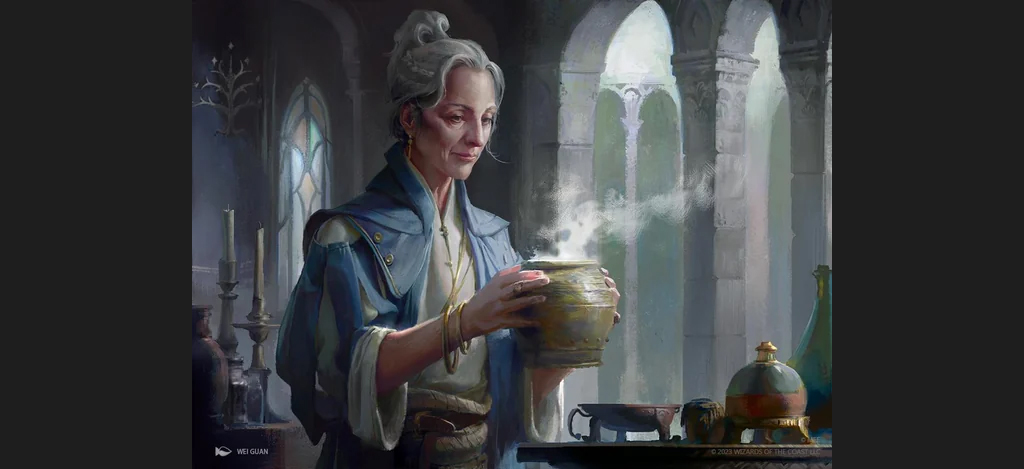
Ioreth © Wizards of the Coast (Wei Guan)
All right, so who is my favorite Vala? And yes, I’m coming around to a point.
Well, the one who intrigues me the most is Vairë, the Weaver . . .
who weaves all things that have ever been in Time into her storied webs, and the halls of Mandos (that ever widen as the ages pass) are clothed with them.
That description is SO evocative, and yet it’s literally the only sentence we get in The Silmarillion about Vairë. In my Primer, here’s how I address this info:
Vairë is a weaver of tapestries and fates. She records all events within the confines of Time in her “webs”—which has to mean she knows about all events as they unfold, no big deal—and then she decks the halls of Mandos with them. Meanwhile, as time marches on, those halls “ever widen” as a result, like some Valinorean version of the Winchester Mystery House except with a clearer purpose. Given her own web motif and the fact that she’s wedded to Mandos, the Doomsman of the Valar, Vairë is a Norn-like goth in my imagination—the Morticia Addams to her husband’s Gomez, one might say.
Vairë gets a bit more “screen time” in the book Morgoth’s Ring, when the fate of the spirit of Míriel (the wife of Finwë) is debated among the Valar; the tragic Elf ends up in the house of Vairë, where it “is her part to record there the histories of the Kin of Finwë and all the deeds of the Noldor.” But still, it’s not very much. Vairë reminds me of the Norns and of Frigg in Norse mythology, or the Grandmother Spider of Native American myths, or the Moirai of Greek mythology. But only a little.
Ultimately, it’s Ulmo I appreciate the most in the actual published Silmarillion because we spend more time with him and see how much he tries to help Elves and Men. More overtly than the other Valar (even though, between the lines, I think they’re all pulling for the Children of Ilúvatar).
I suppose my concluding statement on this particular point is: With The Silmarillion, we can interpret less as more. Even if that’s not what we would have wanted as fans; we would have wanted more—so much more—from Tolkien. But to put this another way: The Silmarillion’s scarcity of lore seems to encourage headcanon, and I at least wanted to recognize that in my research and writing of The Silmarillion Primer.
Okay, seriously, though, who is your favorite Vala and why? You answer can be based on what you know about them or even what you imagine about them based on what little there is. That’s kind of my point.
 Foreshadowed and Foresung