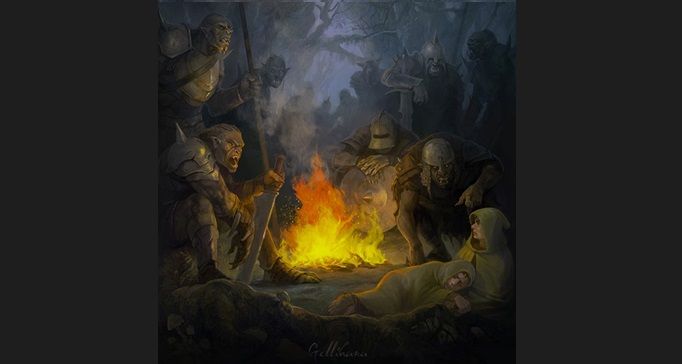
In the real world, what we in the Tolkien fandom call the primary world, Orcs are not a race. They’re a mindset, an ideology, the basest outlook of humanity. Tolkien certainly thought so.
(Illustration: “Orcs” by Gellihana-art)
In this sucky time when American white nationalists and closet Nazi sympathizers occasionally try to co-opt Tolkien by pretending that his works somehow support their bigotry, or do their best to cite their favorite aspects of the story (like when Men fight other Men they deem lesser) . . . I would like to pull up a segment from an article I wrote five years ago about Tolkien’s Orcs in The Hobbit and The Lord of the Rings:
A lot has been written about Tolkien’s conception of good and evil (including Orcs) in terms of race, and certainly modern-day alt-right and white supremacists have tried to appropriate Tolkien for their own use. I feel secure in stating that he would not have given them the time of day. When a German firm, hoping to publish a translation of The Hobbit, inquired whether he was of Aryan descent, he wrote back to say that particular translation could “go hang” and that he rejected their country’s “wholly pernicious and unscientific race-doctrine” (letter #29 from The Letters of J.R.R. Tolkien). And while I’d agree that this Oxford professor of philology and Medieval literature (born in 1892) wasn’t as sensitive to the concept of race in the way that we at least try to be today, I also believe he was decades ahead of his peers and would measure up better than most of us in present times. Again, if he’d been around to experience our generation.
My opinion is that many fans, critics, and even scholars miss the point Tolkien was making. He saw Orcs not in terms of race or ethnicity but in the loathsome moral behavior of anyone, be they human or mythical monster-men. For example, we knew he had a low opinion of technological progress—for progress’ sake—and particularly of the cutting down of trees. In a correspondence with his son (letter #66), he wished the “‘infernal combustion’ had never been invented” or at least “put to rational uses,” for it fouled the air and spoiled the quiet of his garden. In the chapter “Treebeard,” the old Ent himself says this of Saruman and the Orcs who’ve come into his woods:
‘He and his foul folk are making havoc now. Down on the borders they are felling trees – good trees. Some of the trees they just cut down and leave to rot – orc-mischief that’
Wanton destruction and especially waste go hand-in-hand with “orc-work” in Tolkien’s mind. In the chapter “The Black Gate Opens,” as Aragorn’s army advances on Sauron’s land, they see the first signs of the occupancy of Orcs, who in daylight have made themselves scarce.
North amid their noisome pits lay the first of the great heaps and hills of slag and broken rock and blasted earth, the vomit of the maggot-folk of Mordor;
But the greatest atrocities of Orcs—the thirst for violence, the cruelty of war—is what Tolkien saw most clearly in his fellow humans. He wrote many letters to his son Christopher during the Second World War, having himself been a veteran of the First and knowing firsthand its horrors. He hated the whole business of the war—not as a pacifist, for he understood why the war existed, but at how it brought out the worst in everyone, leading to so much misery and death. His own side was not excluded from this contempt.
In one letter (#66, in May of 1944)—mind you, this is ten years before the publication of Fellowship—he drew comparisons from his own work, with which Christopher was already familiar. And he didn’t hesitate to use the O-word. Speaking of the manner in which “we,” the English and their allies, were going about the war, he wrote:
For we are attempting to conquer Sauron with the Ring. And we shall (it seems) succeed. But the penalty is, as you will know, to breed new Saurons, and slowly turn Men and Elves into Orcs. Not that in real life things are as clear cut as in a story, and we started out with a great many Orcs on our side . . .
On our side. Here he is not associating Orcs with the Axis Powers, but the Allied powers, which would include Great Britain, France, the Soviet Union, the United States, and so on.
Today, when we witness the abhorrent words and actions of people, we like to use pop culture analogies. We’re quick to (rightfully) equate white supremacists with the space Nazis of the Galactic Empire. How easy it is to invoke Palpatine when we see powerful people self-aggrandizing, shunning responsibility, or dodging accountability. It comes naturally to us, with so much media to draw from, to harness the stories we love, stories filled with human truths. I think it’s why so many of us love fiction so much.
My point is, Tolkien did this, too, and well before we did. Considering the historic oral traditions of storytelling, I would argue humans have always done this. Except Tolkien used his own stories. It was very personal, for his own son was enmeshed in the war (specifically, Christopher Tolkien joined Great Britain’s Royal Air Force in 1943). In another letter to Christopher less than a year later (#96 from Letters), when the conflict was nearing its end, he yet mourns for the inhumanity of his own Englishmen—the lack of compassion, of mercy:
The appalling destruction and misery of this war mount hourly: destruction of what should be (indeed is) the common wealth of Europe, and the world, if mankind were not so besotted, wealth the loss of which will affect us all, victors or not. Yet people gloat to hear of the endless lines, 40 miles long, of miserable refugees, women and children pouring West, dying on the way. There seem no bowels of mercy or compassion, no imagination, left in this dark diabolic hour. By which I do not mean that it may not all, in the present situation, mainly (not solely) created by Germany, be necessary and inevitable. But why gloat! We were supposed to have reached a stage of civilization in which it might still be necessary to execute a criminal, but not to gloat, or to hang his wife and child by him while the orc-crowd hooted.
The Orcs in this instance are not the defeated. Not the Nazis, the Fascists, the Empire of Japan; not the collateral refugees. Rather, they are the victors who cried for blood and for sadistic revenge, on any side. It is the moral decay of Men that concerned Tolkien, and we see it embodied in his secondary world in the Orcs, “the maggot-folk of Mordor.”
In May of 1945, Tolkien’s contempt for the Second World War really peaked. In yet another letter to his son (#100), he wrote:
Though in this case, as I know nothing about British or American imperialism in the Far East that does not fill me with regret and disgust, I am afraid I am not even supported by a glimmer of patriotism in this remaining war. I would not subscribe a penny to it, let alone a son, were I a free man.
Is it any wonder that Tolkien’s most famous story sets his “good” people (who are not without evils of their own) against an unequivocal Dark Lord who not only yokes other people with his power and lies (people who might otherwise have been good), but also commands a demonic army that represents the worst in all of us? And yet consider the words of Gandalf at the Council of Elrond:
‘For nothing is evil in the beginning. Even Sauron was not so.’
Of course, there is such a thing as point of no return. Sauron himself had a chance to repent, and nearly did, at the start of the Second Age. He passed it by. What of his creatures, though? Some of which he corrupted and bred—but the first Orcs were not his, whatever they were.
I wrote that five years ago, in 2021, when I felt it was especially applicable in our social and political state, and yet it was quoting Tolkien’s remarks about the state of things in the 1940s. So, to quote Neil Peart of Rush (because I am not me if I don’t) who, in turn, was quoting nineteenth-century French journalist/critic Jean-Baptiste Alphonse Karr :
Plus ça change, plus c’est la même chose
The more things change, the more they stay the same
Alternatively, I could quote Bono of U2:
And nothing changes on New Year’s Day
Right?
So Tolkien saw Orcs not in enemy soldiers or immigrants, but in those of his fellow countrymen who gloated at the ruin of others, who lacked compassion, empathy, and imagination, who demanded blood and punishment.
Same, Tolkien. Same.
 Foreshadowed and Foresung