
Continuing the theme of talking about the good things in life . . .
This is just a short post mostly to redirect folks to this awesome and insightful new article in the “Overlooked No Mere” series in The New York Times—which I’d never heard about before. It doesn’t appear behind a paywall, either. I guess that makes sense, since it’s an obituary series. Anyway, it’s this one:
Overlooked No More: Karen Wynn Fonstad, Who Mapped Tolkien’s Middle-earth
And here’s my quick followup opinion.
Fonstad rocks. Her cartography books are exceptional. Her work focused more on accuracy and detail than about aesthetics, but that’s why they’re so useful. I’ve referenced her Atlas of Middle-earth coutnless times while working on my Silmarillion Primer series the first-time, and a few times while working on the book version. Then there are her TSR books I’ve looked through many times: Atlast of the Dragonlance World and The Forgotten Realms Atlas.
Sadly, I failed to get a copy of these last two when they were still in print. At least you can purchade a semidecent digital scan copy, such as on the DM’s Guild. Another thing I love about them was the timing: they captured both Dragonlance and the Forgotten Realms at their TSR prime, long before both settings (particularly the Realms) sank into a kind of mediocrity and imaginatively stunted commercialization at the hands of their latter-day stewards (Wizards of the Coast).

Want to see a realistic layout of the Inn of the Last Home from Dragons of Autumn Twilight, book 1 of the Dragonlance Chronicles? Pages 10 and 11 of her Dragonlance atlas will hook you up. How about the ruins of Xak Tsaroth? Pages 22 and 23. Want to see where the stone well is—the one that the black dragon Khisanth emerged from before totally devastating Riverwind with her acid breath? I vividly remember flipping to that page first as a preteen, when I first set hands on the book, because that was scene was so gut-wrenching and visceral.
What about the Towers of High Sorcery? Want to see what their layouts were? Or the main temple in pre-Cataclysm Istar, where Raistlin and Crysania travel to through time? How about the battlements of the High Clerist’s tower, where Sturm . . . well, it’s all in there.
Ah, but these books don’t only contain maps. They’re filled with Fonstad’s text describing the geographical factors and other circumstantial considerations. Concerning the Inn of the Last Home, which is where the Dragonlance novels truly begin, she worked out its interior dimensions based on the story text.
The common room seated at least 60. It was “bean-shaped, wrapping around the trunk of the vallenwood.” The exterior was decidedly rectangular, so the rounded shape of the common room must have been the result of an inner wall. . . .

Fizban pulled the long table against the trunk so that it would be in shadow at night with the fire lit. This was also true of Raistlin, who was leaning back in a darkened nook in the tree tunk. Goldmoon and Riverwind sat nearer the fire. After the crytal staff was revealed, the companions fled with the couple. They escaped through the swinging doors into the kitchen and dropped through the floor on a rope left there for just such emergencies.
Tree nook, winging doors, hole in the kitchen floor with rope. She really put in the work. Fonstad is the nerd’s cartographer. She was an absolute gift to various fantasy fandoms. This New York Times article helps us see a bit of the human behind the work, and I appreciate that. It even points out that she wasn’t necessarily a fantasy fan, but did take to Tolkien. (And presumably eventually some others, once her freelance work took her deep inside.)
Concerning The Hobbit and The Lord of the Rings:
“I doubt if any other book or books will ever grasp my interest as much as these,” she wrote in her journal in 1975. “Each time I finish a reading I immediately feel as if I hadn’t read them for weeks and I am lonely for them — lonely for the characters within the books, the tremendously vivid descriptions, the whole essence.”
Yep, she got it. She even ends the Atlas of Middle-earth with some maps that show what regions spoke which language predominantly, because she knew language concerned Tolkien the most.
Also, who ever made a map of Thangorodrim and actually placed and labeled Húrin’s chair on its exterior?! You know, the place where Morgoth seated him so he could watch from afar, and through Morgoth’s own corrupted eyes, the unfolding of his family’s destruction.
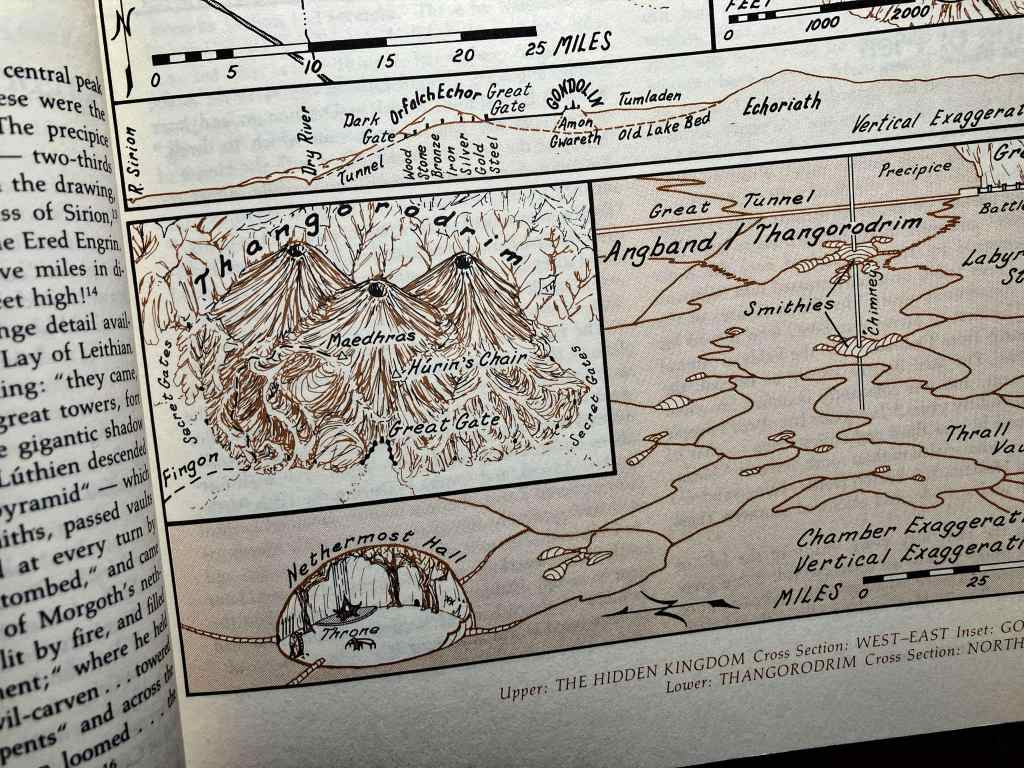
Or who ever even hazarded a guess as to where precisely on the side of the three peaks of those volcanic towers Maedhros was hung (also the work of Morgoth)? Fonstad did. She rocks.
Check out her illustration of the literal Circles of the World.

I love this excerpt from the New York Times article:
For all her devotion to fantasy worlds, Fonstad was bemused by the rise of fan culture. She rarely accepted invites to conventions or conferences, claiming she was too thin-skinned to field criticism. But her reluctance softened near the end of her life, as Peter Jackson’s “Lord of the Rings” film trilogy made the characters Frodo and Bilbo Baggins household names.
In 2004, at a conference in Atlanta, she met Alan Lee, the films’ Oscar-winning conceptual designer, who mentioned that her atlas had been a vital resource for his team.
“Nothing could have made my mother happier in the last few months of her life,” her son, Mark Fonstad, an associate professor of geography at the University of Oregon, said in an interview. “She very much enjoyed those movies, even though she was among the 1 percent of people who could have nitpicked every difference from the books.”
Could have. On top of it all, she would have seen every geographic license taken by Jackson’s team, and enjoyed the films anyway. No gatekeeper, Karen Wynn Fonstad. Good on her.
 Foreshadowed and Foresung