
The finale of season 2 The Rings of Power, quite surprisingly, didn’t terribly disappoint me. I enjoyed it more than I thought it would, and some plot threads ended . . . not as cringey as I expected. But let’s get to it.
Khazad-dûm
- I like that we’re pulled right in to what is inevitably a brutal moment. But the massacre, however many Dwarves King Durin III is meant to have killed in his ring-madness, we don’t really see.
- I do love, love the affection and genuine concern between Durin IV and Disa. A strong point for the show, as always, these two.
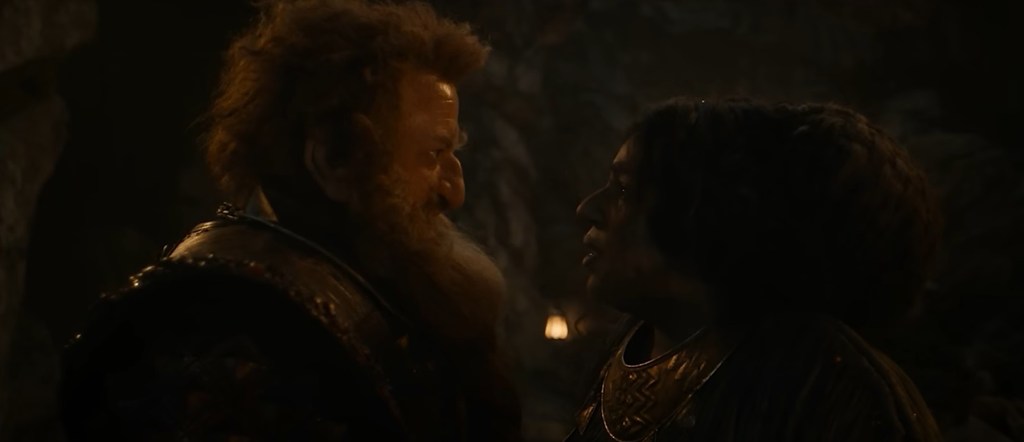
- As was pointed out by Matt (Nerd of the Rings), the fact that we got a shot of Narvi looking awkward (or as I think of it, third-wheelish) when the two Dwarves kiss makes it all the more damning that the Elrond-Galadriel kiss in the previous episode kept the camera on only the two Elves, thus emphasizing the romance and confusion of the scene. If we get to see Narvi’s reaction, we should see Adar and the Orcs also react and see the alleged distraction the kiss was meant to effect.
- Quick aside: I was very glad to see even Dr. Corey Olsen and Dr. Maggie Parke call out the El-Galadriel kiss as not really landing right, and handled wrong. I do think it landed as Amazon meant it, though.
- Anyway, I think Narvi’s discomfort isn’t that it’s a public display of affection, but the fact that he might think he’s potentially witnessing the last meeting of a husband and wife, and feels like maybe it’s too private, too momentous, for him.
- Durin IV’s final moments with his dad were satisfying and tragic.
- As I was fearing a total release of the Balrog and ruining of Moria at this point, way too early, this temporary closure to the Balrog situation was acceptable. Maybe not ideal in my book-besotted head, but I’ll take it. Durin III going out with a kind of redemption is probably the best-case scenario for the plot the show worked up.
- That said, I didn’t love two particular Jackson callbacks:
- (1) The Balrog’s flame-whip specifically lashing around the king’s ankle, à la Gandalf’s. Note that in the book, the whip wraps around Gandalf’s knees, so this is a Jackson-specific callback. Yet again.
- It also leaves me imagining a much “younger” Durin’s Bane, training alongside his fellow Balrogs in the pits of Utumno before the Years of the Sun of the First Age. Gothmog, Lord of Balrogs, is going up and down the line as the Balrogs are working on their tormenting and whip-lashing skills—perhaps using surprisingly articulate combat dummies meant to resemble various uncorrupted Valar or Maiar. Gothmog berates Durin’s Bane whenever he fails to get his whip to wrap properly around the target dummy’s ankle, as is only proper for one of the Valaraukar. “Sorry, boss,” he says in whatever foul language they communicate with, “I’ll keep working on it.” And maybe all these millennia, he has been working on it. Now he’s perfected it. Or . . .
- Maybe this Balrog was one of the ones who brought High King Fingon down in the Nirnaeth Arnoediad, tripping him up with his “thong of fire” so the others could strike the Elf down. And when it worked, Durin’s Bane and Gothmog exchange a knowing nod, right there in the heat of battle. Durin’s Bane, Gothmog might have been thinking, you finally got something right.
- Don’t worry, Durin’s Bane would maybe answer. I won’t let it go to my head. But I digress.
- Maybe this Balrog was one of the ones who brought High King Fingon down in the Nirnaeth Arnoediad, tripping him up with his “thong of fire” so the others could strike the Elf down. And when it worked, Durin’s Bane and Gothmog exchange a knowing nod, right there in the heat of battle. Durin’s Bane, Gothmog might have been thinking, you finally got something right.
- It also leaves me imagining a much “younger” Durin’s Bane, training alongside his fellow Balrogs in the pits of Utumno before the Years of the Sun of the First Age. Gothmog, Lord of Balrogs, is going up and down the line as the Balrogs are working on their tormenting and whip-lashing skills—perhaps using surprisingly articulate combat dummies meant to resemble various uncorrupted Valar or Maiar. Gothmog berates Durin’s Bane whenever he fails to get his whip to wrap properly around the target dummy’s ankle, as is only proper for one of the Valaraukar. “Sorry, boss,” he says in whatever foul language they communicate with, “I’ll keep working on it.” And maybe all these millennia, he has been working on it. Now he’s perfected it. Or . . .
- Whatever happens in future seasons, we know that Durin IV, Disa, and Narvi all see the Balrog. Does it mean they know what it is? No. It’s Durin’s Bane, one way or another. But the fact is, these three are witnesses:
- (1) The Balrog’s flame-whip specifically lashing around the king’s ankle, à la Gandalf’s. Note that in the book, the whip wraps around Gandalf’s knees, so this is a Jackson-specific callback. Yet again.
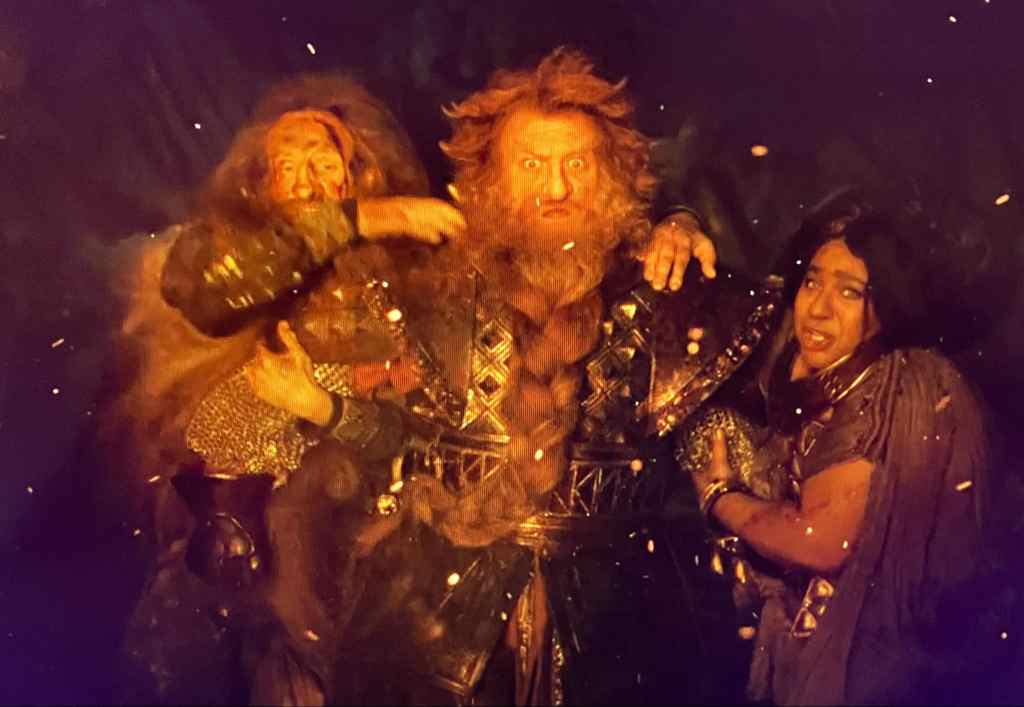
- How do we reconcile this with the fact that no one knows that it is a Balrog until Legolas IDs it in The Fellowship of the Ring? I am going to be very carefully watching to see if the show even tries to explain this. My point is, it’s a big mystery for centuries, for millennia. It is the “nameless fear,” the “Terror” (capital T). It has only been Durin’s Bane all that time. They never know what it is, not until the Company of the Ring encounters it. Maybe Durin, Disa, and Narvi can work with a sketch artist and run it by some Noldor or Sindar who were in some of the First Age wars? Just spitballing here.
- Does one little collapse of stone really contain the Balrog, too? He’s now content to wait until they dig too greedily and too deep again? I’d like to understand.
Rhûn
- Of all the plot threads in this show, this one I’m the most disappointed in. I wasn’t before. I enjoyed the Stranger and the Harfoots, and wasn’t very won over by Stoors.
- This final segment has a few problems, and only one of them is this wizard-reveal party at the end of season 2.
- I’m just left with too many questions. They could address them in the future, but it’s not likely they’ll do it unless the story stays right there in Rhûn and hashes some things out. Questions like . . .
- What’s with the masked riders, the Gaudrim? They were actually kind of interesting. Who the heck were they, and did they matter at all?
- What was the curse on their flesh? How did it come about?
- What was with their screwy treatment by the Dark Wizard? Why in a previous episode did he send Brânk (who the leader is apparently called) and his riders after the halflings, while insisting that he himself would deal with “the Istar,” when in fact they both just showed up in the same place to deal with both halflings and Istar at the same time, anyway? The Gaudrim were intriguing, and it feels like the writers, or post-production scene editors, just kind of screwed them over somehow. Feels like a lot was missing. They could explain some of it later, I suppose, but I suspect that would make a weak retcon to do so.
- “Grand-elf” was a little cringey when it was first uttered an episode or two ago. But now as a bunch of Stoors are saying it awkwardly out loud like they’ve all already agreed on it, it’s especially cheesy, as a set-up for us.
- The ending of this thread just leaves me feeling kind of meh. Was it supposed to feel like a victory? Other than his getting to where he was supposed to be, beneath those stars . . . why? To get just that one staff? To bring Harfoots and Stoors together? To challenge this other wizard? . . . What was the goal here?
- Had Gandalf, the Stranger, not come here, the Stoors would have been left alone in peace, wouldn’t they?
- The Dark Wizard—whose name we are not given because of rights reasons? it feels that way—says that he (the Stranger) is the one who convinced him (the Dark Wizard) to come to Middle-earth in the first place? Setting his mention of Manwë aside—and setting aside the mispronunciation of Manwë (*sigh*)—are we to understand that the showrunners have really just done it again?
- That is, taken one of LotR’s major power figures of good and made them the reason why a major villain is even here on Middle-earth causing trouble? Sauron might not have been repentant, but he was just gonna drift out at sea for a good long while without Galadriel showing up and dragging him back to Middle-earth and right into the place he could do the most damage. Now the implication—not confirmed yet, but put on the table when it didn’t need to be—is that all the evil the Dark Wizard may have done or yet will do—is now because Gandalf pushed him to come here for some reason way before he himself came?
- What the heck is going on with this plot? Each new revelation telescopes further and further away from Tolkien lore, but more important, Tolkienesque ideas.
- Finally, what was the purpose of Tom Bombadil’s riddles and passive aggressive testing? When I stand back and look at the whole Rhûn plot, I keep coming back to: Tom Bombadil delayed Gandalf; if he’d let him search for Nori right away he might have been at the Stoor village long before the Gaudrim and the Dark Wizard. Sometimes it feels like the good guys are given scene after scene of simply creating more conflicts, or at least delaying so the bad guys get to accomplish bad things.
- While I don’t think this Dark Wizard is really meant to be Saruman, they sure are leaning into the Saruman-and-Gandalf dynamics specifically from Jackson’s Fellowship and it’s not helping the situation.
Númenor
- I was expecting a pivot from Ar-Pharazôn, of course. Some new grab for power to supplant Míriel by some new means outside of the books, and I get they’re fastracking the downfall of Númenor storyline . . .
- And I don’t even mind this angle of claiming that Míriel somehow cheated in the sea monster ordeal with Sauron’s help—only because of the all-new story they’ve unfurled . . .
- But how is Pharazôn explaining how he knows anything about Sauron or the fact that he was there in Númenor and allegedly allied with Míriel? Sure, we know that he looked into the Crystal Ball of Plot Contrivance +3, but they’ve established that the Númenóreans consider the stone as Elf trickery; they’ve rejected that sort of nonsense; hell, that’s why they’ve been supporting Pharazôn. Are we to understand that he’s now confessed to having looked in the palantir? I doubt it. So what evidence has he given the officials who wrote up all those declarations that the Faithful are traitors, claiming that Sauron was Halbrand? How did he get those notarized? I know RoP Númenóreans are extremely fickle, but do they just believe everything told to them without proof, like right out of the gate? It’s infuriating that the show leaves this sort of “detail” out.
- Eärien sure does wear many hats (has many jobs)! She’s got an impressive resume. What happened to her being an architect. Now she’s a messenger or diplomat or spokeperson?
- I didn’t dislike the reveal of Narsil. If it’s a callback, it’s an acceptible variety because it’s not inserting anything. Narsil really is Elendil’s sword in the books and Tolkien never said how it was given to him or when precisely it was made by Telchar the Dwarf.

Pelargir
- Kemen’s actor is doing a fine job at getting us to dislike him. I will be watching his career with great interest.
- I like Isildur and Theo’s moment together.
- Passionate words exchanged between Isildur and Estrid. Is this relationship destined to become something in history? Is a woman from among the “low men” (a RoP term) really going to be part of the strong Númenórean bloodline that endures on Middle-earth until finally it thins out in its later decline? Or is Estrid’s presence here just to provide a will-they-won’t-they to please a certain demographic?
- Either way, why must Estrid be so flighty? When Isildur leaves her behind, does she really just consent and fall back to her betrothed, whose declaration of love allegedly made her feel sick? There are many female writers and directors in RoP. So this surprises me.
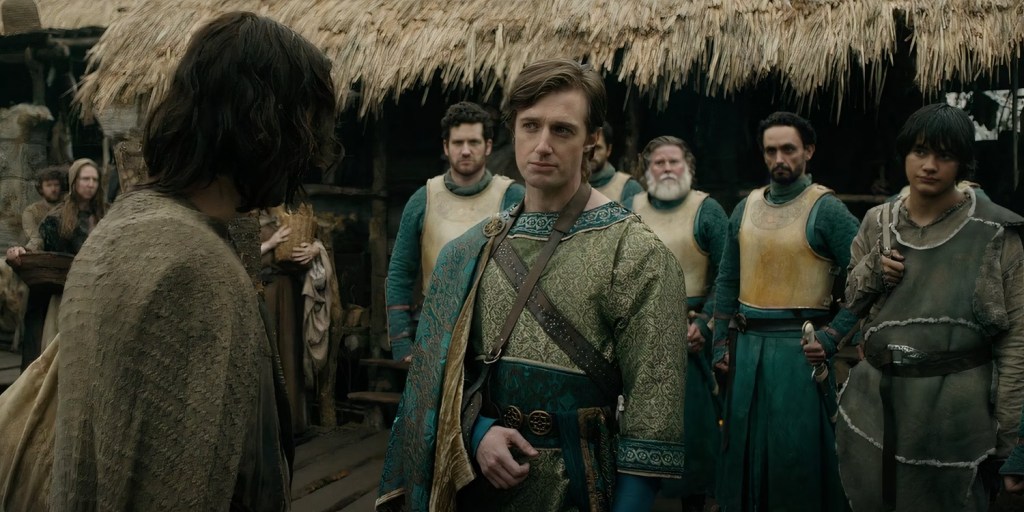
- This whole segment is clearly setting up the colonial Númenor to come, but to me it’s just too little too late. The slow, tragic build-up to the collectors of tribute from the Men of Middle-earth is greatly missed. Every plot is a drive-thru version of its book counterpart, paved with impatient compromises.
Eregion
- I like seeing Galadriel attempting to lead survivors—but only a group of five? I really appreciate that they included an Elf-child with them, for a couple of reasons. One is to make this horrific siege more realistic. Orcs are killing kids. The other reason, I’ll come back to.
- When Galadriel is stopped by Orcs, the plot armor sure is thick. I just can’t imagine why they wouldn’t immediately attack, no matter what she says. And what do they know about the Nine? Adar himself did not. It’s a stretch that her offer would mean anything to them.
- Let’s talk about Celebrimbor. You know what? I have not liked the entire re-ordering plot of the rings or the manner by which Annatar came to Eregion. But once I accept that and move on, I’ve enjoyed the vast majority of what Charles and Charlie have done with their scenes together.
- So this ending, with Annatar sinking arrows into Celebrimbor cruelly—that works. That’s the Sauron we should have been seeing a lot more in place of Halbrand. Their overall interplay of words was satisfyingly painful. Even Celebrimbor spouting out some final prophetic words was okay with me! His grandfather had some special insight in his moment of death (and misused it terribly). I don’t mind him putting a bit of fear into Sauron. So . . . well done.
- That said, crying Sauron always bothers me and they really played it up big this time. Boo-hoo. He’s supposed to be a Maia, and one of the mightiest. Am I saying a Maia can’t cry? Heck no. Valar sure can. But Gandalf and the Istari, all whom are Maiar, are incarnate, totally chained to the flesh. I bet he could cry. Even Melian the Maia, who wasn’t incarnate but simply chose raiment and bound herself to her husband and people that she became more and more part of the world (such that she gave birth to a daughter). I bet she could and did weep. But these are the good guys, who have much to mourn.
- But Sauron? Nope. I would only approve of Sauron tears if they are shed in order to deceive someone. But the jig is up here, Celebrimbor is on his way out, there’s no one to trick in that moment. So to me, it’s cheesy, it’s pandering to an audience who doesn’t understand what he is supposed to be.
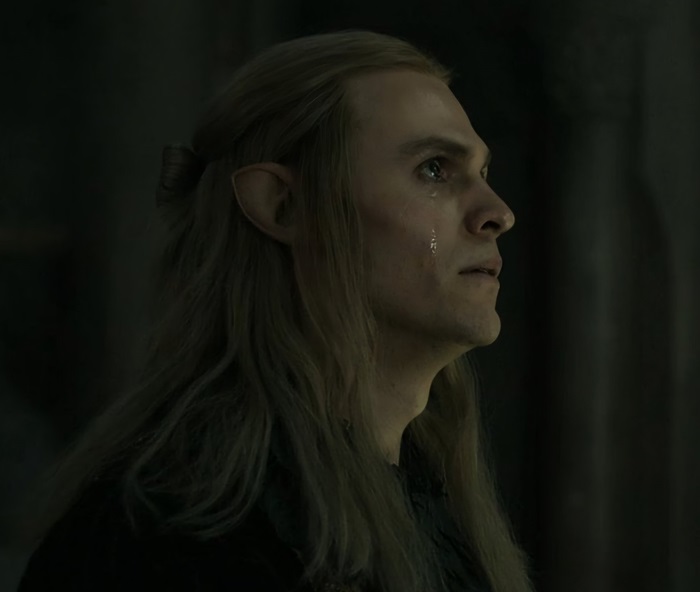
- His is not a human or Elven body, either. We’ve already seen black blood. Why not at least tears that look different? Something to dehumanize him.
- Then again, I have to remind myself: This is a TV show that can’t even say the word “Maia.” As far as the average viewer is concerned, Sauron might just be a human who became a sorcerer and somehow achieved immortality and the ability to shapeshift. So I guess anything goes.
- But dang it, Celebrimbor. His ending was as good as it could be in this show, so props to all involved.
- Now . . . Adar! I absolutely like Adar’s end and the completion of his arc. The fact that he had an arc. I didn’t know where they were going with him, and I appreciate what they did with it in the end.
- Suddenly, the subplot of an ancient Elf, one who was used to help create the Orc race, became less lore-rattling and more interesting. He absolutely was a monster, he commanded Orcs to slaughter non-Orcs, but since he began as an Elf, not an Uruk, he actually cared for them enduringly like an Elf.
- On the one hand, Adar never seemed redeemable to me in life. But on the other, this unexpected twist—that the ring Nenya “healed” him spiritually, morally, just enough to puncture through the milliennia of corruption so that he can see clearly again—means that his spirit was redeemable. Of course, it can. Even Orcs, if they are indeed made from Elven stock, might have Elven spirits (fëar), in which case their spirits become the business of Mandos. Or more likely, Ilúvatar.
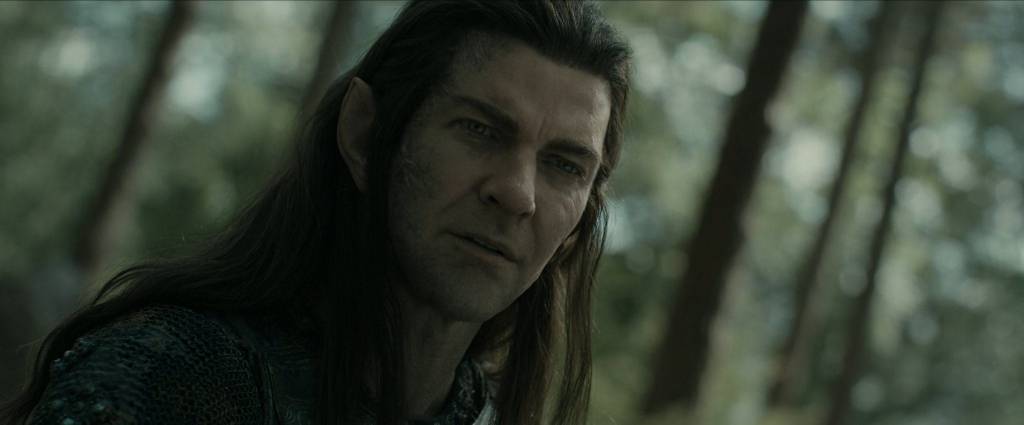
- Whatever the case, it worked for me. And yet his death is just. And tragic, because it means exactly zero characters have the Orcs’ well-being in mind from here on out. Now all Orcs will cleave to Sauron’s management—i.e. enslavement—just as we see them in The Lord of the Rings.
- I’m so, so glad Adar did not give us his original name. He didn’t need to be another named Tolkien character. In this way he remains original. Smart choice by the writers. Some of the writers in this show are good.
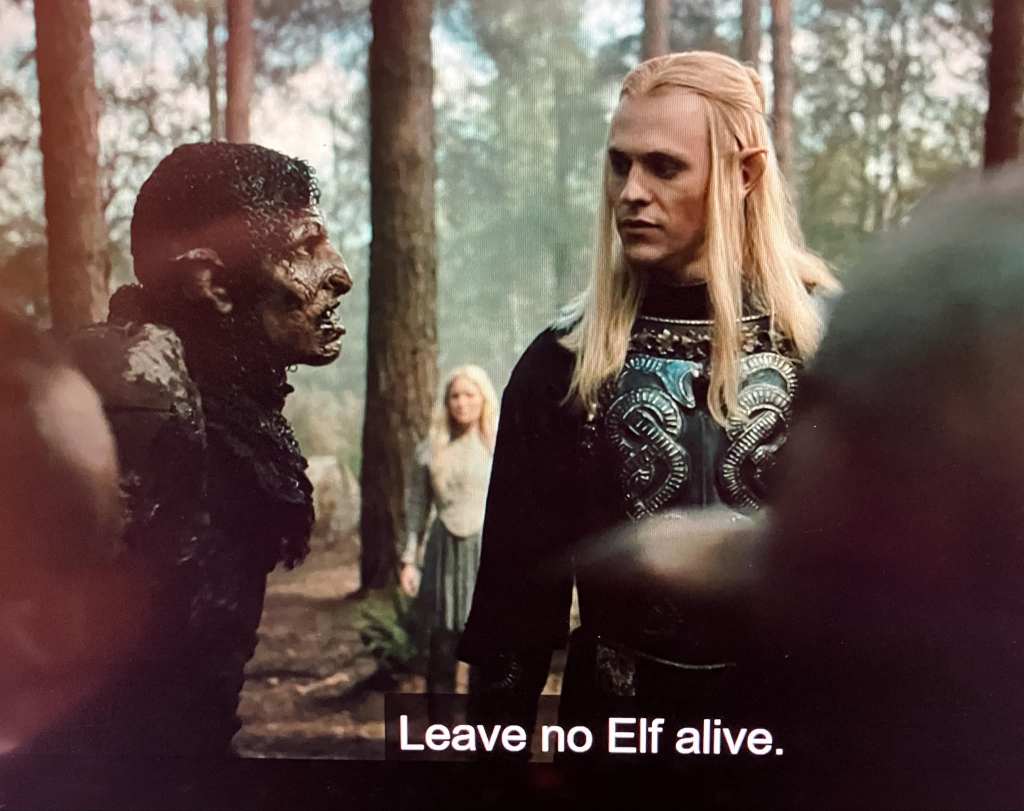
- And yet we have Galadriel, who continues to frustrate in the choices the showrunners have made for her. When Sauron is at hand, issuing orders, telling his Orcs to “leave no Elf alive” in Eregion, she stands there, paralyzed with shock or indecision. Whatever version of Galadriel the showrunners have devised—no matter how many versions of her origin story Tolkien himself was devising—paralyzing indecision should not be one of them. This show has made her many inactions have disastrous consequences.
- When she finally moves, and her duel with Sauron begins, my belief in the secondary world (that is, my immersion in the story) is continually rocked by the fact that this Galadriel does not act or fight like a commander, a general, or a great Elven warrior who’s thousands of years old. A professional soldier does not stop in surprise when wounded to look at the injury and at her opponent.
- Hell, each time either Galadriel or Sauron takes a hit or slash, they both dramatically pause with irritation or surprise and often exchange a look. They lose valuable combat time. Seconds tick away. It’s wasetful and I don’t buy it.
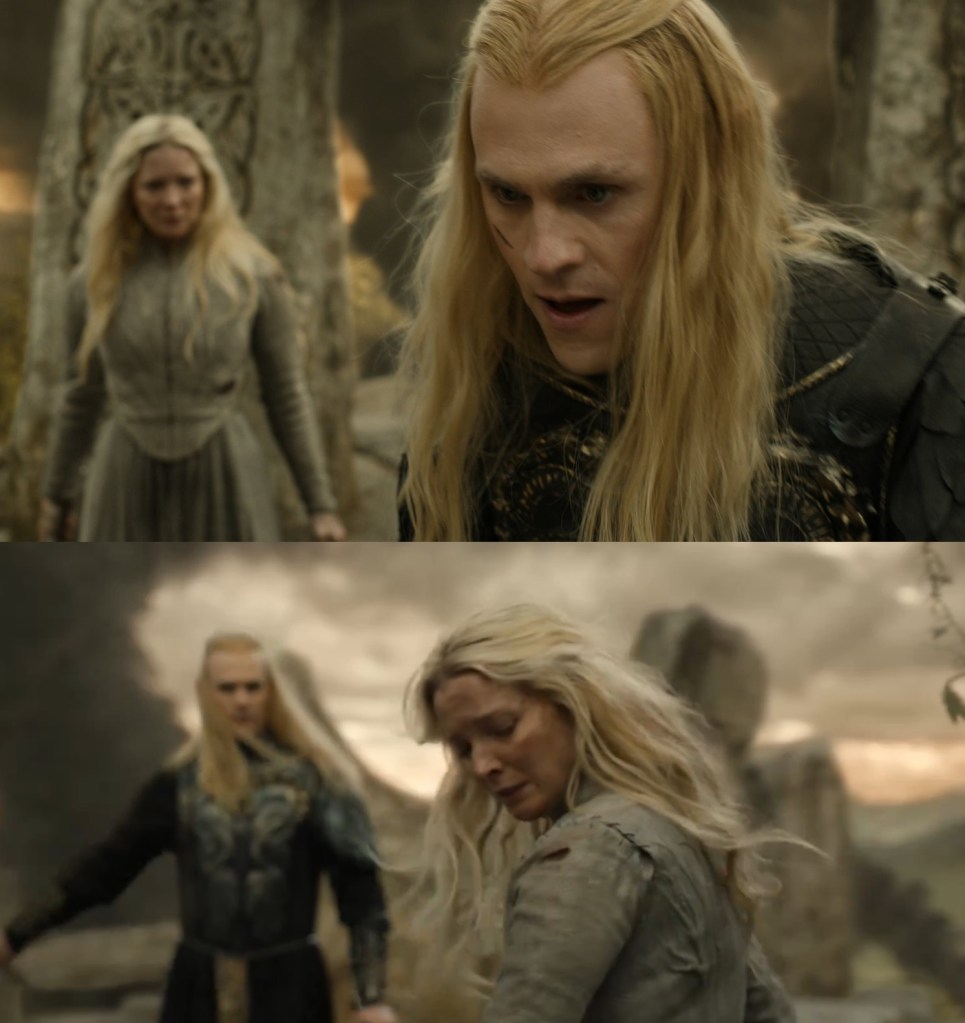
- Yeah, it looks cool, but it also digs into high action and cartoonish combat territory. It’s Willis, Stalone, and Schwarzenegger movie material. Which have their place! But it’s not very Tolkienien.
- My first viewing, it was just fun. But the more I think about it afterwards, the less I am satisfied with the way it all played out. That said, I like that he shapeshifted during the battle. That feels right. Wish we saw him transform into bestial forms and not this particular show’s familiar actors.
- But also, why does his Halbrand form suddenly have Third Age hobbit’s hair and a fresher shave than Galadriel would remember from their time together? They couldn’t match his hair from the first season? It felt like a wardrobe or prop mistake.
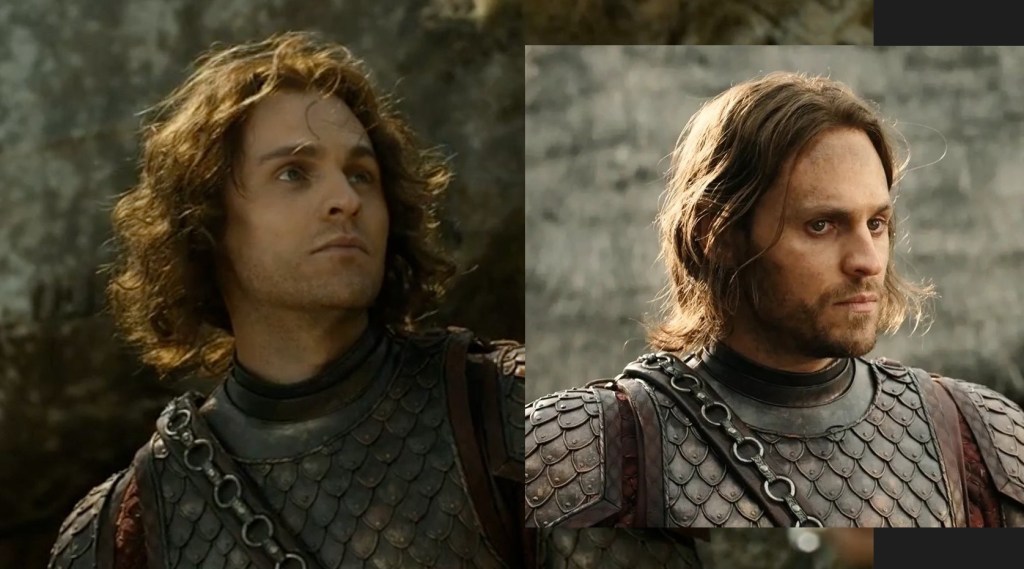
- I’m still not a fan of Morgoth’s crown not having been beaten into a collar for Morgoth, but whatever, we’re past that now.
- Galadriel’s big fall. Setting aside the feasibility of her surviving such a plummet (chalking it up to magic, the ring in her hand but not on her finger), I didn’t care for it as a means to end the battle. Sauron desperately wants all the rings now, not just the Nine, and he would have no better chance than right then, when she is the most vulnerable and wounded. Why he didn’t immediately jump down after her and take Nenya is incredible. Not like the fall would hurt him.
- How many times could he have killed her and yet didn’t? Many.
- Sauron and Galadriel having been paired in this way makes me twitch. The dichotomy alone doesn’t bother me. In latter days, Tolkien himself imagined Galadriel as Sauron’s chief adversary all along. In itself, that’s fine. More than fine. But this is a kind of reversal, where the actions of each enabled the other. That sure feels like something Tolkien wouldn’t have appreciated.
- See, the setup in this show is that Sauron would not have fallen back into evil (or at least would not have had as easy a time doing it) had it not been for Galadriel. In turn, Sauron rescuing Galadriel from the ocean and then choosing not to kill her at every opportunity means that his final defeat—at the hands of Frodo, Sam, and Gollum at the end of the Third Age—is because of Sauron’s mercy. A villain showed a good guy mercy and therefore evil was defeated. Let that sink in.
- Moving on . . .
- So, lots of fans—the Haladriel people—”ship” these two characters and that disturbs me way more than the unfortunate Elrond-Galadriel kiss.
- It disappoints me, but doesn’t surprise me, that Amazon’s social media folks lean into and embrace this. Naturally, anything to get people talking is going to be perceived as positive.
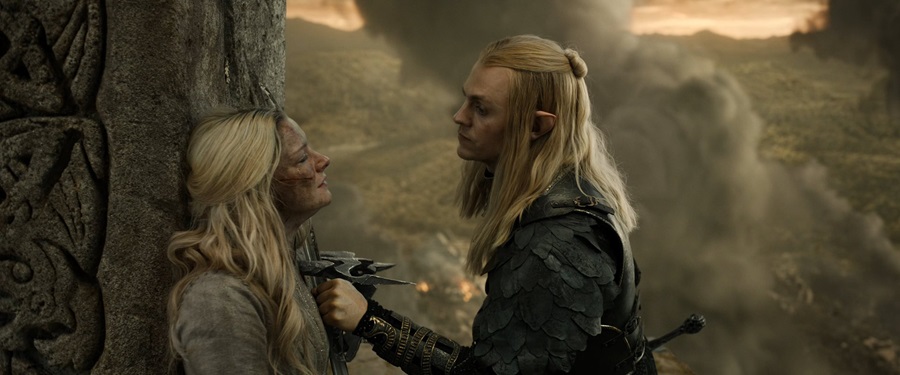
- I wonder: Do the fans who swoon over this fan fiction–style romance realize that Sauron’s direct and indirect actions—before and after this very moment—absolutely include the slaughter of Elf-children? Like that little Elf-girl we saw carried on her mother’s back, following Galadriel, is sure to be hacked apart by Orc-blades. Do the people who want more Haladriel care about this, or do they stick their fingers in their ears over such things?
- Moving on . . .
- Galadriel’s healing at the hands of Gil-galad and Elrond and two of the Elf-rings—with fast-healing Arondir apparently there for moral support—was a bit much. Her Morgul-style wound was definitely another Jackson callback.
- What’s with Gil-galad suddenly spouting new metaphysics? It felt pulled out of thin air just to create some stakes for the moment, but didn’t really feel thought through. He says, just looking at her wound: “Her very immortal spirit is being drawn into the shadow realm.” Which just sounds like it was pulled from an online dramatic fantasy pronouncement generator. If we’re to assume this is a Morgul-style wound, its effect on a mortal would probably be very different from its effect on an immortal. Whatever!
- I think the moment would have felt more emotional if we’d seen Gil-galad have even an ounce of affection for Galadriel anytime in the show before now. But this is the guy who tried to get rid of her by shunting her off to Valinor—a place to dispose of one’s embarrassing political problems.
- Poor Arondir. It really felt like the show didn’t know what to do with him. I’ve always liked him, but he was just . . . there in the final episode. From his first moment running into frame, seemingly fully healed from his terrible wounds in the previous episode, to his posing there with Gil-galad, Galadriel, and Elrond at the end just because.

I’ve had plenty more thoughts, but I just can’t write it all down. There is too much! Like my thoughts around Elrond and the scrolls set aflame. Or the Elf refugees, the passage of time, the dogs! The fact that Gil-galad assumes an awesome leaderly pose but says nothing at all.
The first time I watched episode 8, I actually rather enjoyed it with only a few groans. But it’s when I go back and think through each part that I feel how disjointed and awkwardly stitched the whole thing is. A patchwork within a cluster of patches within a great quiltwork tapestry. Some of it’s an utter delight, full of clever writing and ideas. And some are just not. Plenty of the plot choices can be explained, justified, and hand-waved to make it all more palatable. But then I keep thinking, this is supposed to be Tolkien. Should it need to be explained thoroughly in order to work?
And don’t get my brother started on the sound design of the show!
The Anduin flows on. This was just a Van Helsing, and it’s still fun. I’ll keep watching. And reading.
 Foreshadowed and Foresung
2 responses to “RoP : S2 Ep 8: Shadow and Flame”
Heard an interview with the show runners where they said there was a real “deep cut,” in Tolkien’s later writings in which Tolkien was playing around with the idea of Gandalf coming earlier and (?) even participating in first part of the war of the rings. Just paraphrasing this. Leaves me with questions. Know there are books published since Christopher Tolkien passed. And that some of Tolkiens later notes were recently found in drawers. But this also brings up the question of “fair use access?” They seem to have been given some case by case leeway with the Silmarillion (names etc) even if not everything. And maybe ? some with ? unfinished tales? (I have finally found some of my extra Tolkien books hurray. Silmarillion included yay!! Still looking for unfinished tales…but know there are a lot more that came out since then like Morgoths Ring series and Nature of Middle Earth…a Lot to catch up laugh) Just wondering if it’s possible they have some fair use access to some other notes they may only recently have come to light? Or perhaps I just haven’t read the volume or ?letter in which Tolkien considered Gandalf coming earlier.
Sent from Yahoo Mail for iPhone
LikeLike
The River Anduin flows on…(yes this!) and should keep reminding myself no matter the twists and turns of RoP (wry laugh.) The Van Helsing metaphor seems very fitting to me! I can appreciate why you want to see the narrative, time and sequence and even mapping of scenes to make sense. And are frustrated with what feels like jumping around and skipping to and next this happened…my feeling and observation is that casual viewers are very happy going along for the ride…and the details have little impact if they don’t know them. In fact they are highly enjoying the show. Have a friend who both lovedthe “cool Halbrand reveal” last season. And loved the mentoring relationship between Tom Bombadil and Gandalf. And the staff finding the wizard? Well JK Rowling must’ve borrowed from Tolkien!!! The show seems to be creating its own mythology already chuckle. Of course, I would have loved to see a version of the story as you outlined (IF it was done well!) Just think for those who really love Tolkien there is a feeling of “More than…” something sought in any interpretation of his works. I don’t know maybe it is The River. Nor can I explain why Tolkiens words evoke a landscape of middle earth that RoP doesn’t quite reach for me. Or why even the movies with all their changes still touch a glimmer of the River. But this does feel more like a Van Helsing…pretty but something not quite there…neither can I fully explain why it’s just enough and perfect for others whether they are casual fans or not. As said elsewhere, way too many thoughts on this. So I really do need to leave room for others laugh! And will try to hold back a niggling question about a paragraph on Galadriel from Unfinished Tales for some other time. The Anduin indeed flows on!! Signing off!
Sent from Yahoo Mail for iPhone
LikeLike