I don’t usually talk online about my actual day job. But today I’d like to. Just a tiny bit.
So I’m a senior production editor for Macmillan and I work almost exclusively on books for Tor (i.e. the Tor Publishing Group) and its genre imprints:
- Tor (sci-fi/fantasy)
- Forge (mystery/thriller/Western)
- Nightfire (horror)
- Tor Teen | Starscape (younger readers)
- Tordotcom (experimental speculative fiction)
- Bramble (romance)
Production and design departments generally comprise all the behind-the-scenes folks who make books happen. We’re not the glamorous buyer- or author-facing personnel like editors, publicists, marketers (but we know and like those people). Rather, my coworkers and I are all appropriately bookish, exceptionally nerdy, and uniquely shaped cogs in the system—and almost totally invisible. We escort and guard “final” manuscripts (which start as messy Word docs) down bumpy metaphoric roads that lead toward the printers; we constantly interact with editors, assistant editors, editorial assistants, cover designers, text designers, project managers, and managing editors; we hire the copyeditors, proofreaders, and cold readers who clean the manuscripts up; we look over and advise cover “mechanicals”; we mediate and arrange . . .
Zzzz . . . Zzzz . . .
Well, dang it. I’m losing you. Well, it makes sense; on the surface, we’re boring. We production people reference The Chicago Manual of Style frequently, we’ve always got a M-W.com tab open, and we all have emphatic opinions about em dashes, serial commas, and dangling modifiers.
(And we all have lots of crazy stories about the books we work on.)
Now, some percentage of authors do notice our part in making their books happen, and others at least become aware that someone is. Sometimes these authors will even credit us by name in their Acknowledgments. There’s no commission or bonus points for this—it’s our job, after all—but it does make us feel good. Plus, it kind of unofficially lets us, in turn, say, “Yeah, I did work on that, didn’t I?” Production people aren’t used to being noticed, though. We’re little ghosts in the publishing machine, and most of us our introverts, anyway. Seeing our names show up is just a bit of frosting on the job. It’s purely optional on the authors’ parts.
Now, most of the books we work on we can’t actually read—not cover to cover, at least not on the job. We’re in the weeds with these manuscripts, seeing them very up close, focusing more on the trees than the forest. If we want to actually read a book like the customer does . . . well, we’ll have to do that on our own time. I have set aside a few for exactly this reason.
These are books I’m proud to have worked on. For example, here are a couple of recent novels I’m eager to read through, having spent a lot of time with already and caring about how it does.
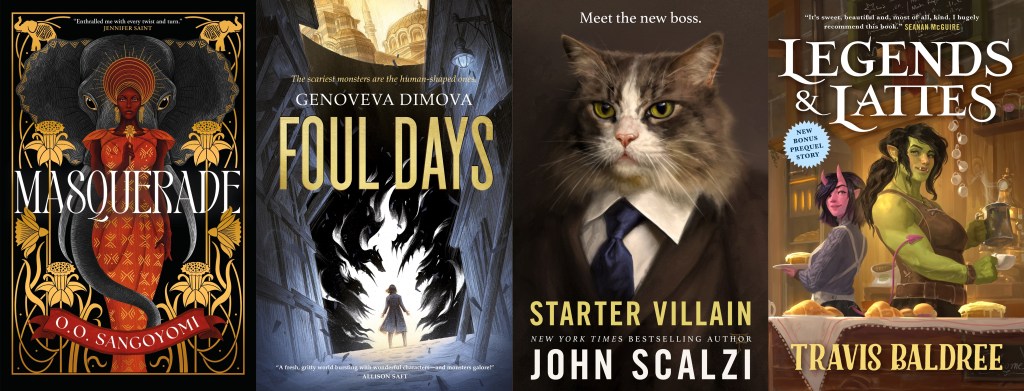
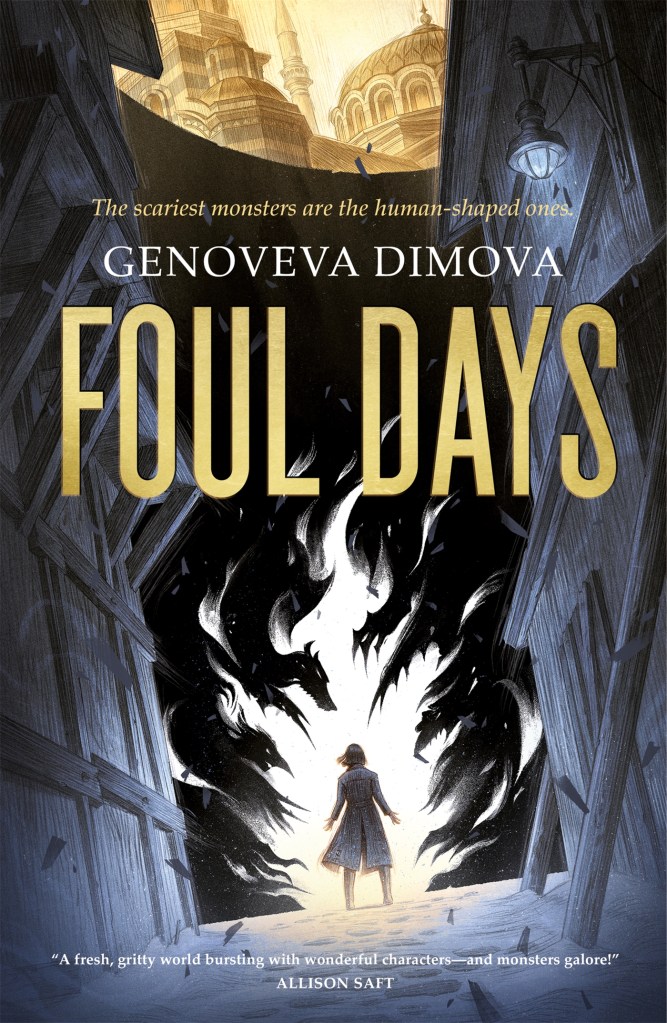
- Masquerade by O.O. Sangoyomi, which is set in precolonial, fifteenth-century West Africa and is loosely based on the story of Persephone. Appreciating mythology and myths retold is kind of my thing. And man, that cover art by Micaela Alcaino is gorgeous; easily my favorite this year. This book just came out, and it’s Sangoyomi’s debut. Congrats to her!
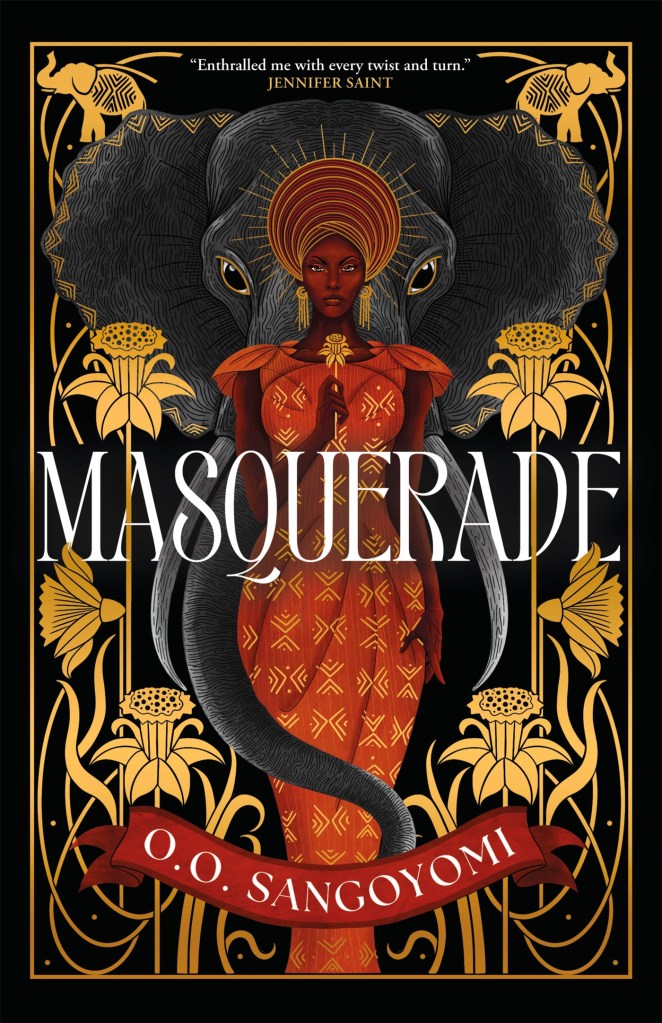
- Foul Days by Genoveva Dimova, a novel of Slavic folklore come to life. Set in the city of Chernograd, in Bulgaria, starring a witch who battles the creatures who prowl the streets during the Foul Days, a time when the boundaries between our world and the world of monsters “is hair-thin.” The most threatening of them, the Tsar of Monsters, is her ex.
There are others, of course. Too many to list. And, sure, there are some books I’m glad to see the back of, manuscripts that either didn’t interest me personally or left me eager to move on from. No need to talk about those. I like liking things, so I’ll try to focus on those.
Acknowledgments are a curious thing. They’re probably the least read pages of any given book, yet they’re so important. Not important to most readers, of course—who among us reads all the way through them?—but to the author and anyone whose help they’re publicly appreciating. Acknowledgments are emotionally validating. Sometimes they’re just a single page, or even a single paragraph. And that’s fine. Authors are only mildly pressured to write something. Some opt out altogether and have no one they wish to thank. Which . . . all right.
All the covers in this post are for books I’ve worked on, and had my name included in the Acknowledgments. There are others, but these are recent.
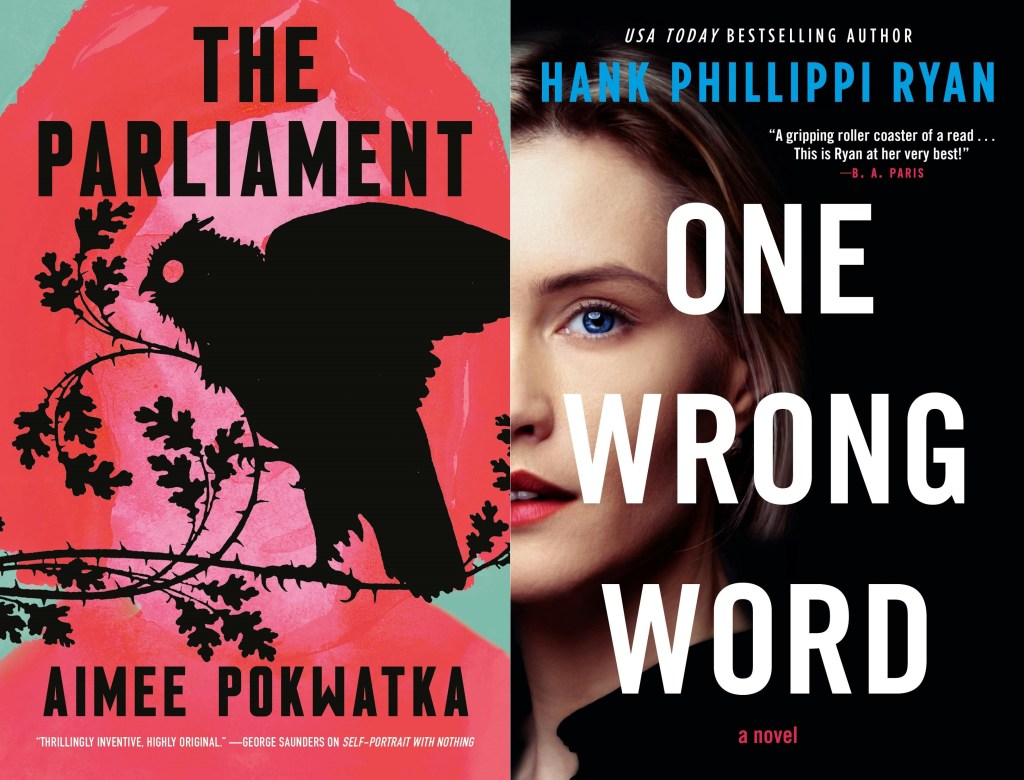
The Parliament is, on the surface, about murderous owls attacking a school while the teacher and students trapped inside pass the time reading a fairy tale. One Wrong Word isn’t really my genre, but Hank Phillippi Ryan is a master of her craft and she’s an easygoing author to work with.
When a manuscript is first transmitted to me (i.e. sent over in its rough Word form along with various related files), the Acknowledgments section is rarely ready yet. In most cases, it hasn’t been written yet. At this point, I ask my editorial counterpart, “Would you have an estimate of how many pages should be set aside for the Acknowledgments?” and they don’t usually know. So while the manuscript is being copyedited, reviewed, proofread, reviewed (rinse and repeat as necessary)—a process which takes a few months—the author eventally writes up their acknowledgments and it’s sent over to me.
Acknowledgments, while often ignored by readers, will be printed thousands of times, depending on the print run of the book and how well it sells. But they’re still important, and I’m glad books still have them.
I wrote only two paragraphs in the Acknowledgments for my Wizards of the Coast novel. While I wish I’d said more, I may not have been able to. WotC placed the Acknowledgments on the same page as the Dedication, which is a little uncommon.
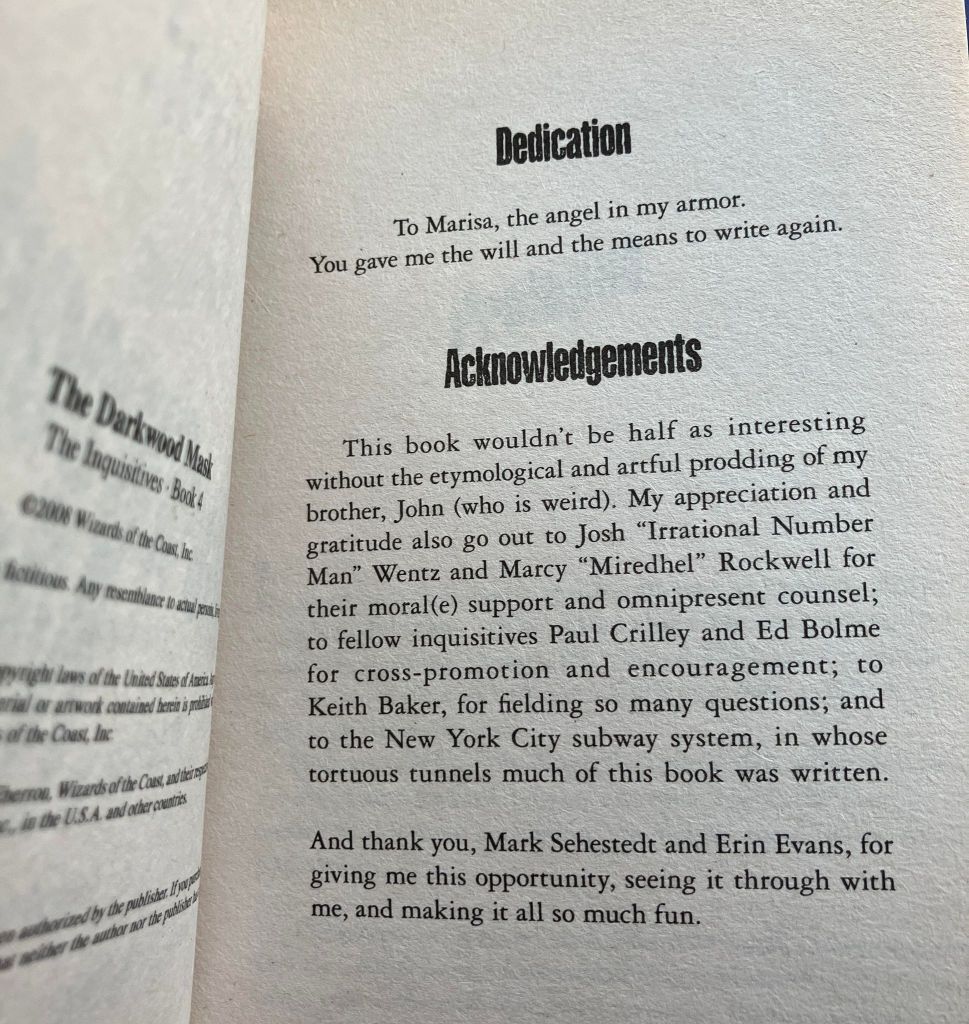
In Tor books, the Acknowledgments are separate and always go in the backmatter after the story but before the About the Author page.
Anyway, I didn’t know that many people in 2008! Now I sure do.
For The Silmarillion Primer, my Acknowledgments will be more substantial. There are my Creator’s Circle members I’ll want to thank, of course (most of whom have already given me valuable feedback), as well as anyone who’s joins my Project Room in the Signum Collaboratory. But there are also a bunch of people who’ve inspired me or outright helped me get to where I am now in the Tolkien fandom. I look forward to writing it.
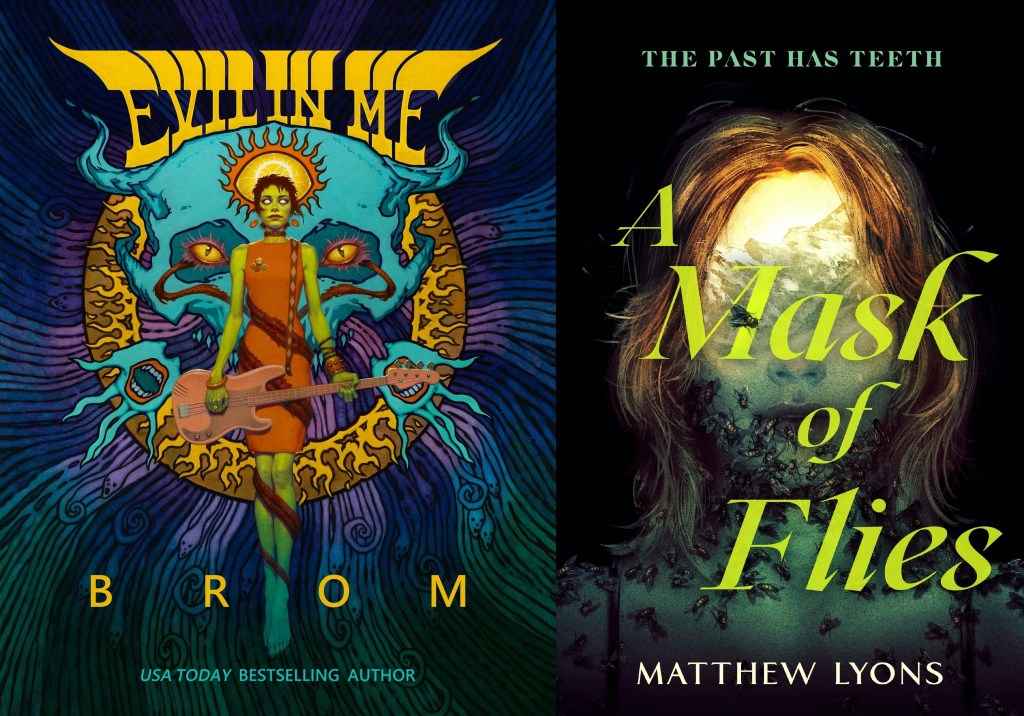
Evil in Me is the latest novel by artist and author Brom, a rock ‘n’ roll–themed, diabolical thriller. Not only did he write the thing, he illustrated everything; there’s even an insert of six full-color paintings of the story’s major characters. A Mask of Flies is a Nightfire horror about a career criminal who botched a bank heist and has retreated to her childhood cabin in the woods.
And now I’m curious. Have you encountered any particularly interesting or meaningful Acknowledgments? Have you ever been listed in anyone’s? If you wrote a book (or many), did you get to credit the folks you wanted?
I especially appreciate when authors credit visual or graphic artists involved. That means the painters or digital artists who create the cover art, but also the designers who work with said art to put covers together. I work with these folks and they’re often just as unsung as production people.
In general, I massively respect people who acknowledge what other people do for them. Within the publishing world and without.
Oh, one last thing to share. One of the books I was delighted to be credited in—which to be fair was one of the easier books to work on—was this one.

Because comedian Joe Pera is funny. And I was just happy to do my part. One of my vital contributions was pointing out where a certain diacritic mark was necessary. If you can spot it.

 Foreshadowed and Foresung
One response to “Common (Ac)knowledge(ment)”
I read a novel called “The Explorer” (I don’t remember the name of the author) which began with an “Introduction.” This Introduction was one paragraph of what we might expect from such a document, and around five more of acknowledgements. I suppose if the goal is to get people to read your acknowledgements that’s one way to do it.
LikeLike